At a Glance
- Narration: A credited reader with a doctoral title fronts a course whose quizzes depend entirely on timing to work at all
- Themes: Nociceptive and neuropathic pain, analgesic pharmacology, nerve blocks and interventional procedures
- Mood: Structured, clinical, briskly instructional
- Verdict: A well-sequenced six-hour review for students with commuting time, sold through a listing that describes a different edition.
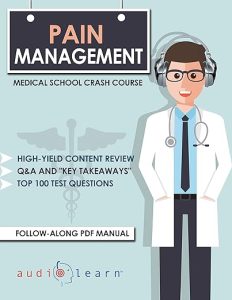
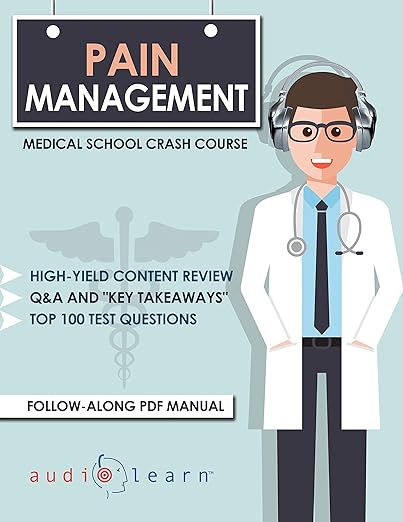
Six hours of pain management, taught the way a medical school teaches it, delivered while you drive between rotations: that is the pitch, and the AudioLearn Medical Content Team has been refining this format for a while. Dr. Cathy Simpson is the credited reader. The audiobook runs six hours and two minutes and belongs to a set called Medical School Crash Courses, though the listing leaves the series position blank. Written by experienced professors, the description says, and pitched at students during coursework, at candidates preparing for the USMLE, and at anyone simply curious about the subject.
Then the description ends by stating that what you are reading describes the print edition of the course, and that the audio version is sold separately. That sentence is sitting on a page with a narrator credit, a runtime and a page count of 132. Somebody has attached a book description to a recording without rewriting it, which means every structural promise below deserves to be checked against what a recording can actually deliver rather than taken at face value.
Simpson Must Signal the Quiz Boundary by Timing
The syllabus itself is genuinely well chosen. Nociceptive pain and neuropathic pain open the course, cancer pain follows, and the pharmacology runs through aspirin, NSAID drugs, capsaicin and acetaminophen before turning to medications for neuropathic pain and then to opioids and muscle relaxers. Procedural material occupies the back half: patient controlled analgesia, epidural and spinal anesthesia, local anesthetics, trigger point and facet joint injection, sympathetic blocks and nerve blocks, botulinum toxin, and the intrathecal pain pump. That sequence moves from mechanism to drug to intervention, which is how the subject is normally taught and how it is most easily retained.
Structure is what the format has to negotiate. The course promises both capsule and detailed explanations of each critical issue, material broken into bite-size sections, and quizzes with key takeaways after every topic. Then it adds a comprehensive test of the top 100 most commonly tested questions with the correct answers. A hundred questions and their answers read aloud is a specific experience, and it works only if a clear pause separates each question from its answer. You are relying on Dr. Cathy Simpson to signal that boundary by timing alone, since nothing in a recording can dim the answer the way a printed page conceals it below the fold. Sample that section specifically.
Judging the level is the harder question, and the syllabus answers it more clearly than the marketing does. Nothing here is aimed at a patient or a curious general reader, whatever the description says about anyone simply interested in the subject. A course that opens on nociceptive and neuropathic mechanisms and closes on intrathecal pumps assumes you already know what an opioid receptor is and why a nerve block might be selective. That is the correct pitch for its stated audience, and it means the phrase about general interest on the listing is doing marketing work rather than describing anything real.
Scope Discipline Beats Textbook Completeness
Hands-free review is the entire proposition and it is a strong one for this audience. Medical students and residents have commuting time, gym time and hospital corridors, and almost no seated study time they are not already spending on something else. A six hour course that runs from mechanism through pharmacology to procedures fills those gaps with structured material rather than podcast noise. Repetition works in this subject, too. Hearing the difference between nociceptive and neuropathic pain four times in a month costs nothing extra and does more than one careful read-through.
Scope discipline is the second reason. This does not attempt to be a textbook. It covers what the description calls the most important topics you might expect to learn in a typical medical school pain management course, and it stops. For USMLE preparation that boundary is exactly what you want, since the exam rewards knowing the standard content confidently rather than knowing unusual content vaguely. The quizzes after each topic are built to review questions commonly tested, which is a candid statement of what the course optimizes for.
Page Count and Runtime Don't Quite Match
Nobody has described this recording. One rating exists, it is five stars, and no written response accompanies it. With zero commentary, everything you can know about the listening experience comes from the structure of the material and the description, and the description was written for a different edition. That is a thinner basis for a purchase than most listings offer, and it is the reason the sample matters more here than usual. The figure shown on the listing is not a trivial one either, so buying unheard carries a real cost.
Figures on the page point in different directions as well. A page count of 132 sits beside a runtime of six hours and two minutes, which is a slow rate for straightforward prose and entirely plausible for dense technical material read deliberately, or for a page count belonging to a different edition. Either explanation is compatible with the print-description note. Consider also that a hundred-question test consumed by ear cannot be scored, reviewed or returned to selectively, so plan to take notes or treat that section as reinforcement rather than as assessment.
Replay Each Bite-Size Section Three Times
Medical students in a pain block, residents refreshing before a rotation, and USMLE candidates wanting a structured second pass are the obvious fits, and nurses or physician assistants working with pain patients would get value from the pharmacology and procedural sections. It suits anyone whose problem is finding study time rather than finding material. Anyone wanting a primary reference, searchable text, or diagrams of nerve blocks should buy differently, because none of that survives the transfer to audio. Check exactly which edition you are buying before you commit six hours to it.
If you do buy, one habit makes the format work considerably harder for you. Treat each topic as a unit and replay it rather than moving forward: the material is broken into bite-size sections precisely so this is possible, and hearing the pharmacology block three times over a fortnight will do more than one attentive pass through all six hours. That is the genuine advantage a recording has over a textbook, and it is the reason this format suits revision even when the listing describing it does not quite match what arrives.
Frequently Asked Questions
What topics does the Pain Management audiobook cover?
Mechanisms first, then drugs, then procedures. It opens on the distinction between nociceptive and neuropathic pain, adds cancer pain, works through the analgesic classes and the agents used for nerve pain, and devotes its back half to interventional techniques ranging from injections and blocks to implanted delivery. A hundred-question review test closes the course.
Is this audiobook useful for USMLE preparation?
That is one of its stated purposes. The content is described as focused and high-yield, with quizzes after each topic aimed at commonly tested questions, plus a final test of the top 100. As a structured second pass over material you have already met in class it works well; as a first encounter with the subject it will move too quickly.
Why does the description mention a print edition?
Because it was written for one and never rewritten. The closing note states that the text describes the print version and that the audio is sold separately, yet it appears on a listing carrying a narrator credit and a six hour and two minute runtime. A 132 page count sits there too, which belongs to a book rather than a recording.
How well does a hundred-question test work in audio?
That depends entirely on pacing, and nothing on this listing describes how the recording handles it. Unlike a printed test you cannot cover an answer, skip ahead or score yourself afterward. The practical approach is to treat it as spaced reinforcement rather than assessment, keep a notebook within reach, and expect to replay the section rather than sit through it once.