Key Details
- Narration: Stacy Gonzalez brings the bilingual and culturally specific material to life with authority; her comfort with the code-switching between English and Spanish that characterizes Díaz and Rivera-Rideau's analysis is essential to the book's credibility.
- Themes: Puerto Rican colonial resistance, music as political act, cultural identity under pressure
- Mood: Scholarly and passionate, with the energy of the music it examines
- Verdict: P FKN R is a serious and rewarding cultural analysis that earns its place in both Bad Bunny's discography and the broader literature on resistance and identity.
An Epigraph About Being Killed for a Flag
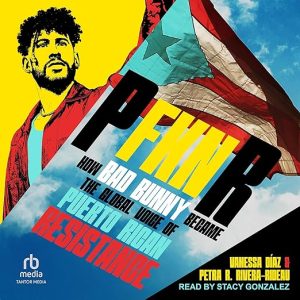
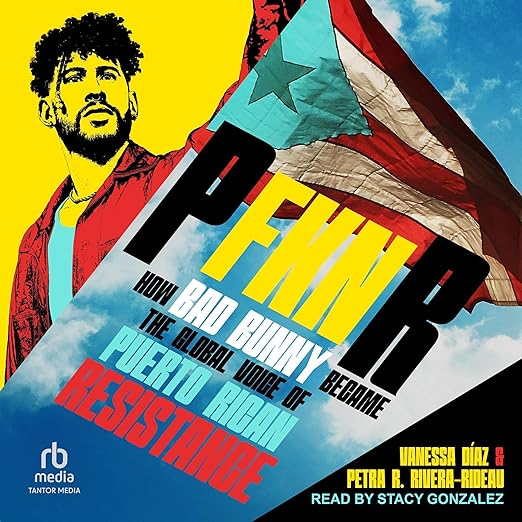
Bad Bunny's full name in this audiobook deserves to be stated plainly: Benito Antonio Martínez Ocasio, born in Vega Baja, Puerto Rico, global superstar, and the figure through whose music Vanessa Díaz and Petra Rivera-Rideau trace a long lineage of Puerto Rican resistance. P FKN R is not a celebrity biography. Stacy Gonzalez narrates a work of cultural scholarship, built from interviews with musicians, politicians, and journalists, that places Bad Bunny within a historical and political tradition rather than treating him as a phenomenon that arrived from nowhere. The audiobook runs ten hours and twenty-three minutes, and it earns the runtime through the breadth of the argument it makes.
The opening epigraph, drawn from LA MuDANZA: "Aquí mataron gente por sacar la bandera / Por eso es que ahora yo la llevo donde quiera," establishes the stakes immediately. This is a book about what the Puerto Rican flag means and has meant, about who was killed for displaying it, and about why the fact of its now-global ubiquity, draped over Bad Bunny's body at Madison Square Garden and Brooklyn Nets games and Super Bowl halftime shows, is a political statement as much as a cultural one. Gonzalez handles the Spanish material, both the lyrics and the historical quotations, with a naturalness that is not incidental; it is structural to a work whose subject depends on the ability to move between languages without apologizing for either.
Gonzalez's Narration Treats Lyrics as Evidence
Díaz and Rivera-Rideau are the creators of the "Bad Bunny Syllabus," which positions them as scholars who have been systematically developing this framework rather than opportunistically attaching an academic argument to a commercial phenomenon. The book's handling of colonialism is specific and historical rather than gestural. It traces the effects of US policy on Puerto Rico through the particular crises that have shaped Bad Bunny's biography and music: the blackouts after Hurricane Maria, the political corruption scandal that drove hundreds of thousands into the streets in 2019, the ongoing debt crisis and the federal oversight board that operates as a form of permanent fiscal colonialism. Reviewer Joshua A. Drew calls Bad Bunny "a once in a generation artist whose musical and cultural influences are truly global" and identifies his refusal to dilute his Puerto Ricanness as central to that influence rather than incidental to it.
Gonzalez's narration is at its strongest in the passages where the scholarly argument meets the lyrical analysis. She treats the song quotations as primary evidence rather than illustration, which is the correct approach: Díaz and Rivera-Rideau's method is essentially a close reading of lyrics against historical context, and a narrator who delivered the song lines as ornament would undermine the book's argument. Instead Gonzalez gives the lyrics the same weight as the interview material, which is how the scholarship intends them to function.
The book acknowledges joy as a form of resistance alongside protest, which is one of its most interesting conceptual contributions. Bad Bunny's music is not uniformly mournful or angry; much of it is celebratory, sexual, and exuberant, and Díaz and Rivera-Rideau argue that the exuberance is also political. The tradition they trace goes back well before Bad Bunny, through salsa and plena and bomba, and the historical grounding gives the contemporary argument roots rather than making it feel like a current-events reaction piece. Gonzalez's delivery in the sections tracing this musical genealogy carries the appropriate weight of accumulated history without becoming a lecture.
The ethnographic research component of the book gives it texture beyond what pure music criticism would provide. The interviews with people whose lives are shaped by the same political conditions that shaped Bad Bunny's music are the passages where the argument becomes most concrete. When an interviewee describes what the 2019 protests meant to them personally, the theoretical framework of the book becomes grounded in individual experience, and the shift between those registers, from academic to testimonial, is something Gonzalez handles with smooth transitions that do not interrupt the flow of the analysis.
Enthusiastic Reviews That Haven't Met a Skeptic
This is not a listening experience that requires prior familiarity with Bad Bunny's discography, though familiarity enriches it considerably. Díaz and Rivera-Rideau explain the specific songs and moments they analyze clearly enough that the uninitiated listener can follow the argument. But the book will hit differently for listeners who already know El Último Tour del Mundo or Un Verano Sin Ti, who can hear the arguments being made in tracks they already carry. For those listeners, the ten-hour audiobook has the quality of a long illuminating conversation about something you already love but have not yet fully understood.
The rating of 4.8 across 26 reviews suggests a readership that is enthusiastic and engaged rather than large and varied. The reviews in the input are all five stars and reflect listeners who came to the book already invested in either Bad Bunny or Puerto Rican cultural studies. The book has not, at least not yet, reached readers hostile to its premise, which means the review record does not fully capture the range of possible responses to its arguments. Listeners who approach Puerto Rican colonial history with skepticism will encounter a rigorous rather than polemical argument, though they should know the authors' position is clear from the start.
The title itself deserves a word. P FKN R is a direct reference to Puerto Rico and to the deliberate, defiant claiming of that identity. The title is also a Bad Bunny lyric gesture, and choosing it for a work of academic cultural criticism is itself an argument: that the register of the music and the register of the scholarship are not separate but continuous. Gonzalez treats this continuity as a given throughout the audiobook, which is the right call.
Academic Work, Genuinely Built to Be Accessible
This audiobook belongs on the list of anyone interested in the intersection of music, politics, and colonialism, and particularly anyone who wants a rigorous analytical framework for understanding why Bad Bunny's cultural moment is more than celebrity. Listeners with a background in cultural studies, Latin American history, or music journalism will find the scholarly apparatus familiar and well-deployed.
Listeners who want pure entertainment or a fan biography will find the scholarly framing more demanding than they expected. This is an academic work written to be accessible, not a popular nonfiction book with academic references. The distinction matters. Gonzalez's narration makes the ten hours as listenable as the material allows, and for the right listener that is a full and rewarding ten hours.
A Few Questions About P FKN R
Do I need to be a Bad Bunny fan to get value from the P FKN R audiobook?
No, though familiarity with his music enriches the listening considerably. Díaz and Rivera-Rideau explain the songs they analyze in enough context that a listener with only passing knowledge can follow the argument. The book's primary interest is in Puerto Rican resistance history, and Bad Bunny is the lens through which that history is examined.
How does Stacy Gonzalez handle the bilingual material throughout the audiobook?
With natural authority. The code-switching between English and Spanish, and the treatment of Spanish-language lyrics as primary evidence rather than decoration, is handled fluently. Gonzalez's comfort with both languages is essential to the credibility of the performance.
How long is this audiobook and is the runtime justified by the scope of the argument?
Ten hours and twenty-three minutes, which is substantial for a work of this type. The length reflects the historical and ethnographic depth of the analysis rather than padding; the book covers Puerto Rican resistance from before the twentieth century through the present, and the coverage earns its runtime.