Quick Take
- Narration: Imogen Church is pitch-perfect for Ruth’s darkly comic interior voice, capturing both the grief underneath the absurdity and the gallows humor on top without letting either swallow the other.
- Themes: Grief and obsession, vigilante justice, the ethics of creative deception
- Mood: Propulsive, darkly funny, with genuine emotional undercurrents
- Verdict: A sharp, original dark-comedy thriller that earns its humor precisely because it takes its protagonist’s grief seriously.
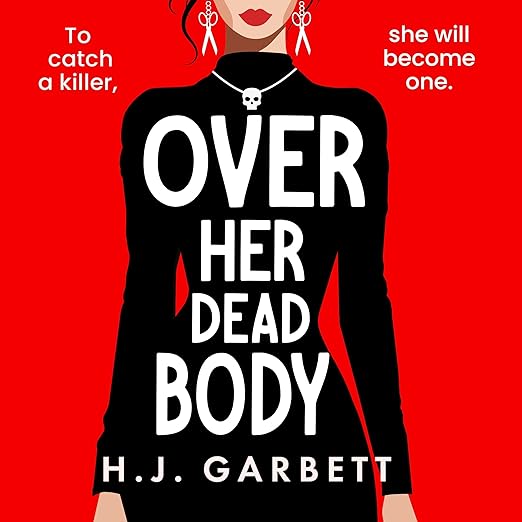
I finished this one on a Sunday afternoon when I’d meant to take a break from reviewing, and then found myself sitting in my car in the driveway for the last forty minutes because I could not stop. H.J. Garbett’s Over Her Dead Body is one of those books that sounds, in synopsis, like it might be too clever for its own good. A grieving journalist. A serial killer with a calling card. A funeral home. Staged crime scenes using harvested hearts. The real killer, watching. On paper it reads like a pitch meeting where someone kept saying yes when they should have paused. In practice, it is considerably more emotionally intelligent than its premise suggests.
Imogen Church handles Ruth from the first chapter in a way that makes you understand exactly why this character is doing something this catastrophically inadvisable. There is a rawness to the early grief chapters that Church lets breathe, and it makes everything that follows funnier and more frightening in equal measure.
The Funeral Home as Comic Engine
The decision to give Ruth access to a funeral home as her primary crime scene resource is both the book’s funniest structural choice and its most unsettling one. Garbett uses the setting cannily. Working at a funeral home has its own professional logic, its own gallows intimacy with mortality, and Ruth’s gradually evolving relationship with that environment tracks her psychological state with real precision. She is not someone who has made peace with death. She is someone who is weaponizing it. The practical black comedy that emerges from this, the sourcing problems, the storage logistics, the professional knowledge that has now become criminal knowledge, is handled with exactly the lightness it needs. Church’s timing in these sequences is exceptional, letting the absurdity surface naturally rather than playing it for effect.
What the Synopsis Understates
The obvious comparison points the publisher offers, Grace Henry’s How to Kill Your Family and Listen for the Lie, are fair but incomplete. What those comparisons miss is how seriously Garbett takes Ruth’s original loss. Her best friend’s murder is not a narrative device to get Ruth to the funny bits. The investigation Ruth undertakes, and the increasingly reckless decisions she makes to force the police to keep looking, are rooted in a grief the book never quite lets you laugh away entirely. When the real killer takes notice of Ruth’s staged work, the thriller machinery that engages is genuinely tense rather than comic. The book earns its darker third act because it has been quietly building toward it from the beginning.
The Investigative Logic and Its Limits
Some thriller readers may find the police procedural elements more suggestive than rigorous. Garbett is not primarily interested in the mechanics of investigation so much as in Ruth’s psychology, and a few of the plot hinges require a willingness to follow the protagonist’s emotional logic rather than demand internal consistency. Reviewer AshleysCaffeinatedChapters called it completely original, and structurally that holds. The specific combination of obsessive grief, forensic staging, and mounting danger from an active killer is not a familiar template. But the third act does demand a certain tolerance for escalation that some listeners may find tests the premise’s internal logic. What it does not do, and this is worth saying clearly, is sacrifice Ruth’s character coherence to get there.
Who Should Listen and Who Should Skip
Listeners who enjoy dark comedy with genuine emotional stakes, who loved the tonal register of How to Kill Your Family or the grief-propelled logic of debut thrillers like The It Girl, will find this completely satisfying. If you require tightly constructed procedural plotting with no loose ends, or if funeral humor is simply not your register, you will have a harder time here. Imogen Church’s narration is one of the better pairings I have encountered in this subgenre, and even on a weaker chapter she carries the material forward with complete commitment.
Frequently Asked Questions
Is Over Her Dead Body more thriller or more comedy, and how graphic is it?
It is primarily a dark comedy thriller, with comedy and thriller elements balanced fairly evenly. The funeral home content is handled with dark humor rather than graphic detail, though there are scenes of violence related to the serial killer plot. It is not a horror novel.
Is this a standalone or the start of a series?
Over Her Dead Body reads as a standalone. There is no indication of a planned sequel, and the narrative resolves its central threads. It is marketed and structured as a complete single story.
How does Imogen Church’s narration handle the dual tone of grief and black comedy?
Very well. Church is a consistently reliable narrator for psychologically complex women’s voices, and she threads the grief-and-gallows-humor needle with real skill here. She does not soften Ruth’s more morally questionable moments or oversell the comedic ones.
If I enjoyed H.J. Garbett’s previous book My Wife, The Serial Killer, how does this compare?
Several reviewers who read both note this is a worthy follow-up with a different structural approach. The funeral home setting gives Over Her Dead Body a more contained, escalating feel compared to the broader domestic premise of the earlier book, though both share the same darkly funny register and strong female protagonist.