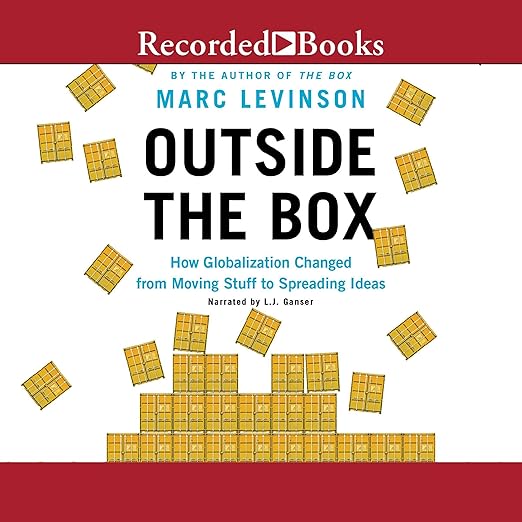
Quick Take
- Narration: L.J. Ganser delivers Levinson’s dense economic history with professional clarity, keeping complex material accessible without over-simplifying.
- Themes: The rise and limits of globalization, value chains and labor displacement, the future of cross-border services over goods
- Mood: Measured and analytically rich, like a very good lecture from a professor who respects your time
- Verdict: The most coherent history of globalization available in audio form, and essential context for understanding the economic realignments reshaping the world right now.
I finished Marc Levinson's The Box a few years ago, the history of the shipping container and its outsized effect on the global economy, and came away with the particular satisfaction that very good economic history produces: the feeling that I was seeing the present through a sharper lens. Outside the Box is the logical next step, expanding the frame from the container revolution to globalization as a whole. I started it during a transatlantic flight, which felt appropriate, and found myself taking notes in my phone's note app in a way I rarely do with audiobooks.
Levinson is a rigorous historian and a clean writer, and the combination makes Outside the Box unusually readable for material this analytically dense. He is not arguing a polemical case either for or against globalization. He is tracing its development across two centuries as the consequence of decisions made under specific conditions by specific people, which is a more interesting and more useful project. The book explains how we got here, and it has the intellectual honesty to resist easy prescriptions for where we should go.
Our Take on Two Centuries of Cross-Border Commerce
The structural argument of the book is that globalization is not a natural state toward which economies tend, but a condition created by particular combinations of technology, policy, and circumstance that can be, and have been, reversed. Levinson traces three broad phases: the first wave of international trade expansion in the nineteenth century, the disruption of that order by two world wars, and the second wave that accelerated dramatically after the 1980s with the development of long-distance value chains.
The value chain analysis is the book's most important contribution. Levinson explains precisely how the shift to international value chains in manufacturing, driven by dramatically reduced transportation and communication costs, transferred industrial employment from North America, Europe, and Japan to Asia. He is careful not to frame this as simply good or bad. He shows the mechanisms, their costs, and their beneficiaries, and he identifies where the analysis went wrong, particularly the systematic underestimation of risk by the businesses that built these chains.
Why Listen to Outside the Box
L.J. Ganser is one of the more reliable narrators in the nonfiction audiobook space, and he handles Levinson's prose well. The book has a lot of statistical content and historical specificity, and Ganser keeps the pacing moving without glossing over the detail. At nine hours, this is a substantive but not exhausting listen. Levinson is disciplined about his own material and does not pad.
Several reviewers praised the book's research and clarity in the same breath, noting that Levinson writes "clearly with sufficient examples" and offers an "excellent overview" across the full scope of the subject. He is not writing for specialists. He assumes an intelligent general reader who wants to understand globalization's mechanisms without needing a background in economics. The framework he provides is genuinely useful: one reviewer described gaining a new perspective on container shipping after reading The Box, and Outside the Box provides the same illuminating lens at a much larger scale.
What to Watch For in This History
The book was completed before the full disruptions of COVID-19 had played out, so its treatment of pandemic effects on global supply chains is necessarily incomplete. Levinson's predictions about the next phase of globalization, focused on cross-border services and information rather than physical goods, have been partially borne out in the years since, but listeners will want to hold the forward-looking sections as informed speculation rather than settled analysis.
The book is also more historical than prescriptive. Readers looking for concrete policy recommendations or investment theses will not find them here. Levinson's project is diagnostic and historical. He explains how we got here and what forces are reshaping the landscape. The conclusions about direction are necessarily tentative, which is the honest intellectual position given how rapidly the landscape is shifting.
Who Should Listen to Outside the Box
Essential for anyone who wants to understand the economic forces reshaping the global order and is tired of pundit-level explanations that begin with the current political moment. This book gives you the two-century context that makes the current disruptions legible. Listeners who have read Levinson's The Box will want this as the natural extension of that project. Those with backgrounds in economics or international trade will find it a useful synthesis; those without that background will find it a genuinely accessible entry point into the subject.
Frequently Asked Questions
Do I need to have read Marc Levinson’s The Box before listening to Outside the Box?
No, the books are independent. Outside the Box takes globalization as its subject at a much larger scale than the container story. That said, readers of The Box will find the conceptual framework familiar and will appreciate how Levinson extends his earlier analysis.
How does the book handle the current political backlash against globalization, including tariffs and trade wars?
Levinson is writing from a historical rather than partisan position. He describes the conditions that produced anti-globalization politics as consequences of the value-chain model’s costs and its uneven distribution of benefits. He was writing before some of the most recent trade policy shifts, so the book provides historical context rather than current commentary.
Is Outside the Box accessible for listeners without an economics background?
Yes. Levinson writes for general readers and is careful to explain economic concepts when he introduces them. Multiple reviewers with no specialist background found the book both clear and genuinely illuminating. The trade history is told through people and decisions as much as through theory.
How does L.J. Ganser handle the statistical and data-heavy sections of the book?
He keeps a consistent pace through the denser passages rather than slowing to pedagogical effect. Some listeners prefer a slightly more deliberate delivery for statistics-heavy material, but Ganser’s approach prioritizes the narrative flow of the argument, which serves the overall listening experience well.