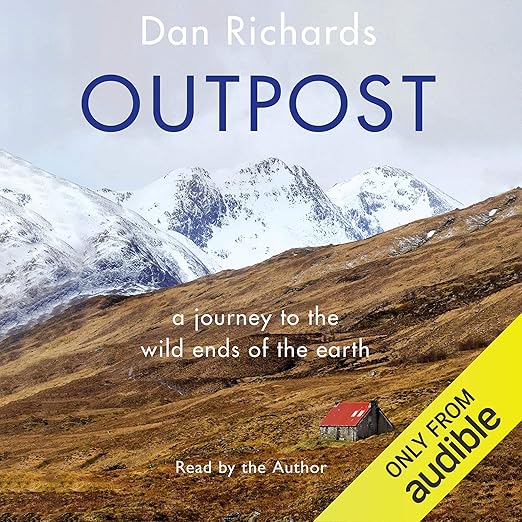
Quick Take
- Narration: Dan Richards reads his own book, and the author-narrator match is essential here – his voice carries the same quality of genuinely searching attention that defines the prose, and he sounds like someone who actually made these journeys.
- Themes: solitude as human necessity, the relationship between writers and remote places, wilderness as both refuge and responsibility
- Mood: Meditative and wandering, with unexpected humor and moments of piercing clarity
- Verdict: A beautifully written travelogue that earns its reflective reach, and one of the more unexpectedly literary audiobooks in the travel genre – though it rewards unhurried attention more than active listening.
I spent a January week listening to Outpost during my morning walks, which turned out to be an accidentally perfect pairing. Dan Richards is writing about remote places and the human pull toward them, and there is something about moving through familiar streets while your ears are full of Svalbard ghost towns and Japanese shrines and fire-watch lookouts in Washington State that makes the concept of distance strange in a productive way. I kept stopping and looking at ordinary things differently, which is not nothing.
Dan Richards is a British writer who has previously explored the kind of subjects – mountain huts, wild swimming, landscape writing – that occupy the outer edge of British nature writing at its most thoughtful. Outpost is a more ambitious project: a series of personal journeys to what he calls outposts, places at the margins of habitation and the limits of what the word comfortable can reasonably mean, structured not as a single expedition but as a collection of expeditions across years and continents.
Our Take on Outpost
The range of locations is genuinely remarkable. Richards travels from the Cairngorms of Scotland – where the Shelter Stone, a natural rock shelter used by climbers and walkers for centuries, represents one kind of outpost – to fire-watch lookouts in Washington State that have housed poets and writers as much as foresters. He visits Iceland’s turf houses, the ghost settlements of Svalbard, a shrine in Japan, Roald Dahl’s famous writing hut in Buckinghamshire, and a lighthouse in the North Atlantic. Each location becomes a case study in a larger argument: why are humans drawn to extremity and solitude, what do these places protect about us, and what happens when they disappear?
The book is as much about the writers, artists, and musicians who have sought these places as about the places themselves. Richards traces the way specific locations have catalyzed specific work – the fire lookout that shaped Gary Snyder’s poetry, the Svalbard settings that appear in Knut Hamsun, the Cairngorm landscape that runs through Scottish literature from different directions. For readers with existing connections to any of these figures, there are specific pleasures of recognition. For readers without those connections, Richards contextualizes generously.
Why Listen to Outpost
Richards narrating his own book is not simply a practical decision – it is a qualitative one. His prose has a specific quality of attention: sentences that do not rush, that find surprising angles on familiar landscapes, that contain what one reviewer described as beautiful, surprising language and many funny moments. That quality does not survive being handed to a neutral professional narrator. When Richards reads his own sentences, he is recovering something about how they were originally experienced – spoken to himself in his head, tested against the reality of being there – that a second voice would filter out.
Reviewer Kelly observed that Richards weaves his personal experiences with the experiences of those who have visited these places before, and that the effect leaves the reader considering larger questions of human nature and our place in relation to the natural world. That is accurate to the project: this is not a book about visiting interesting places so much as about what the act of seeking outposts reveals about the humans who do it. The personal and the cultural are genuinely integrated rather than alternating chapters.
What to Watch For in Outpost
Reviewer Tardigrade offered a balanced note: the Iceland and Svalbard sections are the strongest, while sections built around literary references that did not personally resonate – specifically Kerouac – land differently depending on your relationship to those reference points. This is an inherent risk in a book that relies on a web of cultural associations: not every node of that web will be equally charged for every reader. The Dahl chapter assumes you care about where Dahl wrote; the Gary Snyder chapter assumes some orientation toward American poetry. These sections still work, but they work harder for some listeners than others.
At 7 hours and 51 minutes, this is a comfortable length for the material. The book does not attempt to be comprehensive – it is a series of chosen examples rather than a survey – and that selectivity keeps it focused without feeling thin. There is no chapter that outstays its welcome.
Who Should Listen to Outpost
Readers who love narrative nature writing in the tradition of Robert Macfarlane or Roger Deakin will find Richards a natural companion. The literary density – the web of writers and artists who inhabit these places alongside Richards – means this is a more academic listen than pure adventure travel, and it rewards having a passing familiarity with the landscape writing tradition. But it never becomes inaccessible to someone without that background.
Listeners who need forward narrative momentum or a single sustained journey arc may find the episodic structure occasionally frustrating. Each outpost is its own chapter, and the return to the authorial voice between locations requires a different kind of attention than a through-line journey would. Those who respond to this kind of wandering, associative structure will find it one of the more rewarding travel audiobooks in recent years.
Frequently Asked Questions
Do you need to know the writers and artists Richards references – Dahl, Gary Snyder, etc. – to get the most from Outpost?
Familiarity helps but is not required. Richards contextualizes his references carefully enough that listeners without prior knowledge of these figures can follow the argument. However, chapters built around strong literary associations – the Dahl writing hut, the fire-lookout poets – will carry more emotional weight for listeners who already have a relationship with those figures. One reviewer specifically noted the Kerouac sections landing differently depending on personal resonance.
Is Outpost a single sustained journey or a collection of separate expeditions?
A collection of separate expeditions. Richards travels to each outpost independently across years and continents, and the book is structured as a series of chapters rather than a continuous narrative. The connecting tissue is thematic – the question of why humans seek extreme and remote places – rather than geographical or chronological. Listeners who prefer a single sustained journey arc may find the episodic structure requires a different mode of attention.
How funny is this book? Reviews mention humor, which is unexpected for a travelogue about remote wilderness.
Genuinely and often unexpectedly funny. Richards has a dry, self-aware comedic sensibility that surfaces throughout – particularly in situations where his ambitions for solitude collide with practical absurdity. Reviewer Katherine M described it as wonderfully humorous and deeply poignant, which is accurate: the humor does not undercut the seriousness but exists alongside it naturally. It is the kind of book where you laugh and then feel something larger a paragraph later.
Is there significant overlap between Outpost and Robert Macfarlane’s landscape writing?
The overlap is real but not derivative. Both Richards and Macfarlane work in British landscape writing that weaves personal journey with cultural and literary history. Richards’s specific focus on outposts – marginal places, shelters, lookouts – gives Outpost a narrower and in some ways more coherent argument than Macfarlane’s broader explorations. Fans of Macfarlane will find Richards a natural companion, not a substitute.