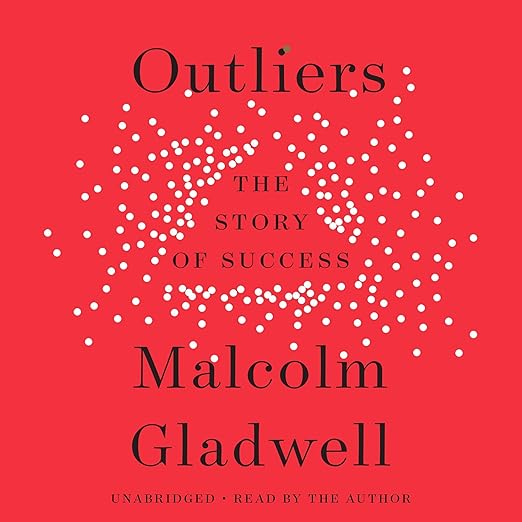
I first listened to Outliers on a cross-country train, back when I was still working for a literary magazine and had just written a piece on why publishing consistently overlooked writers from certain backgrounds while rewarding others from certain institutions. The book did not fully validate my thesis, but it gave it a sharper vocabulary, and I have been recommending it to people in conversations about privilege and achievement ever since, not because it settles those conversations but because it makes them more precise.
That was years ago. Returning to it now, the book has aged into a kind of landmark text that everyone has an opinion about, including people who have not read it. The 10,000-hour rule has become a shorthand so widely deployed that it has lost some of its original precision. The book deserves more careful attention than the shorthand suggests.
Gates, the Beatles, and Hockey's Age Cutoff
Gladwell's central argument is that the popular narrative of extraordinary success, the lone genius, the self-made billionaire, the natural born talent, is almost entirely wrong. What he argues instead is that success is the product of specific cultural inheritances, specific timing, specific thresholds of opportunity that most people never receive. Bill Gates had unusual access to a computer terminal at an early age. The Beatles had Hamburg. Canadian hockey players born in January have a structural statistical advantage over players born in December because of how the age-cutoff system works in youth leagues.
None of these arguments, by themselves, fully explain the success of the people Gladwell examines. But assembled together, they construct a serious challenge to the idea that individual effort and talent, in isolation, account for the extraordinary outliers we hold up as models. The implications of that challenge, for how we structure education, opportunity, and our own self-assessment, are the real substance of the book.
Gladwell Reads His Own Arguments Aloud
Gladwell reading his own work is a specific pleasure that his print books do not provide. His prose is already calibrated to the spoken rhythm of The New Yorker, where he developed his style, but hearing him pace through an argument, the small accelerations when the evidence is building, the slight slowdowns when he wants you to sit with a conclusion, adds a dimension that the page cannot replicate. Reviewer sdone described him as an engaging storyteller "clearly a result of his background as a journalist," and the audio format makes that background most apparent.
The chapter structure is well-suited to listening. Each chapter is essentially a self-contained essay with a clear argument, which means you can pause after a chapter and absorb what you have heard without losing the thread. The Korean Air chapter, examining how cultural power dynamics in the cockpit contributed to a series of fatal crashes, is the most arresting of these individual essays and benefits particularly from the audio pacing Gladwell gives it.
The 10,000-Hour Rule After the Replication Crisis
The 10,000-hour rule, for all its influence, is both the book's most famous contribution and its most contested. Gladwell popularized research that has since been significantly challenged on methodology, the idea that deliberate practice alone, at that specific threshold, produces mastery has not survived replication well. Gladwell's version of the claim was always more nuanced than the shorthand suggests (he was arguing that opportunity for deliberate practice is unevenly distributed, not that practice alone guarantees mastery), but the popculture version has flattened that nuance considerably.
Similarly, some of the cultural generalizations, particularly around Asian mathematical ability and the cultural roots of Korean cockpit dynamics, have aged uneasily and drawn legitimate critique for threading too confidently between cultural observation and cultural essentialism. These are not reasons to dismiss the book, but they are reasons to read it with the same critical attention Gladwell asks his readers to apply to received wisdom about success.
For Listeners Questioning the Myth of Merit
This is for anyone who has thought seriously about why success seems to cluster, by geography, by birth year, by family background, by institutional access, and has not yet encountered a framework for thinking about it systematically. It is also for anyone whose field or industry is shaped by meritocratic mythology that obscures the structural conditions that make individual merit possible. The audiobook format, narrated by Gladwell himself, is the best way to encounter this book for the first time. Return readers who already know the thesis may find the chapters on cultural inheritance hold up better than the more directly prescriptive ones.
Has the 10,000-hour rule in Outliers been scientifically validated?
The research Gladwell drew on has been substantially challenged since the book's publication in 2008. Subsequent studies have found that deliberate practice accounts for less of the variance in expertise than Gladwell implied, and the specific threshold of 10,000 hours has not held up consistently. Gladwell's underlying point, that access to deliberate practice is unevenly distributed, remains interesting, but the precision of the rule should be held loosely.
Does Gladwell narrate his own audiobook?
Yes, and it is one of the better author-narrated nonfiction audiobooks available. Gladwell's journalistic background shapes his prose toward spoken rhythm, and his narration brings a conversational intelligence to the argument that makes the 7-hour runtime feel shorter than it is.
Is Outliers still relevant given how much the conversation around privilege and success has evolved since 2008?
The conversation has caught up to and in some ways moved past Gladwell's framework, which makes the book feel less surprising now than it did on release. But it remains a useful text for grounding more recent discussions of structural inequality in concrete, story-driven examples. Its relevance is less as a revelation and more as a foundation.