In Brief
- Narration: Alan Watts narrates his own lectures, recorded live before audiences. The voice is unmistakable, conversational and precise at once, with the kind of spontaneous timing no studio performance could replicate.
- Themes: Non-dual awareness, the illusion of the separate self, Eastern philosophy for Western minds
- Mood: Expansive and unhurried
- Verdict: Fourteen hours of Watts at his sharpest, drawn from live seminars and curated by his son. The audio format is not a compromise here; it is the original and correct medium for this material.
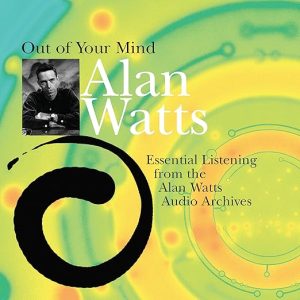
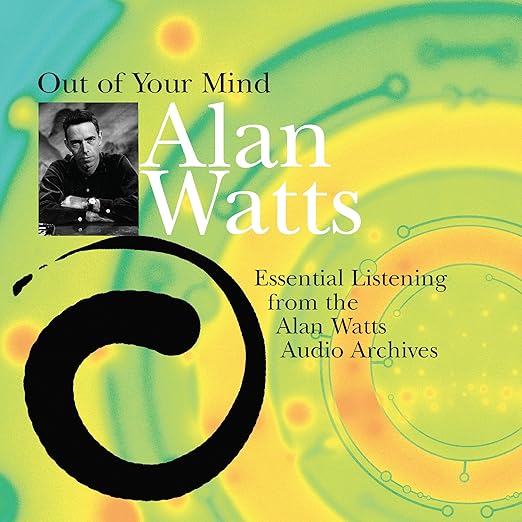
Alan Watts recorded the talks collected in Out of Your Mind decades before streaming platforms existed, and yet the audiobook, running fourteen hours and twenty-two minutes, feels like the format these lectures were always waiting for. Watts worked best in front of a live audience, where the feedback of the room shaped his digressions, and where his talent for finding the exact unexpected phrase that punctures a long-held assumption could operate at full power. This collection, drawn from the Alan Watts Audio Archives and selected by his son and archivist Mark Watts, gathers six complete seminars that represent the range of his preoccupations: the myth of the isolated self, the nature of consciousness, the relationship between Eastern philosophy and Western habits of mind, and the strange game of existence itself.
Our Take on Out of Your Mind
What makes Watts genuinely difficult to replicate is that his method is not instruction but demonstration. He does not explain the concept that the self is a construction and then ask you to accept it. He talks around it, approaches it from three or four angles simultaneously, tells a story about a Hindu deity, pivots to a description of a Zen koan, and somewhere in that movement the fixed idea you were holding loosens without you noticing the exact moment it happened. That quality of indirection is why these lectures survive fifty-plus years without feeling dated. One reviewer noted they could listen to the same episode over and over, and that speaks to something real about how Watts works. The content does not resolve into a summary you can write down. It keeps opening.
The six seminars here address his favorite pressure points: the art of the controlled accident, which is his framework for what becomes possible when you stop treating your life as a problem to be solved; the skin-encapsulated ego, his phrase for the illusion of separateness that he returned to throughout his career; and the relationship between chaos and purpose, which he treats not as opposed but as dependent. If you are familiar with his writing, these will feel like meeting the ideas in their natural form. If you are new to Watts, the lack of prior knowledge is less of a barrier than one reviewer cautioned. The talks are designed to generate their own context through the quality of their internal argument, not through assumption of prior reading.
The curation by Mark Watts reflects decades of intimate knowledge of the archive. He did not select the most famous or most accessible sessions but rather the ones that together cover the widest range of his father's thinking. The result is a set that can be entered at different levels of familiarity with Eastern philosophy, from the relatively introductory seminars on the nature of mind to the denser sessions on Buddhist and Hindu cosmological frameworks. Each seminar rewards extended attention, and the fourteen-hour duration reflects genuine content rather than runtime padding.
Why Listen to Out of Your Mind
The audio format is not incidental to the experience; it is definitional. Watts was a speaker before he was a writer, and the recorded lectures preserve things that transcription cannot. The slight shift in his delivery when he moves from exposition to what might be called performance, the pauses that work like punctuation, the moments of real laughter from the audience that tell you something just landed in an unexpected way, these qualities make the fourteen hours pass differently than a typical long audiobook. There is no sense of needing to reach the end. Each seminar is complete in itself, and the collection rewards both linear listening and returning to individual sessions on different days.
Mark Watts made his selections from hundreds of recordings in the archive, and the care in that process is audible in the quality and coherence of what is here. The digital restoration has produced consistent, clear audio across all six seminars, with only the ambient room presence of the original recordings remaining, which adds to the sense of occasion rather than distracting from the content. Watts's voice itself, baritone, British-inflected, with a comic timing that belongs to his era of broadcasting, is one of the more distinctive in the recorded philosophical tradition.
What to Watch For in Out of Your Mind
Watts has a habit of using the second person in ways that can catch you off guard. He will say something like, you are not something that is happening in the world, you are something the world is doing, and the grammar and the idea arrive together at full force. First-time listeners sometimes find this disorienting rather than illuminating, particularly early in the first seminar. The suggestion from at least one reviewer that some background in Eastern religions helps is not wrong, but it overstates the requirement. What helps more is a willingness to follow an argument that is not going toward a conclusion you can anticipate.
The collection does not provide easy internal navigation by topic if you want to return to a specific passage. The overall arc moves from the more accessible seminars to the denser philosophical material, so front-loading the collection is a reasonable approach for new listeners. For those already familiar with Watts through his writing or earlier recordings, the later seminars here are the more adventurous and less-covered territory in his catalog.
Who Should Listen to Out of Your Mind
This audiobook suits listeners who have some tolerance for ideas that do not resolve into action items. If your relationship to nonfiction is primarily instrumental, Watts will frustrate you in the best possible way or simply frustrate you, depending on what you are looking for. If you are drawn to philosophy, Eastern religious thought, or the question of what consciousness actually is beneath the stories we tell about it, these seminars are among the most rewarding audio available on those subjects. Watts is not for listeners who want to be told what to do differently. He is for listeners who want to see differently, and the live-audience format of this collection makes that shift feel possible in a way that reading the transcripts rarely achieves. Listeners who found Eckhart Tolle or Ram Dass illuminating will find Watts a useful and more philosophically rigorous companion.
Questions Listeners Ask
Is this audiobook suitable for someone with no background in Buddhism or Hinduism?
Yes, though some patience in the early seminars helps. Watts explains the traditions he references in ways designed for Western audiences encountering them for the first time. One reviewer noted the talks were recorded for audiences without specialized backgrounds, and the structure reflects that intent.
How does the audiobook version compare to reading Alan Watts in print?
The lectures come from a different register than his writing. The books are more structured; the seminars are more digressive and alive. Listening to Out of Your Mind gives you Watts as a performer and thinker in real time, which is a different experience from following his written argument on the page.