At a Glance
- Narration: Steve Blane is credited on a translated testimony whose plain prose asks a reader to stay out of its way.
- Themes: Child survival at Buchenwald, rabbinic inheritance, the founding decades of Israel, public faith
- Mood: Grave, measured, unexpectedly warm in its later chapters
- Verdict: One of the essential young-survivor accounts, and unusual for following the life all the way forward.
Few memoirs earn their length the way this one does, and I say that about an audiobook running fifteen hours and thirty-five minutes. Israel Meir Lau was eight years old when Buchenwald was liberated in 1945, one of the youngest survivors of the camp. He became Chief Rabbi of Israel. Steve Blane is the credited narrator, and Gildan Media issued the recording in November 2011.
The structure is what makes that length necessary. The early portion is testimony. What follows is the life afterward: emigration to Mandate Palestine, the years in which the State of Israel was being built, and eventually a public role that put Lau in rooms with the Dalai Lama, Nelson Mandela, Popes John Paul and Benedict, and a long line of heads of government. Most camp memoirs end at liberation. This one treats liberation as roughly the halfway mark.
The Last Link in an Unbroken Chain
One line in the publisher's description reframes everything that follows it. Lau is 'descended from a 1,000-year unbroken chain of rabbis', which means the child who survived Buchenwald was also, in a very literal sense, the last link of something the camp was designed to end. He does not press the point. He does not need to. The rest of the book is what happened when that link held.
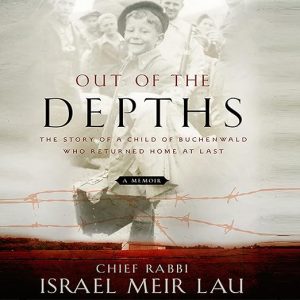
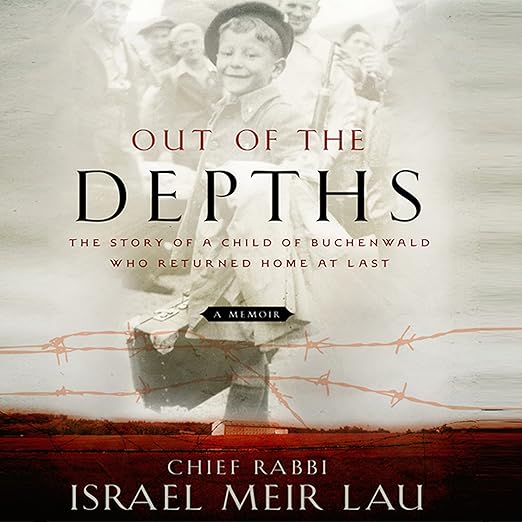
A five-star reviewer proposes an alternative subtitle and, in doing so, describes the image on the cover better than any summary could: an orphan carrying his possessions in a small suitcase, along with a rifle handed to him by a kindhearted American soldier so that an eight-year-old could act on a wish for vengeance. That detail sits at the exact center of the book's moral problem, and it is the one readers keep returning to.
Another reviewer, who also recommends Lau's earlier book, calls him 'an exceptional Rabbi, speaker, and religious leader in search of unity with the divine and with his fellow men', and notes that this is the second of his books to be translated into English. The same notice describes the memoir as divided in two parts, the first invoking the knife, the fire and the wood, which that reader glosses as a reference to the akedah.
Lau is called a master storyteller in the description, and I would not argue. What struck me is how little the prose reaches for effect. Scenes that would justify any amount of emphasis are set down at conversational volume and allowed to do their own work, which is the discipline that makes fifteen hours of this bearable rather than crushing.
A Survivor's Account That Becomes Statecraft
This is testimony from one of the youngest people capable of giving it. Lau was a small child throughout the events he describes, which produces a memoir built out of a child's sightlines: what he could see, what adults said over his head, what he understood only decades later. That perspective is rare in the literature, and it is the strongest single reason to choose this memoir over a better-known one written by an adult who had adult words for what was happening.
What genuinely distinguishes this memoir is its second half. A survivor's account that continues into statecraft, religious office and diplomacy is unusual, and it answers a question most memoirs of this kind leave hanging: what does a life look like after that. Readers who expect the book to close with liberation get instead several decades of institutions, arguments and public responsibility.
It is also, unexpectedly, a book about public life. The account carries Lau out of Mandate Palestine, through the founding decades of the modern state, and into an office that brought him face to face with religious and political leaders across the world. Anyone assuming that a Holocaust memoir must be exclusively a record of suffering will find something more complicated here: a survivor carrying that history into rooms where policy gets decided, decades after the events that made his name.
A Translated Text Read Aloud in English
A translated text read aloud in English is also its own artifact, worth knowing about before you start. The cadences you hear belong partly to a translator, and the religious vocabulary arrives in whatever register that translation chose. Material this grave puts one demand on any reading of it, which is to stay out of the way, and the plainness of the prose is a strong indication of how it wants to be handled.
The Written Pool Is More Uniformly Enthusiastic
The score needs interpreting rather than trusting. A 4.8 average sits across 272 ratings, while all five written responses on the page award the top score. That means the written pool is more uniformly enthusiastic than the full body of ratings behind the average, which is normal on books of this kind and worth remembering before you read the comments as a consensus.
Two of those five notices are also extremely short. A reader in the United Kingdom offers two lines, one of them calling this 'a story that had to be told and has to be read', and a reader in Canada manages four words of endorsement. Both are sincere. Neither tells you anything about the experience of listening for fifteen hours, so lean on the three longer notices when you are weighing the purchase.
Factor in the tonal shift as well. The camp chapters and the diplomatic chapters are separated by an enormous change of register, and a listener who came for the testimony will find the later material slower and more institutional. That is a fair criticism of the pacing and also, I would argue, the entire point of the book, which is that the child did not stop existing in 1945.
Treat the Two Halves as Two Books
This belongs with listeners who read Holocaust testimony seriously and want a perspective the canon underrepresents, namely that of a survivor too young at the time to have adult context for any of it. It also serves readers interested in the religious and civic history of Israel's first decades, since Lau was inside those rooms.
It fits less well for a listener wanting a short or introductory account, for anyone who needs the narrative to end at liberation, and for readers with no appetite for the theological framing, which is present throughout and is not decorative. Lau is a rabbi describing a rabbinic life, and the memoir assumes you accept that frame even if you do not share it.
My advice is to treat the two halves as two books and give yourself permission to pace them differently. The first asks for quiet and full attention. The second reads more like a public life and survives being heard in shorter stretches. Taken that way, the running time stops being the obstacle it looks like on the product page.
Questions Listeners Ask
How much of the audiobook covers Buchenwald itself?
Roughly the first portion. Lau was eight at liberation, so the camp material is delivered through a small child's field of vision, and the book then follows him through a French orphan camp, emigration to Mandate Palestine and a long public career. Expect a large share of the running time to sit after 1945.
Is this audiobook a reasonable entry point for someone new to Holocaust memoir?
It is, with one caveat: at fifteen and a half hours it is long for a first encounter. The advantage is the child's-eye perspective, which requires no prior reading, and the plain narrative style. Anyone wanting something shorter should start elsewhere and come back to this one.
Do you need background in Jewish religious practice to follow it?
No, though some of it will land harder if you have it. Lau writes as a rabbi and the theological vocabulary is constant. One reviewer reads a section title as an allusion to the akedah, the binding of Isaac, and that is the sort of reference a listener can look up afterward or let pass without losing the thread.
Why does a reviewer describe the cover photograph rather than the text?
Because the cover image is genuinely part of the story. One five-star notice describes an orphaned boy holding a small suitcase and a rifle that an American soldier had pressed on him, then builds an entire alternative subtitle around that detail, treating the rifle as the symbol of a choice the rest of the book spends fifteen hours explaining.