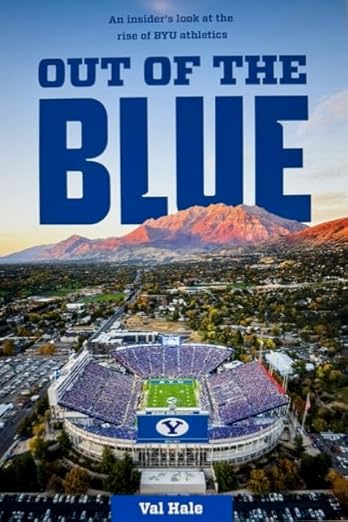
Val Hale spent twenty-four years inside BYU's athletic department, from intern to athletic director, and Out of the Blue, which Hale narrates himself, is the institutional memoir that position uniquely qualifies him to write. This audiobook covers the arc of one of college athletics' most distinctive programs through a period that included LaVell Edwards's dynasty, the names that defined an era, Danny Ainge, Jim McMahon, Steve Young, Robbie Bosco, and Ty Detmer, and the administrative decisions that shaped what the Cougars became when that golden run ended. No ghostwriter or professional narrator could bring to this text what Hale himself brings: twenty-four years of direct participation in every story he tells.
From Royal Blue to Navy, and Why It Mattered
The book's framing device, tracing Hale's career from intern to the director's chair, gives the narrative a structural through-line that prevents it from becoming a pure nostalgia anthology. This is not just a collection of glory-days anecdotes, though there are plenty of those. It is an insider account of how a major college athletic program actually functions: the hiring decisions, the facilities planning, the budget negotiations, the identity questions that arise when you decide to change a team's colors from royal blue to navy. That last detail, which Hale discusses with surprising depth, speaks to the book's understanding that institutional identity is built from specifics, not from general statements about excellence or tradition.
The BYU program Hale describes was rising to national prominence during a period when college athletics was becoming a significantly more complex commercial enterprise. His vantage point as an insider who was never a football player himself, but who was present for the coaching relationships, the recruiting conversations, and the administrative politics that surrounded the on-field success, gives the book a perspective on that period that players' memoirs and coaches' autobiographies do not offer. Reviewers who graduated from BYU or followed the program during earlier eras respond to the book as both a confirmation of memory and an education in what was happening behind the scenes.
Hale's Voice Is the Athletic Department Speaking
Self-narrated sports memoirs succeed when the author's voice carries authority that transfers to audio, and Hale's does. His twenty-four years in the program mean that when he describes his relationship with LaVell Edwards, the weight of institutional respect is audible in how he speaks about it rather than only inferable from what he writes. For BYU fans, the experience of hearing Hale walk through the program's history in his own voice is close to hearing the athletic department speak for itself in a way that third-party narration simply cannot manufacture.
The book's strength is its specificity. Hale does not write in the language of generic sports inspiration. He writes about particular decisions, particular coaches, particular moments in the program's administrative history that shaped outcomes on and off the field. The review from Ken Nottingham captures this: the book walks you down memory lane through the glory days and even through the not so glorious independence years, with a specificity that brings those memories to life. That honesty about the program's complicated years following its shift in conference alignment is one of the book's more distinctive features. It would have been easy to produce a purely celebratory memoir; Hale's willingness to address the harder chapters elevates the book above the vanity sports autobiography category.
An Organizational Biography Told From the Inside
The book's primary audience is explicitly Cougar fans. Reviewers describe it as essential for that readership and acknowledge that without an existing investment in BYU athletics, the granular institutional detail will carry less weight. Non-fans reading the book as a general study in college athletic administration will find transferable insights about program building, but the emotional resonance of names like LaVell Edwards, Danny Ainge, and Ty Detmer depends on understanding what they represented to the BYU community at their peaks. That is not a flaw in the book's construction but a feature of its audience awareness.
At seven and a half hours, the audiobook is appropriately sized for its content. It does not overstay its purpose. The title is a play on BYU's color change and a broader reflection on the surprises Hale encountered across his career, and while the wordplay is light, it reflects the book's overall tone: honest about difficulty, warm toward the program and its people, and committed to telling the story straight rather than mythologizing the decades he spent inside it.
The reviewer who graduated from BYU in 1966 and describes the book as covering the inner workings of the athletic department and its growth to what it is today is describing something Hale delivers precisely: an institutional history told from inside the institution. For the BYU community, this is not just a sports memoir but a kind of organizational biography of a department that has shaped how tens of thousands of alumni experienced their college years. That institutional dimension is what distinguishes Out of the Blue from a player memoir or a coaching biography. It is, at its core, a book about how an organization develops its identity over decades of decision-making by people who care about it.
Instructive Even Beyond the Cougar Context
BYU alumni and fans, particularly those who followed the program during the Edwards era, will find this the most satisfying available account of what was happening inside the building during those years. Sports administrators and college athletic professionals interested in the operational realities of a program building toward national prominence will find Hale's insider perspective genuinely instructive beyond the Cougar context. General sports memoir listeners who are not BYU-affiliated will find the book rewarding if they approach it as a study in institutional loyalty and long-term program development rather than as a celebration of specific teams. Casual sports fans without existing investment in BYU athletics should know that the specificity of the content assumes and rewards that investment.
The Short Version
- Voice: Val Hale narrating his own memoir is an asset. His institutional knowledge and personal investment in the BYU athletic program give the narration an authenticity that a third-party reader could not replicate.
- Big ideas: Institutional loyalty and athletic program building, the BYU glory years and post-independence identity, leadership transitions and facility development
- Atmosphere: Warm, reflective, and deeply rooted in Cougar fandom
- Worth it?: Hale's self-narrated BYU athletic memoir is essential listening for Cougar fans and genuinely interesting for anyone curious about how major college athletic departments are built and sustained from the inside.