Quick Take
- Voice: Susan Lyons brings a measured, warm formality to Karen Blixen's prose that respects the text's literary register without distancing the listener - a careful, unhurried performance that allows the descriptive passages to open fully.
- Big ideas: Colonial African landscape and its moral complexities, love for a specific place, the impossibility of return
- Atmosphere: Elegiac and quietly luminous, unhurried prose for an unhurried listen
- Worth it?: This two-in-one audiobook pairs Blixen's most famous memoir with its companion volume in a sixteen-hour recording that rewards listeners willing to move at the pace of the prose and hold the book's colonial context in honest view.
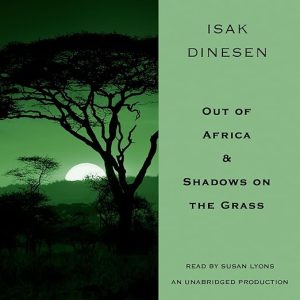
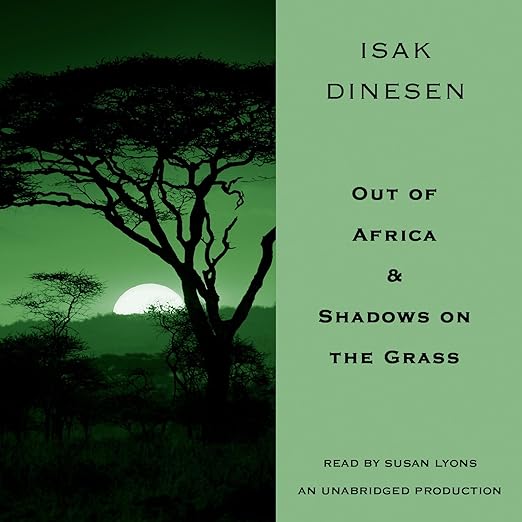
Isak Dinesen's memoir of her years on a Kenyan coffee farm, combined here with the companion volume Shadows on the Grass, arrives as a sixteen-hour audiobook narrated by Susan Lyons - and it is worth approaching with some preparation for what kind of listening experience these two texts actually provide. Out of Africa, published in 1937 under Dinesen's real name Karen Blixen, is one of the twentieth century's great works of place-writing. It is not a narrative of plot or event in any conventional sense. It is a book about light, about the specific weight of the air in the Ngong Hills, about the dignity of the Kikuyu and Somali people around her farm, and about the strange, irreversible nature of belonging somewhere you were not born and cannot return to once it is gone.
Thirty Years Separate These Two Memoirs
The question of how to read Blixen in the twenty-first century is not a simple one, and reviewers of this audiobook engage with it honestly. One notes that the book reflects "Euro-centric thinking" in its treatment of the African people around her - an accurate observation about a colonial memoir written in the 1930s, and one that Dinesen herself seems partially aware of, struggling, as that same reviewer puts it, to understand the deep connections between the people and the land. Another reviewer describes her as an incredibly brave person and a gifted writer whose portrait of colonial Africa remains honest about her own perspective. Reading Blixen today requires holding both things at once: the genuine literary achievement of the prose and the real limits of her perspective. The audiobook does not resolve this tension, nor should it. What it does is give the prose its full scope.
The two texts complement each other in ways that make the pairing more than a convenience. Out of Africa was written in the immediate aftermath of Blixen's departure from Kenya in 1931 - the farm sold, the relationship with Denys Finch Hatton ended by his death, the entire decade-long life in Africa suddenly gone. Shadows on the Grass, written across the 1950s with a final piece completed in 1960 when Blixen was in her seventies, returns to four figures from that time and considers them with the distance of age. The later collection is quieter, more deliberately elegiac, and the shift in register between the two texts within the same audiobook is itself instructive about how a writer's relationship to the same material can change across thirty years of memory and retrospection.
Lyons Resists the Urge to Overperform Blixen
Susan Lyons's narration is the right choice for this material. The risk with Blixen's prose is overperformance - the sentences are long, formally structured, and ornamented in ways that can tip into self-parody if read with too much theatrical weight. Lyons keeps her reading spare and unhurried, allowing the images to land without announcement. Her rendering of the book's most famous passages - the Ngong Hills at sunrise, the lion on the plain, the little gazelle Lulu who came to live with her unbelievably ladylike and beautiful - does not dramatize them but simply presents them with the trust that the writing is sufficient. It is.
The Meryl Streep and Robert Redford film adaptation, which many listeners will know before encountering the book, borrowed the title and some of the atmosphere but reimagined the material considerably. The audiobook is not the film's companion but its predecessor and, in literary terms, its primary source. The film gives the romance between Blixen and Finch Hatton a conventional narrative arc; the book treats it as one thread among many, and the many other threads - Knudsen the old charcoal burner, the primitive festivals, the big game that were her near neighbors - are where Blixen's real attention lies and where the writing is most alive.
Echoes From the Hills Carries the Most Weight
The book's structure resists summary. Out of Africa is organized into sections that each have their own internal logic but do not drive toward a climax. The farm sale and departure are known from the beginning; what Blixen is doing throughout the text is not building toward that ending but inhabiting the years before it, and the audiobook's unhurried pace serves that orientation. Listeners expecting a continuously dramatic arc will need to recalibrate their expectations in the opening hours and allow the text to teach them how to read it.
Shadows on the Grass is shorter and more structured, built around four distinct portrait essays. Some listeners may find it the more accessible of the two texts as an entry point. The fourth piece, "Echoes from the Hills," written specifically for this volume when Blixen was seventy-five and nearing the end of her life, carries a weight the earlier pieces do not have - the particular heaviness of someone looking back at a place they loved and know they will not see again - and it is one of the most quietly powerful things in the entire sixteen-hour collection.
Sixteen Hours of Sentences Over Sustained Plot
Readers who love literary memoir written at the level of the sentence, who are prepared to engage with a colonial perspective critically rather than accept or dismiss it wholesale, and who want sixteen hours of sustained prose in a vanished landscape will find this a rare and rewarding listen. Fans of the film should expect something quite different - not a dramatization but a meditation on belonging and loss. Listeners who need consistent narrative momentum or a clearly protagonist-driven arc will find the book's essayistic structure genuinely resistant to that kind of engagement and should approach with adjusted expectations or look elsewhere.
Questions Listeners Ask
How does Susan Lyons's narration handle Blixen's formal, ornate prose style in this audiobook?
With restraint, which is the correct approach. Lyons does not over-dramatize the descriptive passages or add theatrical weight to the already-weighted sentences. Her unhurried delivery lets the images settle and trusts the writing to do its own work, which it consistently does across the full sixteen hours.
Is this audiobook appropriate for listeners who have only seen the Meryl Streep film?
It is, but prepare for a different experience. The film gives the relationship between Blixen and Finch Hatton a central romantic arc; the book treats it as one thread among many, with equal or greater attention given to the landscape, the farm's workers, and the daily texture of life in colonial Kenya.