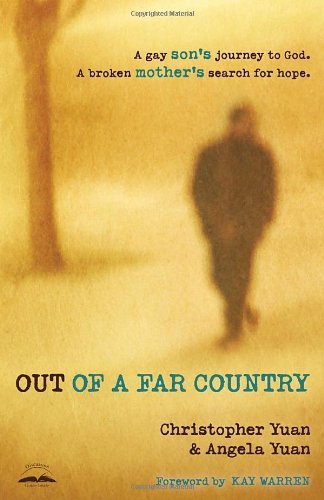
I came to Out of a Far Country on a rainy Sunday afternoon, somewhere between a stack of memoirs I had been moving through for a feature on first-person faith narratives. I did not expect it to stay with me the way it did. The book belongs to a fairly specific genre: the testimony memoir, where the story's arc bends deliberately toward conversion and spiritual resolution. Knowing that going in changes how you receive it.
What Christopher Yuan and his mother Angela have written is, at its core, two simultaneous stories of falling apart and being put back together. Christopher traces his years of drug dealing, addiction, and imprisonment; Angela writes about the slow collapse of her belief that she could fix her son and her eventual turn to faith as the only thing left. The dual structure is the book's genuine strength. It gives the account a texture that a single narrator would flatten.
Yuan self-narrates the audiobook, and that decision is load-bearing. His voice has the steady, practiced quality of someone who has told this story many times from a pulpit, and if you are a listener who responds well to that register, the performance will feel warm and direct. If you are more accustomed to literary memoir narration, there is a certain flatness to some of the emotional peaks that a professional voice actor might have shaded differently. The mother's sections are also read by Yuan, which creates an odd ventriloquism effect at times, though he manages the shift in perspective reasonably well.
What the 1-star review in the source data gets right, and what deserves naming honestly, is that the book's architecture is built around the family's experience of having a gay son more than around the son's interior life as a gay man. The resolution the book offers, celibacy framed as a holy vocation, is a specific theological position, not a universal truth. That is worth knowing before you begin.
What Christopher Yuan Gets Right
The memoir works best as a portrait of a family in crisis. The scenes of Angela discovering Christopher's drug use, of the years of estrangement, of her own near-suicide attempt, are genuinely affecting. Reviewers consistently single out the book's emotional honesty, and that assessment holds. The book does not pretend that faith made everything easy or immediate. The timeline of recovery is long and painful, and Yuan does not skip the ugly stretches.
There is also something worth taking seriously in the prison section. Yuan's description of his HIV diagnosis while incarcerated and his subsequent years of study at Wheaton are among the most vivid passages. He writes about that period with a specificity that lifts the narrative out of abstraction and into something you can actually picture.
Where Christopher Yuan Loses Some Ground
Listeners who are not embedded in evangelical Christian culture may find the theological commentary that frames each chapter's meaning somewhat heavy-handed. The book does not simply tell a story and let the reader draw conclusions; it explains what the story means, consistently, in terms of biblical narrative and divine purpose. That framing will feel like reassurance to its intended audience and like editorializing to readers outside that tradition.
The dual-narrator structure also occasionally produces timeline confusion. Because both Angela and Christopher are covering overlapping years from different vantage points, there are moments where a listener benefits from mentally reconstructing the chronology rather than simply following the audio forward.
Who Should Pick Up Out of a Far Country
If you are a parent of an LGBTQ+ child who is processing that reality through a Christian faith framework, this book will speak directly to your experience in ways that few other memoirs do. If you are a pastor, counselor, or church leader who works with families in that situation, it provides a kind of extended case study. If you are a gay or queer listener hoping to find your own experience centered in the narrative, this is not that book. And if you approach faith memoirs with a strong interest in literary craft above testimony, you will likely find the writing functional rather than exceptional. The book earns its audience; it simply has a particular one in mind.
Common Questions
Is Out of a Far Country written from both Christopher's and Angela's perspectives?
Yes. The book alternates between Christopher Yuan's first-person account of his addiction and imprisonment and his mother Angela's parallel story of grief, depression, and her own spiritual journey. Both sections are narrated by Christopher in the audiobook.
Does the book affirm or condemn homosexuality?
The book presents celibacy as the theologically correct response to same-sex attraction within a Christian framework. It does not affirm same-sex relationships. Readers looking for an affirming perspective on LGBTQ+ identity will find this book does not provide one.
Do you need to read the print version or does the audio work as a standalone experience?
The audio works as a standalone. Christopher Yuan's self-narration adds a personal dimension that the print version cannot replicate, though some listeners may notice that his vocal delivery is more consistent than dramatically varied across both his own and his mother's sections.