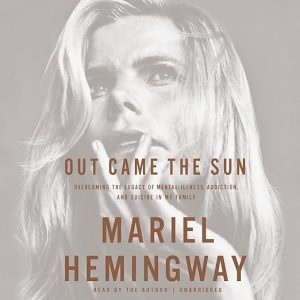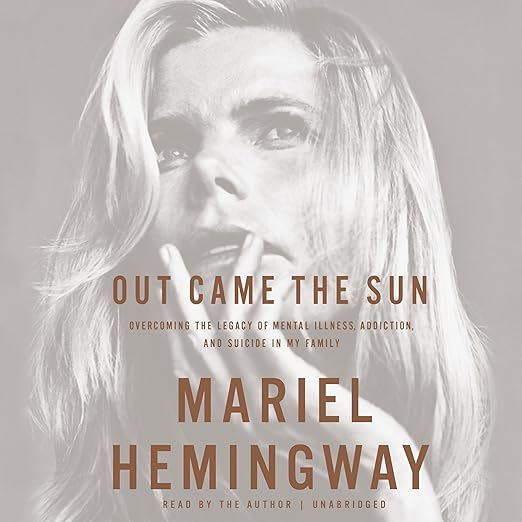
I came to Out Came the Sun knowing something about Ernest Hemingway and considerably less about Mariel. She is, as the memoir establishes early, his granddaughter - born just months after he shot himself in 1961. The book opens with darkness, noise, the sound of smashed plates, and the wish that it were all a terrible dream. It is not. This is the Hemingway household in the 1970s, and by the time the memoir's first pages establish the family inventory - her grandfather's suicide, her mother's cancer, her sister Muffet's schizophrenia, her sister Margaux's depression that would later end in an apparent overdose, her parents' alcoholism - you understand that Mariel Hemingway grew up treating sanity as an active project rather than a default state.
The audiobook runs nine hours and seven minutes. Hemingway narrates herself, published by Blackstone Audio in 2015. The comparison to Mary Karr and Jeanette Walls that appears in the marketing is not without merit: this is literary celebrity memoir with a genuine commitment to honesty, not a publicist-approved account of difficult times.
What We Made of It
Hemingway writes about the family's inner logic with both proximity and distance - the proximity of someone who lived it, and the distance of someone who has spent decades in therapy and in public life processing what it meant. The chapter on her sister Margaux is particularly striking: Margaux was also an actress and model, also caught in the family's gravitational field, and her death in 1996 is discussed with a complexity that resists easy explanation. Mariel writes about her own coping mechanisms - obsessive control of food and schedule, the particular rigidity that passes for health in certain anxious personalities - with a self-awareness that prevents the memoir from becoming a simple story of victim and circumstance.
Hemingway narrating her own memoir makes a specific kind of sense. She is an actress - she knows how to inhabit material emotionally and how to modulate that inhabitation for an audience. One reviewer was riveted and found it inspiring. Another simply wrote that Hemingway has a facility with words that surprised them, which speaks to something the marketing undersells: she can actually write. The memoir does not read like a ghostwritten celebrity account. The prose is genuinely hers, and the audio gives you her voice alongside it.
What to Watch For in Out Came the Sun
One reader who had given five stars to Hemingway's previous books - Finding My Balance and Healthy Living from the Inside Out - expressed bafflement at Out Came the Sun, finding it a reversal of the self-help trajectory of her earlier work. That observation captures something real. This memoir is not a wellness guide. It is a reckoning, and reckonings do not always resolve into programs. Some listeners expecting the organized positivity of Hemingway's earlier public persona may find the memoir's honesty about ongoing struggle, spiritual searching, and a marriage she describes as claustrophobic, less comfortable than they anticipated. That discomfort is probably the point.
Best Suited For
Readers interested in the Hemingway family history beyond Ernest will find Mariel's account the most intimate available. Mental health memoir readers, particularly those interested in inherited trauma and how it moves through generations, will find the book genuinely substantive. Fans of Mary Karr's The Liar's Club or Jeanette Walls's The Glass Castle will recognize the emotional register. Those seeking a recovery narrative with clear resolution should know this memoir is more honest about the ongoing nature of that work than most. And for anyone who has wondered what it means to survive a family famous for not surviving, this is a direct answer - one that refuses easy consolation but offers instead something rarer: the specific texture of a life being constructed, carefully and deliberately, in the shadow of everything that came before it.
At a Glance
- Read by: Mariel Hemingway reading her own memoir is intensely personal, her voice carrying the quality of someone who has spent decades managing emotional exposure as both an actress and a public mental health advocate.
- At its heart: the Hemingway family legacy, mental illness and inherited trauma, survival and self-construction
- Vibe: Searingly honest, occasionally unsettled, ultimately forward-facing
- Short version: A candid and literary family memoir that earns its place alongside the best celebrity accounts of inherited trauma, though listeners expecting the organized positivity of Hemingway's earlier wellness books may find the tonal shift disorienting.
Good to Know
Does Mariel Hemingway narrate Out Came the Sun herself?
Yes. She narrates her own memoir, which gives the listening experience an intimacy and authenticity that suits material this personally exposing.
How many of the Hemingway family members discussed in the book died by suicide?
The book references Ernest Hemingway's 1961 suicide and four other family members across generations. Margaux Hemingway, Mariel's sister, died in 1996 in circumstances consistent with an apparent overdose, though the details have been discussed publicly over the years.