In Brief
- Read by: James Fallows self-narrates with the measured authority of a long-form journalist; his delivery is calm and credible, occasionally a shade formal, but well-suited to the reportorial material.
- At its heart: American civic reinvention, local community resilience, the gap between national politics and local problem-solving
- Vibe: Measured optimism, journalistic in texture, quietly surprising
- Short version: A deliberately hopeful and rigorously reported account of what American communities actually look like when seen from the ground up rather than from cable news.
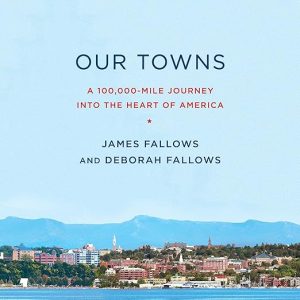
I have a long-standing habit of reading or listening to books about America that I suspect will irritate me, as a corrective to the comfort of my own assumptions. I came to Our Towns by James and Deborah Fallows with mild skepticism: national-media journalists spending five years flying a small plane over the American heartland and discovering that things are not so bad sounded like it could slide easily into the kind of selective optimism that mistakes individual bright spots for structural reality. What I found instead was something more careful and more interesting than that thumbnail suggested, and more honest about the distinction between the two.
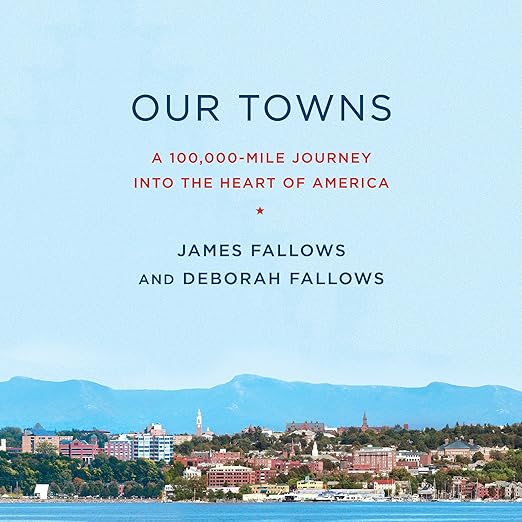
The Fallowses spent five years traveling across America in a single-engine prop airplane, visiting dozens of towns that draw national attention, as the synopsis notes, only after a disaster or during a political campaign. Their project was explicitly to look at what was actually happening at the local level, beneath the national narrative of paralysis and polarization. They spoke with civic leaders, educators, entrepreneurs, librarians, city planners, artists, immigrants, and public servants in communities from different regions, different economic circumstances, and different political orientations. At nearly sixteen hours, the book gives that accumulated reportage the space it needs to breathe and accumulate into something more than a collection of dispatches.
The Review
The most valuable contribution of Our Towns is its consistent demonstration that the political polarization defining national coverage is not always reproduced at the local level in the way it appears from Washington or from cable news. The towns the Fallowses visit are in red and blue states, have red and blue ideas, but mostly have leaders that do not think in red and blue, as one reviewer accurately put it. That observation recurs in various forms across the book: local problem-solving often happens across ideological lines that national politics has declared impassable, because at the local level the consequences of impassability are immediate and visible rather than distant and abstract.
The specific communities profiled are varied and specific enough to resist the generalizing impulse that can undermine this kind of project. Fallows is a long-form journalist, and his strength is the accumulation of particular detail that resists easy synthesis. The book does not argue that America is fine or that problems are overstated; it argues that the energy and creativity directed at local problems is real and significant and largely invisible from a national perspective focused on Washington dysfunction. Whether that argument is ultimately reassuring or frustrating will depend considerably on what you are looking for from the listen.
Why Listen to Our Towns
Fallows self-narrates, which is the natural choice for a first-person journalistic memoir of this kind. His delivery has the quality of a seasoned Atlantic correspondent: measured, precise, not prone to emotional performance or to the dramatic heightening that audiobook production sometimes imposes on nonfiction. There is occasionally a slight formality to his reading that distances the listener from what should be warmer moments, but this is a minor complaint against an otherwise effective narration over a long runtime. Deborah Fallows is a co-author and co-traveler, and her presence in the narrative, particularly in sections dealing with education and public libraries, adds a second perspective that keeps the book from becoming a solo voice exercise.
The book's most emotionally resonant sections are those where the Fallowses describe their own relationship to the project and to each other, a couple who have spent decades in journalism doing this kind of extended reporting together. That personal dimension grounds the reportage in a way that prevents the book from feeling purely like a collection of dispatches rather than a sustained inquiry with a human center at its core.
The Caveats
One reviewer was direct about their disappointment: hoping for a feast of discovery and finding something lighter and more impressionistic. That is a legitimate reading, and it reflects a genuine tension in the book's ambition. Our Towns is reportorial rather than analytical; it accumulates observations without building toward the kind of structural argument that would satisfy readers looking for a diagnostic framework or a policy prescription. It shows rather than analyzes, which is a choice that some readers will experience as insufficient and others will find exactly right for their needs.
A more sympathetic reviewer noted that the book would serve as a historical document of how the time actually was when the Fallowses visited, which is true and undervalued as a purpose for journalism. Reporting that captures lived civic reality in specific places at a specific time has a kind of value that policy analysis does not provide, and the book will be more interesting to read in ten years than it might appear to readers arriving with a prescription in mind.
Who Should Pick Up Our Towns
Listen if: you are fatigued by national-level political discourse and want a ground-level portrait of what American communities are actually doing with limited resources and significant problems, told with specificity and reportorial rigor. Also valuable for anyone interested in local civic reinvention, community leadership, or the sociology of small and mid-sized American cities that rarely receive sustained national attention. Pass if: you are looking for systemic analysis or policy prescription, as this book describes what it sees without arguing for structural conclusions, and that restraint may read as evasion depending on your expectations.
Questions Listeners Ask
Is Our Towns a politically neutral book, or does it have a clear ideological lean?
The Fallowses are Atlantic journalists with identifiable political sympathies, but the book's reportorial method is genuinely bipartisan in the communities it covers and the leaders it profiles. The argument for local optimism is not party-specific.
Does the book's reportage feel dated given when it was published?
The communities documented reflect the mid-2010s period of the Fallowses' travels. One reviewer describes it as a historical document of that moment, which is accurate. The civic dynamics described predate some significant subsequent disruptions.
Is James Fallows an effective narrator of his own material?
Yes, with the caveat that his style is journalistic and measured rather than warm or performative. Listeners who prefer emotionally expressive narration may find him slightly formal across the long runtime.
Is there a free audiobook version of Our Towns available?
Yes, Our Towns is listed at $0.00 on Audible for eligible members, making it available as a free audiobook under current membership plans. Verify availability and current pricing on the Audible product page.