Quick Take
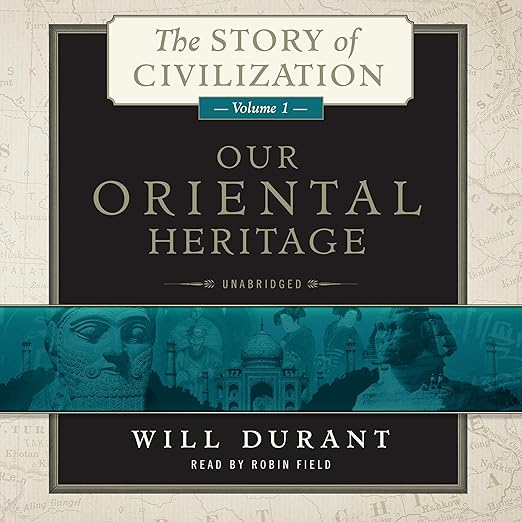
- Narration: Robin Field handles fifty hours of dense civilizational history with admirable steadiness – his voice has the cadence of a distinguished lecturer, authoritative without becoming pedantic.
- Themes: The origins of civilization, Eastern antiquity, the long sweep of human cultural development
- Mood: Expansive and magisterial, occasionally overwhelming in scope but consistently rewarding
- Verdict: The foundational volume of one of the twentieth century’s greatest intellectual projects – demanding in its scale but offering a depth of historical perspective unavailable almost anywhere else in audio.
I came to Our Oriental Heritage the way most people come to Will Durant: through a recommendation from someone who had been quietly transformed by it. I had read Durant’s The Story of Philosophy years earlier in graduate school, marveling at his ability to make Kant accessible without making him trivial. That same quality operates here, but at a scale that is almost geological. Fifty hours of audio covering Sumer, Egypt, Babylon, Persia, India, China, and Japan feels less like listening to a book than like sitting through a semester of the most articulate historical education you have ever received.
This is the first volume of Durant’s Pulitzer Prize-winning Story of Civilization series, an eleven-volume project that he and his wife Ariel worked on across several decades. Our Oriental Heritage covers the origins of human civilization from the emergence of writing in ancient Sumer through the Persians, who controlled the largest empire in recorded history before Rome, and continues into Indian philosophy, Chinese thought, and the Japanese samurai tradition. The breadth is genuinely staggering and requires a kind of reading patience that audiobook culture does not always cultivate.
Our Take on Our Oriental Heritage
What Durant achieves in this volume is not a recitation of facts but an argument: that the world we inhabit is the product of an enormously long human project, and that the civilizations we now call Eastern are not peripheral to that project but foundational to it. He traces the Babylonians developing astronomy and physics, planting what he calls the seeds of Western mythology. He follows the Judeans preserving their culture in the books of the Old Testament. He arrives at Indian and Chinese philosophy not as exotica but as parallel responses to the same fundamental human questions that Greek philosophy would later formalize in ways more familiar to Western readers.
One reviewer describes the experience of reading this book after a long career as a history enthusiast and being genuinely surprised by how much it changed their understanding of how we got to the present moment. That reaction is common among Durant readers, and it comes from his ability to synthesize rather than simply accumulate. The man can hold five thousand years in view simultaneously and still make you feel the particularity of a single event or idea.
Why Listen to Our Oriental Heritage
Robin Field’s narration is a genuine asset for a text this demanding. Fifty hours of complex historical prose read poorly would be nearly unbearable. Field reads Durant as the text deserves, with the measured pace of someone who understands that the listener needs time to absorb each period and civilization before moving to the next. He does not rush through the Egyptian sections to get to the more familiar Persians. He gives every civilization the same quality of attention, which mirrors Durant’s own democratic generosity toward his subjects.
The audiobook format has one particular advantage over the print version for this material: it forces a pace of engagement that is actually calibrated to the density of Durant’s prose. Readers who skim in print tend to get lost in his synthesis. Listeners are carried through it continuously. Several reviewers who encountered the book in print formats before the audio version report that the audio gave them a richer experience of the same text.
What to Watch For in Our Oriental Heritage
The book was published in 1935, and its age shows in ways that a thoughtful listener should hold in mind throughout. Dozens of ancient cities and archaeological discoveries postdate Durant’s research. His framing of India’s colonial situation reflects the assumptions of a moment when Britain still administered the subcontinent. His treatment of China does not account for any of the twentieth century’s transformations. One reviewer notes that had the book been written even a decade later, its historical portrait would look substantially different.
Durant also writes with an intellectual confidence that later scholarship has complicated in important ways. His synthesis is occasionally too neat, his attributions occasionally too clean. He is not an archaeologist or a specialist in any of the traditions he covers; he is a philosopher turned cultural historian, and that position has both advantages and limitations. The book is best read as a grand introduction rather than a final authority, and the audio format encourages exactly that relationship to the material.
Who Should Listen to Our Oriental Heritage
This is not an entry-level listen. Fifty hours of civilizational history requires genuine commitment, and listeners looking for a casual introduction to ancient history will find more accessible options. But for those who want to understand how the world’s oldest civilizations built the foundations that later cultures inherited, and who want that argument made by one of the most eloquent historical writers of the twentieth century, this is irreplaceable. Listeners who found pleasure in Herodotus’s Histories or who have worked through Gibbon or Toynbee will feel at home. Those beginning their serious engagement with world history could do worse than starting exactly here, with the caveat that contemporary specialists would add considerable nuance.
Frequently Asked Questions
Does the 1935 publication date seriously undermine Our Oriental Heritage’s reliability?
For specific archaeological or historical facts, yes. Many ancient sites and civilizations have been discovered or reassessed since 1935. Durant’s broader synthetic argument and narrative skill remain valuable, but the book should be supplemented with contemporary scholarship for any specific historical period.
How does Robin Field’s narration hold up across fifty hours of dense historical prose?
Consistently well, according to reviewers. Field maintains the quality and pacing of a distinguished lecturer throughout, which is the right register for Durant’s style. The narration does not flag noticeably across the full fifty hours.
Is Our Oriental Heritage suitable for listeners new to world history, or does it assume prior knowledge?
Durant writes accessibly and explains his subjects without assuming specialist knowledge. However, the sheer scale and density of the material means complete beginners may find the scope overwhelming. Some prior familiarity with ancient civilizations, even casual familiarity, makes the listening experience significantly more rewarding.
Do I need to listen to the subsequent volumes for this one to feel complete?
Our Oriental Heritage is explicitly the first volume of eleven, but it covers its own substantial arc from Sumer through Japan. It stands alone as a satisfying account of Eastern antiquity. The subsequent volumes cover Greece, Rome, and the European tradition, and many listeners work through the series over years rather than in sequence.