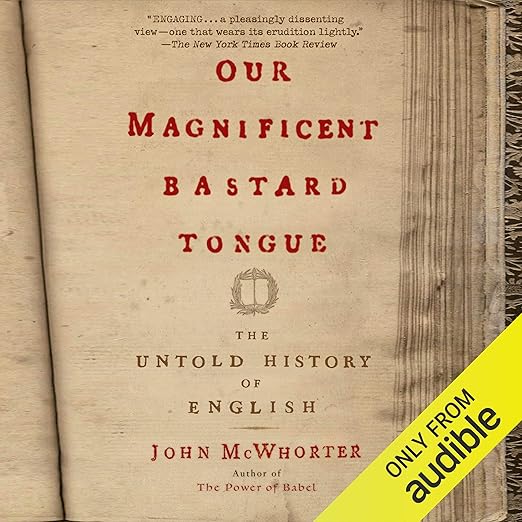
I first came to Our Magnificent Bastard Tongue during a stretch when I was rereading Old English poetry and feeling freshly bewildered by how alien it looks on the page compared to the language we speak today. John McWhorter's slim, audacious book arrived at exactly the right moment. I finished the audiobook in two sittings, then started it again almost immediately because I wanted to pay better attention to the arguments the second time through. That rarely happens to me with linguistics books, which tend to be either too technical for general audiences or too thin on actual evidence for serious readers. McWhorter, who also narrates his own work here, has found a tone that works for both camps.
The central argument of Our Magnificent Bastard Tongue is that English is strange in ways that have been consistently misattributed or left unexplained. McWhorter focuses not on vocabulary, which is the territory most popular linguistics books occupy, but on grammar. Why does English use the progressive tense so obsessively? Why do we insert a meaningless do into questions and negatives? Why does English, alone among its Germanic relatives, lack grammatical gender? His answers draw on Celtic and Welsh influences that mainstream linguistics has historically dismissed, and he makes his case with the controlled combativeness of someone who has watched good evidence get ignored for decades.
How Our Magnificent Bastard Tongue Holds Up
The most provocative and rewarding section of the audiobook concerns the influence of Celtic languages on English grammar. McWhorter argues that the Celts, whom the Anglo-Saxons conquered, left their mark on English syntax in ways that have been systematically underestimated. Linguists have traditionally credited the loss of grammatical gender and the adoption of the progressive and do-support constructions to internal development within Germanic languages. McWhorter challenges that consensus directly, presenting the distribution of these features across languages as evidence that contact with Celtic speakers reshaped English during its formative period in ways the field has been slow to acknowledge.
Whether or not you find his argument fully convincing, the presentation is exhilarating. Reviewer Stephen Adams, who speaks several Germanic languages fluently, noted that the theory makes more sense than the alternatives he had encountered in other sources. Even a reader sympathetic to the mainstream account will come away from this section questioning assumptions they had never thought to examine. That is the mark of genuinely useful popular scholarship, the kind that provokes productive doubt rather than simply confirming what readers already believe.
The choice to have McWhorter narrate his own book is exactly right for this material. His is a professorial voice with real warmth and occasional flashes of impatience directed at colleagues whose work he considers inadequate. When he is making an argument he clearly regards as underappreciated, you can hear the restrained frustration of someone who has been saying the same thing in academic contexts for years. That emotional texture adds something that a professional narrator reading the same words probably could not replicate.
At just over five hours, the audiobook moves at a pace that feels genuinely propulsive rather than padded, which is a significant virtue in a field where academic authors sometimes struggle to find the appropriate density for a popular audience. Reviewer Jansen, listening from Germany with an adult lifetime of Germanic language learning behind him, found the progressive tense and do-support material directly applicable to his own linguistic experience. That cross-cultural response points to something important: this is not a book only for native English speakers. It works for anyone who has tried to explain to a language learner why English behaves the way it does and found the standard answers unsatisfying.
Weak Spots in Our Magnificent Bastard Tongue
The section on Phoenician influence on Germanic languages is more speculative than the rest and has attracted the most skepticism from professional linguists since the book's publication. McWhorter acknowledges this himself but presents the hypothesis with an enthusiasm that can feel disproportionate to its evidential basis. That portion of the audiobook works best as an exercise in thinking about language spread and contact rather than as a settled argument worth defending in full. Readers who arrive expecting every chapter to carry the same evidential weight as the Celtic influence sections may feel the ground shift under them toward the end.
McWhorter is also deliberately narrow in his focus. He wants to make a specific argument about specific grammatical features, and he keeps his attention there throughout. Readers expecting extensive treatment of Norman French borrowings, the history of English vocabulary, or the Great Vowel Shift will be surprised by how little page time those subjects receive. That narrowness is a principled choice rather than an oversight, but it is worth knowing before you start so you arrive with appropriate expectations about scope.
Who Should Listen to Our Magnificent Bastard Tongue
If you have ever found yourself genuinely curious about why English grammar looks and sounds the way it does, especially if you have experience with other languages that follow different rules, this audiobook is one of the most enjoyable five hours you will spend on the subject. Teachers of English as a second language, amateur linguists, and anyone who has taught grammar without being fully satisfied by the standard explanations will find McWhorter's arguments directly useful. Dedicated historical linguists may find the argumentation selective and the handling of the Phoenician hypothesis too credulous. General readers who care primarily about vocabulary history or the stories behind individual words may want something with broader coverage. For everyone in between, this is a rare linguistics book that rewards the same kind of close attention you would give to a genuinely rigorous intellectual argument.
Good to Know
How controversial is the Celtic influence thesis among professional linguists?
It remains contested. McWhorter presents it as an underappreciated argument with solid distribution-based evidence. Some linguists find it convincing; others consider the evidence insufficient. The Phoenician hypothesis in the final section is considerably more speculative.
Is the audiobook worth listening to if I have already read the print edition?
The author-narrated version adds genuine value through McWhorter's vocal delivery of arguments he clearly cares about deeply. The emotional texture of his impatience with dismissive colleagues does not come through in the same way on the page.
Does McWhorter cover the Norman French influence on English vocabulary?
He deliberately focuses on grammar rather than vocabulary, which means the Norman French borrowings receive very little attention. If vocabulary history is your primary interest, you should look for a broader history of the English language alongside this one.