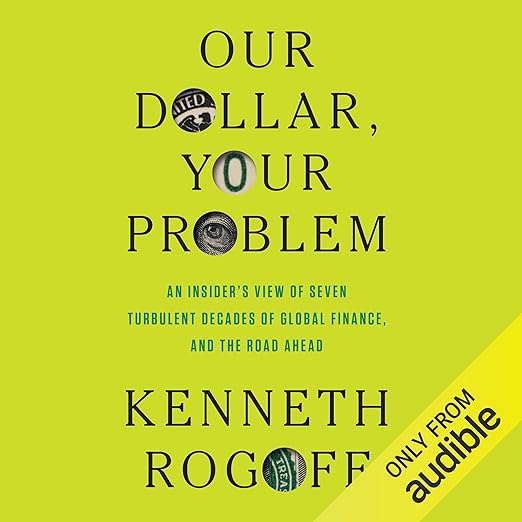
Quick Take
- Narration: Evan Sibley delivers a measured, authoritative read that suits the academic weight of Rogoff’s prose without becoming dry or distant.
- Themes: Dollar hegemony, global financial fragility, geopolitical currency competition
- Mood: Sobering and intellectually charged, with occasional flashes of genuine suspense about where the money system is headed
- Verdict: Essential listening for anyone trying to understand why the dollar’s dominance may be more fragile than Washington assumes.
I started listening to this one on a Tuesday morning commute, somewhere between the news about rising Treasury yields and a podcast about de-dollarization that had been sitting unplayed in my queue for weeks. Kenneth Rogoff had been on my radar since This Time Is Different, co-written with Carmen Reinhart, which I read during the sovereign debt crisis years and which changed how I thought about financial complacency. When I saw his name attached to a book specifically about the dollar’s future, I moved it to the top of the list immediately.
What I did not expect was how personally the book would be framed. Rogoff draws on his own experiences as Chief Economist at the IMF, his meetings with central bankers, finance ministers, and heads of state, to give what could easily be a dry monetary policy treatise the texture of genuine lived observation. That grounds the analysis in a way that most academic economists simply cannot manage.
Our Take on Kenneth Rogoff’s Dollar Argument
Rogoff’s central claim is both simple and unsettling: the dollar did not reach its current position of global dominance purely through economic superiority. Luck played a role. The yen stumbled. The ruble collapsed with the Soviet Union. The euro arrived burdened by structural contradictions that the 2010 crisis exposed brutally. The dollar won partly by default, and Rogoff wants you to hold that uncomfortable thought while he walks you through what comes next.
He is careful not to overstate his case. This is not a declinist screed predicting the imminent death of dollar hegemony. Rogoff is far too empirically grounded for that. What he does argue, convincingly, is that American policymakers have grown dangerously comfortable with the exorbitant privilege the dollar confers, and that overconfidence, combined with real structural pressures, creates risk that is not priced into current assumptions. The detail on how America’s fiscal position interacts with its currency privilege is particularly sharp.
Why Listen to This Over Reading It
Evan Sibley’s narration is the right call for this material. He reads with the calm precision of someone who has spent time around financial journalism, never artificially dramatizing the more alarming passages but never flattening them either. When Rogoff shifts from historical narrative to forward-looking analysis, Sibley adjusts his pacing accordingly, giving the listener a sense of movement through the argument rather than a static lecture. The book also comes with a bonus PDF of charts and graphs, which matters for a work this quantitatively grounded, and I found myself pausing the audio to open that PDF on my phone more than once.
One reviewer called it an easy read for a complex topic, and I think that captures something real, though I would qualify it. Rogoff writes accessibly, but he does not simplify dishonestly. He covers the rise of the Chinese yuan as a potential rival, the uncertain role of cryptocurrency in reshaping reserve currency dynamics, and the domestic political instability that now colors international perceptions of dollar reliability. None of these are simple topics, and Rogoff handles the complexity with intellectual honesty rather than false reassurance.
What to Watch For in the Later Chapters
The section on how dollar dominance can generate financial instability not just abroad but within the United States is where the book becomes most thought-provoking. Rogoff argues that the feedback loops between America’s reserve currency status, its fiscal behavior, and global capital flows create vulnerabilities that are easy to ignore during good times and difficult to address once they become acute. This is not a new argument in academic literature, but Rogoff’s access to insider experience makes it feel more concrete than it typically does in journal articles.
There are moments where listeners without a background in international economics may feel the book accelerating past them. Rogoff does his best to contextualize, and the pacing of Sibley’s narration helps, but some of the mechanism-level explanation of how currency intervention works assumes a certain baseline familiarity. That said, one reviewer who described themselves as a total neophyte still found value in it, which suggests Rogoff has calibrated the accessibility reasonably well.
Who Should Listen to Our Dollar, Your Problem
This is the kind of audiobook that rewards listeners who follow economic news with genuine curiosity, even if they have no formal economics training. If you have ever wondered why the United States can run persistent deficits without the consequences that would sink a smaller country, or why other nations talk about de-dollarization but never quite manage it, Rogoff provides the most honest and historically informed answer I have encountered in audio form. It is equally valuable for anyone in finance, policy, journalism, or simply anyone who wants to understand the architecture of the global economy before it potentially shifts beneath our feet.
Skip it if you are looking for a simple prediction or a clear-cut thesis about when the dollar will fall. Rogoff is too careful and too intellectually honest to offer that, and if that kind of intellectual ambiguity frustrates you, this will feel unresolved. For everyone else, it is one of the better pieces of economic thinking available in audio format right now.
Frequently Asked Questions
Does Rogoff predict the dollar will lose its reserve currency status soon?
No. Rogoff is careful to avoid making a specific timeline prediction. His argument is that dollar dominance is more fragile than Americans assume and that overconfidence increases risk, not that collapse is imminent or inevitable.
How does Evan Sibley’s narration handle the more technical economic passages?
Sibley maintains a measured, authoritative pace throughout. He does not stumble on the technical terminology, and he adjusts his rhythm when the text shifts from historical narrative to forward-looking analysis, which helps listeners track the argument.
Is the bonus PDF of charts and graphs essential for understanding the audiobook?
Not essential, but genuinely useful. The audio holds up on its own, but listeners interested in the quantitative comparisons Rogoff references will get more from the argument with the PDF open alongside.
How does this compare to Rogoff’s earlier book This Time Is Different?
This is more focused and more personally voiced than This Time Is Different, which was a sweeping historical survey co-written with Carmen Reinhart. Our Dollar, Your Problem is narrower in scope but more argumentative and more willing to draw direct policy conclusions.