The Short Version
- Voice: Samara Naeymi brings a lively, curious energy well suited to social history that moves quickly across centuries without losing narrative clarity.
- Big ideas: diary-keeping as resistance and self-expression, feminist history, the diary form's evolution from paper to TikTok.
- Atmosphere: Curious and wide-ranging.
- Worth it?: An engaging cultural survey for feminist-history readers, best approached as a broad tour rather than a deep single-subject biography.
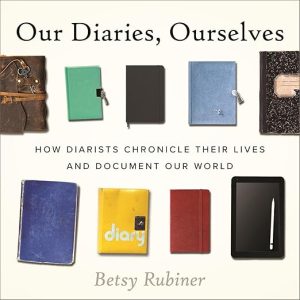
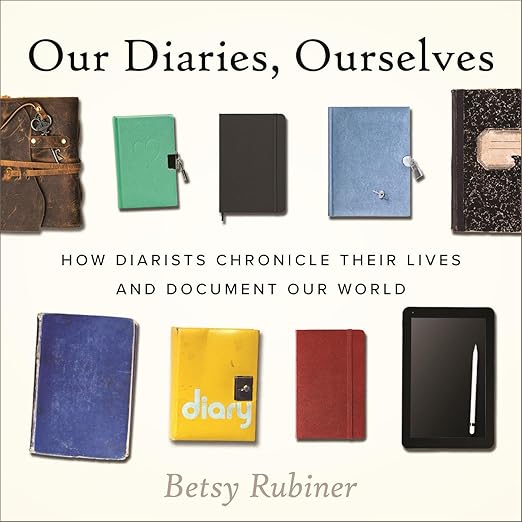
Betsy Rubiner traces the diary from Marie Curie's private notebooks to Taylor Swift's captioned posts, treating the form itself, not any single famous diarist, as the real subject of this audiobook. Featuring figures like Audre Lorde, Virginia Woolf, and Alison Bechdel alongside less expected names, Our Diaries, Ourselves reads as a genuine cultural history of a private practice that turns out to have shaped public history more than most people realize.
The book moves at real speed across centuries and continents, which sets expectations early: this is a panoramic survey rather than a deep biographical dive into any one figure, closer in spirit to a cultural history lecture than to a single-subject literary biography.
An Unnamed Nod to Lister, an Unnamed Nod to Frank
The sheer range on display, an early twentieth-century scientist's lab notebook in one chapter, a present-day pop star's social captions in another, is itself the book's clearest argument: that the diary has never been one fixed form, but a continuously adapting habit that moves with whatever technology happens to be available, paper and ink in one century, a phone screen in another, with the underlying impulse toward self-documentation staying essentially constant across all of it.
Rubiner's specific examples do a lot of work here. The book references what it was like to be an openly gay woman in nineteenth-century England, almost certainly a nod to Anne Lister, whose coded diaries remain one of the most famous surviving records of lesbian life from that era even though the synopsis does not name her directly, and it gestures toward the inner world of a young girl in hiding, an unmistakable if unnamed reference to Anne Frank.
A Small Italian Town Built Around Diary-Keeping
Beyond the famous names, Rubiner spends real time on Pieve Santo Stefano, a small Italian town that has built an entire cultural identity around diary-keeping, home to a national diary archive, a dedicated museum, and an annual festival celebrating ordinary people's private writing. That detour into a place most listeners have never heard of is one of the audiobook's more memorable stretches, proof that Rubiner is genuinely curious about the diary as artifact and not just cataloging famous names for structure.
Rubiner's own research process seems to have taken her well beyond famous names into genuinely obscure archival material, which is where a book like this earns its keep: anyone can list Woolf and Anne Frank, but building an entire chapter around a small Italian town's diary festival requires the kind of curiosity that goes looking for stories nobody assigned as required reading.
Naeymi's Lively Voice Handles Big Historical Sweep
Samara Naeymi narrates with a lively, curious energy that suits wide-ranging social history moving quickly across centuries, and her delivery handles the shifts between scholarly analysis and anecdotal storytelling without ever making the seam between the two obvious. For a book covering this much historical ground in under nine hours, that kind of pacing control matters more than it might for a narrower, single-subject book.
A real, if quiet, irony sits in choosing audio to celebrate a fundamentally written form of self-expression, and Rubiner's own text seems aware of that tension: diaries are private, handwritten, deliberately unpolished in a way a produced audiobook can only gesture toward rather than replicate. That tension does not undercut the book, though; if anything, hearing these private texts described aloud by a narrator adds its own layer to the book's larger argument about diaries wanting, eventually, to be witnessed.
Rubiner frames diary-keeping partly as a tool of resistance within a patriarchal society, women across centuries using private pages as one of the only spaces where their own perspective could exist unfiltered and unedited by anyone else's expectations. That framing gives the historical survey a clear throughline underneath the individual stories, tying figures as different as a nineteenth-century Englishwoman and a twenty-first-century pop star into the same larger pattern of claiming private space for an authentic voice.
The book's move from paper diaries to social media platforms also raises a real generational question worth sitting with: whether the impulse driving a teenager's locked diary and a teenager's public TikTok account are actually the same impulse wearing different clothes, or something meaningfully different now that the audience is built into the format from the start. Rubiner does not pretend the answer is simple, which is to the book's credit.
TikTok as the Locked Diary's Direct Descendant
Because the book prioritizes breadth over depth, listeners hoping for a full biographical treatment of any single diarist, a complete Woolf or Lorde deep dive, for instance, should adjust expectations: each figure gets enough space to illustrate a point about diary-keeping generally, not a full life story. This is a book about the practice across history, not a collection of individual biographies.
No reviews or ratings are attached to this listing yet, so the reaction described here reflects one listener's impression rather than a confirmed consensus. Given how much ground the book covers, from nineteenth-century England to contemporary social media, some sections will land more strongly than others depending on which historical periods and figures already interest a given listener.
The book's inclusion of TikTok as a contemporary diary form is a genuinely interesting structural choice, treating short public video confessionals as a direct descendant of the locked leather diary rather than something categorically different. Listeners skeptical that a public social platform can function the same way a private notebook once did should expect Rubiner to make her case directly rather than simply asserting the connection.
Listeners specifically hoping for practical journaling advice, prompts, techniques, habit-building tips, should know this is a cultural history rather than a how-to guide; nothing here is structured as an exercise to complete alongside the listening. The value is entirely in the historical and cultural context, not in any accompanying instructional material.
A Match for Feminist History and Life-Writing
This is a strong match for listeners interested in feminist history, women's life-writing, and social history approached through an unusual artifact-first lens, along with anyone who journals themselves and wants cultural context for why that private habit has mattered so much to so many people across centuries.
Skip it if you want a focused, single-subject biography rather than a sweeping survey, or if the appeal of a book like this depends entirely on deep engagement with one particular diarist rather than a curated tour through many.
Book clubs interested in feminist nonfiction with a lighter, more anecdotal touch than a dense academic history will also find this a comfortable, well-paced group listen.
Public library reading groups and continuing-education book circles focused on women's history will likely find this an easy, accessible group selection too, requiring no specialized background to enjoy or discuss.
Questions Listeners Ask
Does this audiobook focus on one diarist in particular, or is it a broader survey?
It is a broad survey spanning centuries, featuring figures like Audre Lorde, Virginia Woolf, Marie Curie, and Taylor Swift rather than a deep biography of any single diarist.
Do I need background in feminist history to follow this audiobook?
No prior background is required. Rubiner explains each figure and period as she introduces them, keeping the survey accessible to listeners new to the subject.