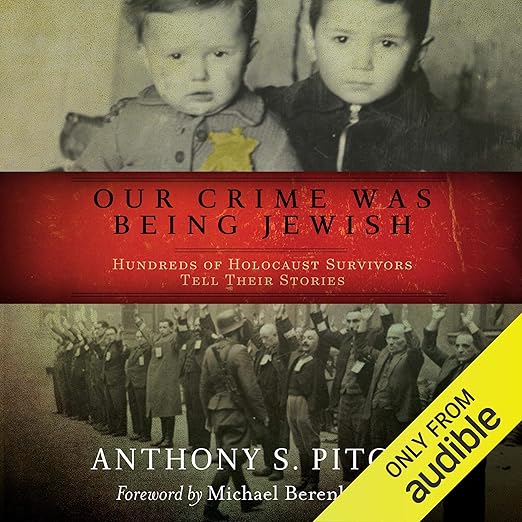
Auschwitz-bound, a woman shouted a plea across a cattle car that Anthony S. Pitch chose to build his entire book around: 'If you get out, maybe you can tell the story! Who else will tell it?' Rather than writing one continuous survivor memoir, Pitch made the harder structural choice for this audiobook, compiling 576 vivid memories from 358 Holocaust survivors, each told in that survivor's own words rather than filtered through a single narrator's retrospective summary. Narrator Malk Williams carries all 358 of those voices across thirteen hours and eight minutes, and the scale alone sets this apart from a conventional single-subject memoir. Pitch worked with sources including the United States Holocaust Memorial Museum to compile and verify these accounts, supplementing the written testimony with photographs in the print edition.
576 Memories Against One Incomprehensible Number
The structure here is closer to oral history than memoir, hundreds of short, first-person accounts rather than one continuous narrative arc, and that choice shapes everything about how the book functions. Reviewer Ellis Reyes lays out the chronological spine underneath all those individual voices: the early rise of antisemitism under Hitler, Kristallnacht, deportation and ghettoization, the daily reality inside the camps, and finally liberation and its aftermath. Individual testimonies slot into that timeline, teenagers who watched parents and siblings sent to the gas chambers, starving children beaten for trying to steal food, people who watched friends take their own lives rather than face what came next.
Six million Jews were killed in the Holocaust, a number so large it resists comprehension in the abstract, and Pitch's method works against that abstraction directly. By assembling 576 specific, named memories rather than one generalized account, the book keeps returning a listener's attention to individual human beings rather than a statistic. That approach is slower and more demanding than a single narrative memoir, but it's also the book's entire reason for existing: preserving testimony precisely because, as Pitch's compiled sources insist, so many of the people who lived through it did not survive to tell their own story.
The title itself functions as a kind of indictment, restating, almost verbatim, the twisted logic used to justify genocide: that simply existing as a Jewish person was itself a criminal act deserving death. Pitch doesn't need to editorialize heavily against that logic anywhere in the book, because letting 358 survivors describe, in granular first-person detail, exactly what was done to them under that logic makes the argument more effectively than commentary could. The title alone tells a listener what stance the book takes before a single testimony begins, and the accumulated weight of hundreds of individual accounts across thirteen hours only deepens that initial indictment rather than complicating it.
Williams Resists Flattening 358 Distinct Survivors
Voicing 358 distinct survivors without flattening them into one generic tone is a genuinely difficult narration challenge, and it's where Malk Williams does the most important work in this production. Williams varies register across forensic, matter-of-fact accounts, shattering descriptions of family separation, and quieter anecdotes of resistance or small mercies, treating each survivor's specific way of telling their own story as worth preserving rather than smoothing into a single narrative voice. That variation matters enormously for testimony-based material like this. A single flattened reading risks turning genuinely distinct human beings into an undifferentiated wall of suffering, and Williams's performance actively resists that flattening throughout the full runtime.
Reviewer Courtney M. Dunbar adds a real-world texture to why this material still resonates: she describes visiting the National Archives and seeing an advertisement for Pitch himself speaking about the book, evidence of the serious historical weight this collection carries beyond its listing. William R.'s shorter review captures something simpler and just as true, calling it an excellent read built from so many accounts of what actually happened, sad as they are. For anyone drawn to primary-source-adjacent Holocaust history rather than secondhand historical analysis, hearing these accounts voiced rather than silently read adds real weight.
Pace Yourself, This Isn't a Single Sitting
This is intense, often graphic material, and it should be approached with that understood going in. Ellis Reyes describes it as heart-wrenching and often graphic, an accurate warning rather than an exaggeration: descriptions of violence, starvation, and death appear throughout, not as isolated content warnings but as the book's actual subject matter across its full thirteen-hour runtime. The print edition's supplementary photographs also don't carry over into audio, a real if secondary loss for listeners who'd want that visual documentation alongside the testimony. Pace yourself with this one. Thirteen hours of survivor testimony, however necessary, is not built for a single uninterrupted sitting, and the compiled-testimony structure actually makes it easier to break into sessions than a continuous narrative would.
A real preservation urgency sits behind why a book like this exists now rather than later. Survivors of the Holocaust are, by the nature of time, a shrinking population, and institutions dedicated to Holocaust remembrance have spent decades specifically racing to record firsthand testimony before it's lost entirely. Pitch's collection belongs to that same urgent project of documentation, and framed that way, the compiled-testimony structure stops feeling like a stylistic choice and starts feeling like the only responsible one: preserving as many distinct voices as possible, in their own words, while that was still possible, rather than filtering hundreds of survivors down into a single composite narrative for the sake of smoother storytelling.
Set It Aside if the Violence Is Too Much
This belongs with readers of serious Holocaust history and testimony literature, students studying the period, and anyone who wants primary-source-adjacent material rather than a single secondhand historical analysis. If you've read Elie Wiesel or Primo Levi and want a much wider aperture, hundreds of individual voices instead of one, this delivers that scope while keeping each account specific and human rather than reducing survivors to a single collective story.
Educators building Holocaust curriculum will also find real value in the sheer range of testimony available here, enough distinct individual accounts to illustrate many different facets of the same historical catastrophe within a single source rather than needing to assemble excerpts from dozens of separate books.
Approach this with real caution, or set it aside for now, if graphic descriptions of violence and death are more than you can handle right now, since this book does not soften that material for listener comfort. It's also not the right fit if you want a single narrative throughline rather than compiled testimony; listeners wanting one survivor's complete story should look for an individual memoir instead, and return to this collection when they're ready for its full, deliberately unresolved scope.
How many survivor accounts does this audiobook actually include?
576 individual memories drawn from 358 Holocaust survivors, compiled by Anthony S. Pitch and told in the survivors' own words rather than summarized secondhand.
Does one narrator voice all 358 survivor testimonies in this audiobook?
Yes. Malk Williams narrates the entire collection and varies register across forensic accounts, accounts of family separation, and quieter stories of resistance, rather than reading every testimony in the same flat tone.
Where did Anthony Pitch source the testimonies collected in this audiobook?
Pitch worked with sources including the United States Holocaust Memorial Museum to compile and verify the survivor accounts, supplementing them with photographs in the print edition.