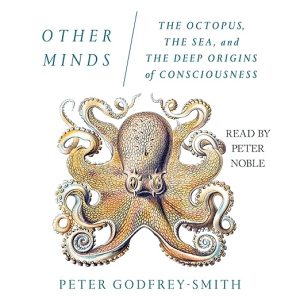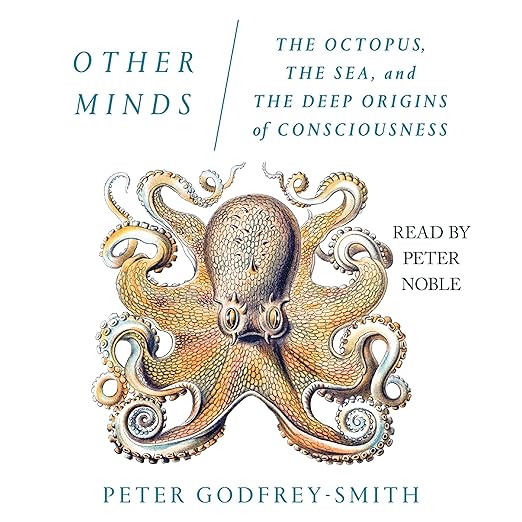
- Narration: Peter Noble provides a measured, thoughtful delivery that suits the philosophical nature of the inquiry without overwhelming the science.
- Themes: Evolution of consciousness, cephalopod intelligence, the deep history of nervous systems
- Mood: Quietly astonishing, philosophically rich
- Verdict: One of the most genuinely mind-expanding science audiobooks in recent years, using the octopus to ask questions about consciousness that have no tidy answers.
I finished Other Minds on a Sunday afternoon after a week in which I had been thinking, for entirely unrelated reasons, about what it means to be aware of oneself. I had picked it up based on a recommendation from a colleague who studies cognitive science, and it delivered more than I anticipated. Peter Godfrey-Smith is a philosopher of science who also scuba dives, and that dual identity is not incidental. It shapes everything about how this book thinks.
The central inquiry is elegant: cephalopods, primarily the octopus, represent a branch of intelligent life that evolved completely independently of the vertebrate lineage that produced humans. If intelligence emerged twice, what does that tell us about the nature of mind itself? And what is it actually like to be an octopus, distributed across eight semi-autonomous arms, changing color through skin that may be doing something like seeing?
First, the Big Picture
Godfrey-Smith is careful not to over-claim. He does not argue that octopuses are conscious in the way humans are, but he takes the question seriously and provides the evolutionary and neurological framework necessary to think about it rigorously. The result is a book that is genuinely modest and genuinely unsettling at the same time. The modesty comes from philosophical discipline. The unsettling quality comes from how seriously the evidence demands the question be taken.
The chapters on how the earliest nervous systems evolved, probably in ancient jellyfish relatives, and how early organisms moved from merely sensing their environment to acting on it and ultimately signaling to others, are among the best popular explanations of evolutionary neuroscience I have encountered. Godfrey-Smith has the gift of making the ancient present, of making you feel the weight of deep evolutionary time as something real rather than abstract.
The Best Parts of Other Minds
One reviewer who came to the book with a minor level of curiosity about cephalopods found it the most interesting book they had encountered on the subject, not because of the octopus facts per se, but because of the larger questions the octopus opened up. That experience is close to universal among the book's readers. You come for the octopus and you stay for the philosophy of mind.
Godfrey-Smith's underwater encounters, visiting the octopus congregation at Octopolis off the coast of Australia, where octopuses that are supposed to be solitary have gathered in unusual numbers, give the book an irreducible specificity. This is not just theoretical inquiry. It is grounded in real observation, and the passages describing those dives have a quality that is rare in science writing.
A Few Reservations
One common caveat in the reviews is that listeners who come primarily for octopus facts will find only a portion of the book, roughly a third by one estimate, focused directly on cephalopods. The rest is evolutionary history, neuroscience, and philosophy of mind. If you are hoping for a natural history of the octopus specifically, you may want to supplement with other titles. If you are open to the broader inquiry, the philosophical scaffolding is where the book does its best work.
The audiobook is seven hours long and covers genuinely complex material. Peter Noble's narration is steady and clear, but listeners who are entirely new to evolutionary biology or philosophy of mind may want to listen in shorter sessions to allow the ideas to settle.
Who Should Pick Up Other Minds
This is for listeners who want science writing that engages philosophical questions seriously without retreating into vague speculation. Readers who enjoyed Helen MacDonald's H Is for Hawk for its combination of personal observation and larger inquiry will find a similar quality here, though the register is more academic. Fans of popular philosophy of mind, particularly work by Daniel Dennett or Thomas Nagel's famous essay on what it is like to be a bat, will find Godfrey-Smith working at a comparable level for a general audience. Listeners who want straightforward nature documentary content about octopuses will find the book asks more of them than they may be looking for.