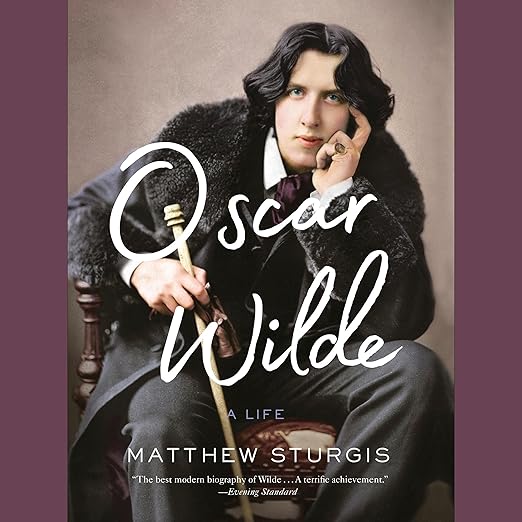
Matthew Sturgis spent years with Oscar Wilde's newly discovered letters, the full libel trial transcripts, and draft notebooks that previous biographers never accessed, and the resulting audiobook, Oscar Wilde, narrated by John Pirkis across an absorbing 34 hours and 27 minutes, is not simply the most complete account of the man's life. It is a fundamentally different kind of biography than anything that came before it. The Evening Standard called it simply the best modern biography of Wilde, and it earns that verdict at the level of primary source work alone.
The comparison point hanging over any Wilde biography is Richard Ellmann's 1987 account, still widely read and widely praised. One longtime Wilde reader describes arriving at Sturgis already knowing the Ellmann and finding new information on nearly every page. That is the measure of what Sturgis has done: he has not retold a familiar story with different prose, he has returned Wilde to the facts as Wilde actually experienced them, which turns out to be subtly but importantly different from the received version.
What makes Sturgis's approach distinctive is his resistance to retrospective myth-making. He is not interested in Wilde as archetype, the doomed queer martyr, the wit who burned too bright, but in Wilde as a specific person living in specific circumstances, making choices that felt contingent rather than inevitable. The Irish childhood sections are particularly vivid: the dreamy boy, the stellar classicist, the born entertainer developing before a live audience. Sturgis reconstructs the Oxford years with a granularity that reveals how early Wilde's personality was formed, and how much of his later life was continuous with that formation rather than a departure from it.
The Constance Lloyd chapters are among the most affecting in the book. Sturgis portrays the marriage as something more than a cover or a convenience, Constance was a real person with a real life, and her death in exile at 39 is not treated as a footnote to her husband's story. This is the kind of corrective that decades of Wilde biography had failed to make adequately, and Sturgis makes it without moralizing, which is harder than it sounds.
Pirkis Reads Wilde Without Tipping Into Camp
John Pirkis is precisely the right narrator for this material. He does not perform Wilde, a temptation that would have been easy and fatal, but reads Sturgis's prose with the engaged precision of someone who has genuinely absorbed the subject. The wit in Wilde's correspondence comes through without campiness; the tragedy of the prison years lands with full weight because Pirkis has calibrated the register carefully across the preceding hours. By the time the trials arrive, you are invested in this person in the way that 34 hours of careful biography should produce, and Pirkis honors that investment.
The duration of the audiobook warrants acknowledgment: 34 hours is a serious commitment. But this is genuinely a book that benefits from extended time. Sturgis's argument builds incrementally, and the density of specific detail, letters, dates, documented friendships, creates a portrait of Wilde that accumulates rather than arrives. Listeners who rush this one will miss the texture. At natural pace, across several weeks of listening, it reads as what it is: a definitive account.
Sturgis is also unusually attentive to Wilde's working methods as a writer. The sections covering the composition of the major plays, the speed of writing, the specific theatrical calculations behind the comedies, the ambitions of Salome, treat Wilde as a serious craftsman rather than a genius who produced art incidentally. This is a corrective that the biography tradition needed. So much Wilde criticism has focused on the life as the primary text that the actual process of making The Importance of Being Earnest or An Ideal Husband sometimes recedes into footnote. Sturgis restores the work to its proper place alongside the biography.
A Documented Life, Not a Punchline Version
Pay close attention to Sturgis's handling of the libel trial against the Marquess of Queensberry, he had access to the full transcript, which transforms what most accounts treat as a familiar narrative into something far more contingent and complex. The decisions Wilde made in the days leading up to the trial, and the reasons he made them, look different when you have the documentation Sturgis deploys. It does not exonerate poor judgment, but it complicates the image of a man walking into catastrophe with eyes shut.
The final section covering Wilde's post-prison years in Europe is often the most neglected in popular accounts. Sturgis gives it proper weight, including the friendships, the failed attempts to restart creative work, and the daily reality of a life rebuilt from wreckage. Wilde's death in a Paris hotel arrives here as the end of a documented human life, which is both more accurate and more devastating than any punchline version of the story.
A Long Listen That Changes What You Know
Listeners who know Wilde primarily through his plays and epigrams will find this audiobook biography genuinely revelatory, Sturgis's Wilde is a more complicated person than the aphorism machine. Readers who came to the Ellmann biography should listen to this one as a companion: the difference in documentation is substantial, and the two books illuminate each other. Scholars and serious Wilde enthusiasts will want this in their rotation for the archival material alone. Casual listeners should be prepared for a long, detailed listen that rewards patience disproportionately, this is not a one-sitting book, but the kind that changes the shape of what you know about a subject.
Before You Listen
How does this audiobook compare to Richard Ellmann's earlier Oscar Wilde biography?
Sturgis had access to materials unavailable to Ellmann, newly discovered letters, draft notebooks, and the full libel trial transcript, producing a more factually grounded and less mythologized portrait. Longtime Wilde readers consistently report learning new things even knowing the Ellmann well.
Is this audiobook suitable for listeners who do not already know Wilde's work or life?
Yes. Sturgis builds the life from the ground up, beginning with Wilde's Irish childhood, so no prior knowledge is required. Some familiarity with the plays makes the sections on his theatrical career more resonant, but it is not a prerequisite.
Does John Pirkis's narration handle the comedic voice of Wilde's letters without becoming a performance?
Pirkis navigates this well, he reads Wilde's wit with evident appreciation but does not impersonate or overplay. The result is more like a gifted reader sharing a remarkable correspondence than an actor attempting a character voice.
At 34 hours, is this audiobook best approached as a continuous listen or in extended sessions?
Extended sessions over several weeks suits the material best. Sturgis builds his portrait incrementally through accumulated detail, and the biography rewards immersive attention rather than sprint-listening.