Key Details
- Narrator: An audio-first publisher behind it, which is worth noting on a title whose entire written pool is grading the print edition instead.
- Subjects: Negro Leagues baseball, erasure and recovery, a player-manager's temperament, segregation in American sport
- Tone: Patient, argumentative, quietly angry
- Bottom line: The best kind of recovery biography, worth pairing with a printed copy for the sheer number of names.
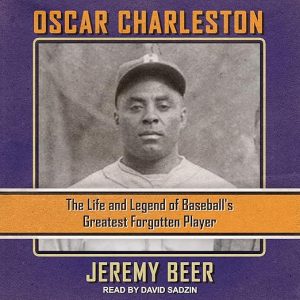
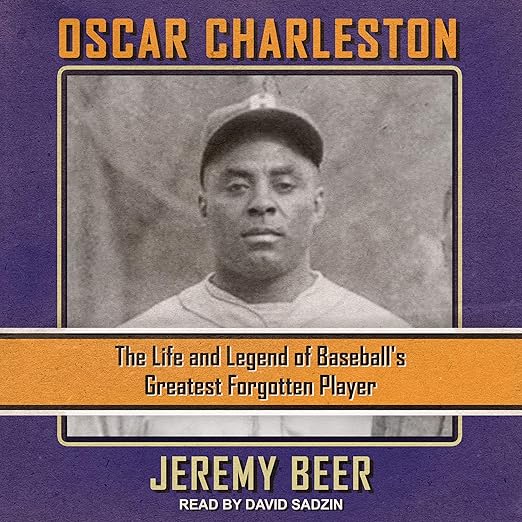
Buck O'Neil's line about Ty Cobb, Babe Ruth and Tris Speaker rolled into one man is doing enormous work on this listing, and my verdict up front is that Jeremy Beer's book earns the quotation instead of hiding behind it. Thirteen hours and twenty-four minutes on a player most serious fans could not pick out of a lineup, whose career ran from 1915 to 1954, and who is regarded among experts as the best in Negro Leagues history. The audiobook has one structural problem, which we will come to, and it has nothing to do with the writing.
The Sheer Weight of Association Is the Argument
Forgotten is the word every notice reaches for, and WDX2BB's four-star review does the best job of explaining the mechanism. Charleston played roughly a century ago in leagues that were loosely organized and thinly publicized at the time, and once you list the components his disappearance stops looking mysterious. No major league record, no newsreel canon, no statistical apparatus anybody trusted for decades afterward. That notice frames the whole thing as a checklist of reasons a person vanishes from a sport's memory, which is a far more useful frame than outrage would be.
Beer's answer to the problem is accumulation. The book stacks the career, the temperament and the company Charleston kept until the case makes itself: a man who played against, managed, befriended and occasionally fought Lou Gehrig, Jimmie Foxx, Lefty Grove, Satchel Paige, Josh Gibson, Jesse Owens, Roy Campanella and Branch Rickey, who became a legend in Cuba, and who ranked among the most popular figures in Black America during his prime. That is not the record of a supporting player, and the sheer weight of association is the argument.
Management is where the book finds its second life. Charleston worked as a player manager for several clubs from the mid-1920s onward, joined the Pittsburgh Crawfords in 1932 and went on to manage a team many consider the finest the Negro Leagues ever produced, carrying five future Hall of Famers in Cool Papa Bell, Josh Gibson, Judy Johnson, Satchel Paige and Charleston himself. He also became the first Black man employed as a scout by a major league team. Any one of those facts would anchor a biography on its own, and Beer has to keep all of them moving at once without letting the career become a list.
A Cast of Dozens Sadzin Must Keep Straight
Readability is what this pool agrees on, and it agrees loudly. John C. Kunich's notice reports finishing the entire book inside a few days because stopping was not an option, and credits Beer with bringing Charleston, Gibson, Paige and Bell to vivid life rather than merely documenting them. For a biography with this much archival labor behind it, that is the compliment that counts. The research is the price of entry in this genre; the storytelling is the actual product, and plenty of well-researched sports books never manage it.
Timothy Muldoon's notice identifies the second thing the book pulls off, which is that it doubles as a history of the leagues themselves across Charleston's playing years. That is a genuine bonus rather than padding, because a life this embedded cannot be told without the institutional story wrapped around it, and most readers arrive knowing the Negro Leagues as a phrase rather than as a functioning enterprise with seasons, rosters and rivalries of its own.
Tantor Audio produced this, David Sadzin is credited, and the production question worth naming is name density. This is a book carrying dozens of proper names across four decades, a great many of them belonging to people the average listener has never encountered, and a hired reader has to keep every one distinct and consistent from first minute to last with no visual anchor of any kind. That is the genuinely hard part of a biography like this one, and it gets decided in a studio rather than on the page. Get it right and the roster becomes a cast; get it wrong and it becomes noise you stop tracking somewhere in the second hour.
A Notice That Opens on the Wrong Product
No index is the structural problem, and on this particular book it bites harder than usual. A print reader who loses track of which Hall of Famer was playing where in a given season flips back and checks. A listener re-scrubs, guesses, or lets it go. Given how much of Beer's argument works by comparison, this player against that one, this season against that season, losing the ability to verify yourself is a real cost, and I would keep a text edition or at least a roster within reach.
Every visible notice on this page is grading print. They describe finishing the whole thing inside a few days, an excellent read, the best read of the year. That is a print pool grading print, so the 4.7 across 224 ratings should be treated as a verdict on Beer's prose and on nothing else. Paul Stratford's notice even opens on a tabletop baseball simulation and its booklet before catching itself and noting that this is a review for another product, which is honest of the reviewer and a useful reminder to read what a pool is actually grading.
The Biography and the Erasure Aren't Separate
Baseball readers will need no persuading, and Chuck Shonholtz's notice widens the audience correctly: anyone drawn to American history will find this works, because the story of why Charleston's name faded runs straight through segregation in the sport and then through decades of simply not writing about Black baseball afterward. The biography and the erasure are not separate subjects here. Recovering the player requires explaining the disappearance, and Beer does both at once without letting either job crowd out the other. That balance is the reason this works as history rather than as advocacy, and it is why the book can be handed to someone who came only for the baseball.
Statistics are not the argument here. What Beer builds instead comes from testimony, context and the shape of a career, which is partly a function of what the era's record-keeping actually preserved and partly a choice about what a life story owes a reader. Casual listeners with no stake in the sport will find thirteen hours a long commitment for one player. Newcomers to the Negro Leagues should treat this as a deep first stop rather than an easy one, because it assumes from the opening page that you can hold a great many names at once.
Do you need to know baseball to follow this audiobook?
It helps but is not required, because the framing is historical at least as much as athletic. What you genuinely need is patience for names, since the cast runs to dozens across four decades of clubs and leagues, and nothing on a recording will remind you who a given player was.
How much of this audiobook is about the Negro Leagues themselves?
A substantial share, and unavoidably so. The reasons Charleston's name faded are structural rather than personal, which means the leagues, the clubs and the color barrier have to be explained before the life makes sense. Expect institutional history braided through the biography rather than sitting beside it.