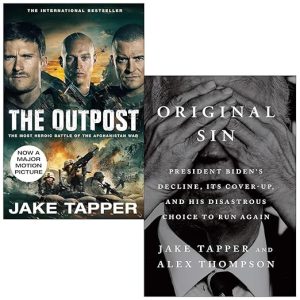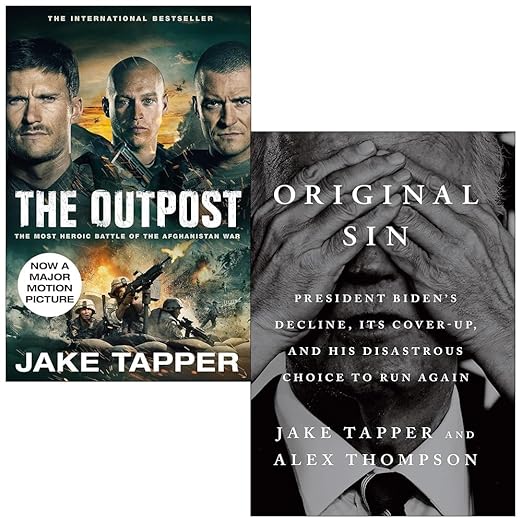
Somewhere on this page an audiobook is being sold, but the description opens with a shipping notice. Before a word about Joe Biden, before a word about anything at all, it announces which physical volumes will be sent to you, lists them by binding, hardcover and paperback, and closes on two UK book numbers. Underneath that copy sit a runtime of eleven hours and six minutes and a reader credit. Those two lines are the only things on this entire page that describe a recording.
Evaluation is not the first job on a page like this. A warning about what you can and cannot learn from the listing has to come first. Everything else on the page belongs to a printed two-book set: a page count of 1,056, an identifier in the product-code slot that is really a book number, and a publisher line beginning with an invisible formatting character left behind by whatever pulled the data across. Somebody merged a print bundle with an audio edition into a single entry, and nobody caught it.
Start with the practical consequence. The set described here contains two entirely different books: an account of Biden's decline and the 2024 debate, and a battle narrative about a remote outpost in Afghanistan in 2009. The title above the page says only Original Sin. The runtime is a single figure. Nothing anywhere tells you whether the recording covers the political book, the war book, or both, and eleven hours is a plausible length for either of them alone.
The second consequence concerns authorship. The copy states plainly that "two of America's best-respected political journalists" take the reader behind closed doors. The byline names one. Whoever the second writer is, this listing does not say, and a reporting book with a co-author whose name never appears is a real gap rather than a cosmetic one, because in this genre the reporting is the product and the reporters are the warranty on it. Books of this kind live or die on their sourcing, and a name you cannot check is a source you cannot weigh.
The Strengths
Set the page aside and the material described is strong. The political half is an account of a decision taken privately and defended publicly: that Joe Biden alone could win, and that his "condition and limitations" were therefore something to lie about, in the description's own words, to allies and to the public alike. The debate of 28 June 2024 is treated as the moment the deception stopped working. Narrow, reportable questions make the best political books, and that is a narrow reportable question.
Reporting reaches further than the White House itself, too. The description advertises an account of who knew, running "from White House staffers to senators to Hollywood celebrities", which is a wider net than these books usually cast and a more uncomfortable one, since it implies a shared silence rather than a single failure. Read as a book about institutions rather than about one man, it becomes considerably more interesting than another chronicle of a bad campaign.
The war book bundled beside it is a different kind of achievement and, judging by the copy, a more established one. A single attack at 5:58 in the morning on 3 October 2009, on an outpost fourteen miles from the Pakistani border, where fifty-three soldiers held off nearly four hundred attackers. Four months later a review found no reason for the troops to have been at Keating in the first place. Jon Krakauer's line about "heroism, hubris, failed strategy, and heartbreaking sacrifice" is quoted on the page, and it is a fair summary of the shape. The two subjects share nothing beyond an author, which is presumably the whole reason somebody thought to sell them together in one box.
Weak Spots in Original Sin
Nothing on this page confirms which book you are buying. That caveat outranks every other one, and I would not press play until the seller's own product page answers it. A listing whose description is a dispatch note for printed volumes is not a listing anybody has checked, and the one thing that would settle the question, a chapter list or a table of contents, does not exist anywhere here.
The metadata then contradicts itself in three separate places. A four-figure page count describes two bound books and cannot describe a recording of anything. The reference sitting where an audio product code belongs is itself a book number. And the publisher and language lines both begin with an invisible formatting character, the sort of debris left when text is pasted from one system into another. None of it is sinister. All of it means the page has not been read by a person.
Ratings tell you nothing either. Two of them produce the 4.5, which is arithmetically fine, since a pair of whole-star votes can land on precisely that figure. What it is not is evidence. Two people are not a sample, nobody has written a word, and on a book this politically contested the absence of written responses removes the only thing that would let you gauge who is buying it and what they made of it.
Finally, a word about the subject rather than the file. This is a book about a recent and unresolved political argument, published while the people in it are still active, and the description's framing leaves no doubt where it lands. Jake Tapper is credited as the reader as well as the writer, so the case arrives in the voice of the man making it. Some listeners will want precisely that. Others should know it before pressing play.
Recommended For
Political readers who follow White House reporting closely are the obvious audience, particularly those more interested in how information moves inside an administration than in the verdict at the end of it. The second book folded into this description will suit a partly different reader: military history, a single engagement reconstructed in detail, and an inquiry that concluded the position should never have been held at all. Anybody who follows neither subject closely will find the political half the easier entry, since it assumes almost no prior knowledge of the campaign it describes.
Everybody else should wait for the page to be fixed. That sounds like an evasion and it is not one, because the fundamental question, which book has been recorded, is not answerable from anything published here. Until the listing says plainly what has actually been read aloud, treat the description as a catalog of printed volumes and the recording itself as an unknown quantity.
- Voice: The author reads it himself, which on a book of contested reporting is a decision with a point of view attached.
- Big ideas: A president's decline, institutional silence, political reporting
- Atmosphere: Adversarial, insider-paced, contested
- Worth it?: The reporting is worth hearing, and the page it is being sold on has plainly not been checked by anybody.