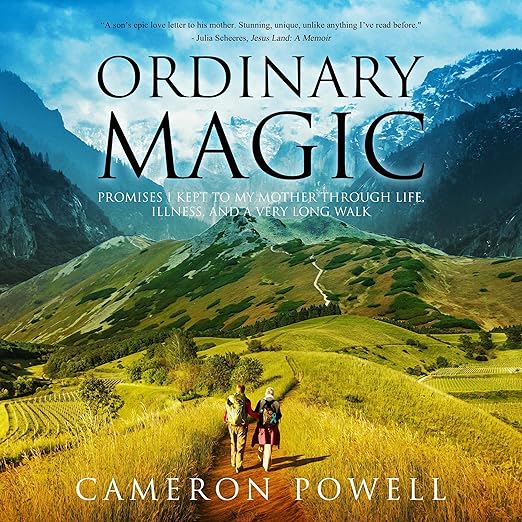
Cameron Powell narrates his own audiobook, which is itself a significant fact about Ordinary Magic. This memoir arrives in two distinct parts: the first, a funny and physically demanding account of walking the Camino de Santiago alongside his German-born mother, Inge, who at 67 chose a 500-mile trek across Spain over another round of chemotherapy. The second, written in real time as Inge's health declined years later, is something else entirely. Powell is a San Francisco author, attorney, and startup entrepreneur by background, but what he becomes on the page in those later chapters is harder to categorize and, for the right listener, harder to put down.
How Ordinary Magic Holds Up
The Camino section of the book is the more immediately pleasurable of the two. Powell does not sentimentalize the pilgrimage. He writes about it with what reviewer Grady Harp called a "keen sense of humor" that reads as earned rather than performed. The group that forms around Cameron and Inge on the trail, a politically direct Spaniard, a theatrical Frenchwoman, a teenager far from home for the first time, is a genuine ensemble, and Powell sketches them with enough specificity that their presences register. Inge, though, dominates these sections simply by being who she is: a woman who responded to a cancer recurrence by choosing blisters and altitude over a hospital ward.
Powell built the book from blog posts he wrote during both journeys, and that origin shows in the texture of the prose. The chapters are immediate and granular. There is no retrospective smoothing of rougher moments. That rawness is part of what made the original posts land with readers who followed them online, and Powell has preserved it here rather than editing toward a tidier emotional arc. The result is a memoir that feels lived-in rather than crafted after the fact, which is both its strength and, occasionally, its limitation.
Mary Dearborn, biographer of Hemingway and Henry Miller, called the book "studded with gems of spirited observation and wit" and described it as "almost impossible to put down." Novelist Julia Scheeres, who wrote Jesus Land, called it "an epic love letter." These are not lightweight assessments, and they track with what the book actually does. Powell is not simply narrating a pilgrimage or a death vigil. He is doing something the memoir form rarely manages with this kind of directness: showing how love functions as a practical act, hour by hour, when there is nothing comfortable left to say.
Why Ordinary Magic Works as an Audiobook
Powell's decision to narrate his own work is the right one. A professional narrator reading these chapters would impose a controlled distance that the material actively resists. The second half of the book, which covers Inge's final decline, is written in present tense and reads as a document produced in the middle of grief rather than at its far edge. Powell's voice carries the weight of that. He does not perform sorrow; he inhabits it, and the effect over 10 hours and 19 minutes is cumulative rather than overwhelming at any single point.
The transition between the Camino narrative and the second section is worth preparing for. Powell structures the jump across a gap of three years, and the tonal shift is deliberate. The Camino chapters are adventurous, outward-facing, and frequently funny. The later chapters pull inward. Some listeners expecting the lighter register of the pilgrimage story have found the second half difficult to sit with, not because it is overwrought, but because it is not. Powell's restraint in those final chapters is what makes them effective, and that restraint requires patience from the listener who arrived for a travel memoir.
Weak Spots in Ordinary Magic
The memoir carries what Powell described as a "lifelong fascination with the human mind and heart." This shows up in intermittent analytical passages where he steps back from narrative to reflect on Inge's psychological resilience or on his own responses to grief. These sections work unevenly. When they are tied closely to specific moments, they add dimension. When they move toward general observation, they risk the lecture quality that memoir analysis sometimes slips into. The balance is imperfect but does not damage the larger work.
Reviewer Nancy J., who noted she prefers fiction, was "captured by Powell's wit, honesty, and tenderheartedness." That description is accurate and worth holding onto as a forecast of the experience. The wit is real, and it survives the book's most difficult passages. Powell never abandons humor entirely. Even in the sections about Inge's decline, there are moments where the absurdity of how we navigate grief surfaces, and he does not look away from them. That willingness to stay in the full range of emotional experience rather than elevate only the noble and moving parts is what gives the memoir its durability and what makes the ten-hour listening commitment feel proportionate to what the book delivers.
The Right Listener for Ordinary Magic
This audiobook is for listeners who read memoir seriously and are not put off by emotional directness that arrives without protective irony. Fans of Bill Bryson's trail writing will find the Camino section very much in that register, though Powell's stakes are considerably higher. Fans of C.S. Lewis's A Grief Observed or Joan Didion's grief writing will find the second half more familiar in its ambitions. The book is probably not the right fit for listeners looking for a straightforward adventure narrative or a tidily resolved inspirational arc. It is uneven in the way authentic documents of real experience tend to be, and that unevenness is part of what makes it honest.