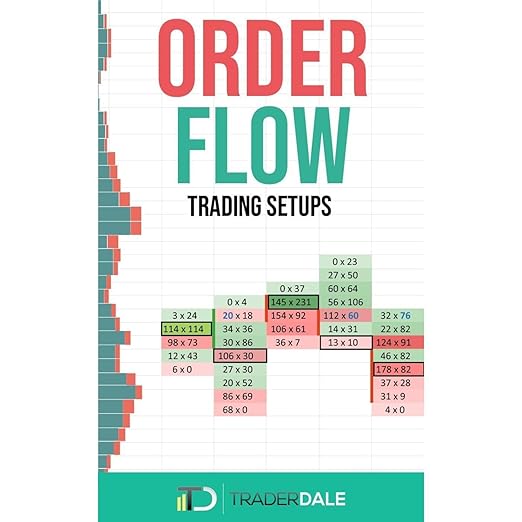
Quick Take
- Narration: Virtual Voice narration makes this a functional but cold listening experience; the synthesized delivery works for technical content but strips any sense of the author’s personality from the material.
- Themes: Institutional order flow analysis, Volume Profile integration, reading real-time market supply and demand
- Mood: Dense and methodical, best treated as a reference listen rather than a single pass
- Verdict: Useful as a second read after Trader Dale’s Volume Profile book, but newcomers to institutional trading concepts will likely find this confusing without that foundation first.
I was somewhere between a report on bid-ask imbalances and a section on delta footprint charts when I realized that ORDER FLOW: Trading Setups is a book that absolutely requires the right context to work. I came to it without having read Trader Dale’s earlier Volume Profile title, and the experience was a bit like walking into the third act of a film: the logic was visible, the terminology was consistent, but the connective tissue I needed was missing. That is not a fatal criticism, and it is actually the most honest thing I can tell potential listeners up front. Reviewer AO on Audible put it clearly: read Volume Profile first, then consider this one.
For those who have done that groundwork, ORDER FLOW: Trading Setups functions as the second half of a coherent system, explaining how real-time order flow data fits into and refines the framework of volume-based market analysis. The book is part of The Insider’s Guide To Trading series, and the sequencing within that series is not incidental; it is essential to how the content is designed to be used.
What Trader Dale Actually Teaches Here
The core concept is straightforward in principle and genuinely complex in execution. Rather than relying on lagging indicators derived from price action, Trader Dale’s approach looks directly at the flow of orders in the market, particularly the behavior of institutional participants, to identify where significant buying and selling pressure is concentrated. The book covers absorption, delta imbalances, bid-ask footprints, and zones of interest that emerge from the interaction between large buyers and sellers. The argument is that these signals are more timely and more revealing than conventional technical analysis because they show what is actually happening in real time rather than summarizing what already happened.
The setups Trader Dale describes are built around his particular combination of Volume Profile and Order Flow, and they are presented with specific entry and exit logic, risk management parameters, and real trade examples. Reviewer Solomon described the book as a well-organized primer on stock movements influenced by big institutions, which captures what it does best: it takes the abstract concept of institutional participation and translates it into pattern recognition that an individual trader can attempt to replicate. Reviewer Jose G. noted that the content is practical and direct, with visual examples that help identify entries, continuations, and reversals based on actual buyer-seller interaction. That endorsement holds, with the caveat that the visual examples exist in the print and PDF format rather than in the audio.
The Virtual Voice Problem and the Format Mismatch
The audiobook uses Virtual Voice narration, which is now common enough in the independently published trading space that listeners have to make a deliberate choice about whether the format serves them. For technical content with a lot of numerical specifics and visual chart references, the synthesized delivery is a genuine limitation. Order Flow analysis is inherently visual; footprint charts, delta histograms, and volume profile distributions are tools that traders see on screens, not describe in prose. The audio format strips away that visual layer, and the Virtual Voice narration adds nothing in its place by way of emphasis, pacing, or interpretive inflection.
This is not a knock against the content, which Reviewer Meagan L. described as genuinely illuminating on how order flow works, with a YouTube channel that extends the learning further. It is simply a format mismatch that listeners should weigh carefully before committing to the audio version. Treating the audio as a conceptual overview and then supplementing with the visual materials from Trader Dale’s other resources seems like the most productive approach rather than expecting the audio alone to build the required competency.
Sequencing, Prerequisites, and What You Will Actually Get
At just under two and a half hours, this is a brief audiobook for a technically dense subject. The runtime reflects the book’s design as a focused extension of earlier work rather than a standalone introduction. Listeners who treat it as a standalone are likely to find it incomplete, and the Audible reviews reflect exactly that split: traders already familiar with Volume Profile concepts find the content practical and actionable, while newcomers find it assumes too much prior knowledge. The specific setups described, including aggressive order flow entries, continuation patterns, and reversal signals based on absorption, are presented with enough detail to be studied, but the underlying vocabulary needs to be in place first.
Listen if you have already worked through Trader Dale’s Volume Profile title and want to add real-time order flow reading to your analytical toolkit. Listen if you trade futures or forex and are looking for a framework built around institutional footprints rather than conventional technical indicators. Skip if you are new to trading or new to volume-based analysis; the prerequisite work is not optional here, and starting with this book cold will produce confusion rather than insight. Skip also if you require a human narrator to engage effectively with dense technical material, since the Virtual Voice delivery is functional but uninspiring and lacks the interpretive warmth that makes complex content easier to retain.
Before You Buy: Prerequisites and Honest Expectations
At just under two and a half hours, this is a brief audiobook for a technically dense subject. The runtime reflects the book’s design as a focused extension of earlier work rather than a standalone introduction. Listeners who treat it as a standalone are likely to find it incomplete, and the Audible reviews reflect exactly that split: traders already familiar with Volume Profile concepts find the content practical and actionable, while newcomers find it assumes too much prior knowledge and too much visual context that the audio format cannot convey.
Listen if you have already worked through Trader Dale’s Volume Profile title and want to add real-time order flow reading to your analytical toolkit. Listen if you trade futures or forex and are looking for a framework built around institutional footprints rather than conventional technical indicators. Skip if you are new to trading or new to volume-based analysis; the prerequisite work is not optional here, and starting with this book cold will produce confusion rather than insight. Skip also if you require a human narrator to engage effectively with dense technical material, since the Virtual Voice delivery is functional but uninspiring and lacks the interpretive warmth that makes complex content easier to retain over time.
Frequently Asked Questions
Do I need to read Trader Dale’s Volume Profile book before listening to ORDER FLOW: Trading Setups?
Multiple reviewers, including one who read both books, strongly recommend it. The order flow concepts in this book are built on the Volume Profile framework, and listeners who skip the first book will encounter terminology and assumptions that are not fully explained here.
Is the Virtual Voice narration a significant problem for understanding the content?
For conceptual listening, it is functional. But order flow analysis is inherently visual, relying on footprint charts and delta histograms that cannot be fully conveyed in audio. Listeners should plan to supplement the audio with the written book, the PDF, or Trader Dale’s YouTube channel for the visual component.
What markets is this trading approach designed for?
Trader Dale’s Order Flow methodology is primarily designed for futures and forex markets where detailed order flow data is accessible through footprint chart software. Stock traders may find some concepts applicable, but the data infrastructure the approach relies on is most readily available in those markets.
At two and a half hours, is this too short to be genuinely useful?
The brevity reflects the book’s design as a focused extension of prior work rather than a comprehensive standalone guide. Listeners who have the Volume Profile foundation in place will likely find the runtime appropriate. Those expecting a complete trading education in one package will be disappointed.