Quick Take
- Narration: Neil Macgillivray brings a Scottish lilt to the Orcadian material that adds real texture to Edmonds’s lyrical prose, grounding the ancient landscape in the right sonic register.
- Themes: Neolithic community and monument-building, landscape as historical evidence, the limits of archaeological knowledge
- Mood: Contemplative, evocative, and occasionally speculative
- Verdict: A beautifully written archaeology of Neolithic Orkney that will absorb listeners who want their prehistory poetic as well as rigorous, though its speculative passages will irritate those who prefer hard evidence.
I listened to the middle section of Orcadia on a rainy Tuesday afternoon when the weather outside matched what I imagine the Orkney Islands feel like in November: grey, horizontal, and absolutely indifferent to your presence. It was the right atmospheric condition for Mark Edmonds’s book, which is not really an archaeology text in the conventional sense. It’s something harder to categorize: part scholarly reconstruction, part landscape writing, part meditation on what it means to try to know people who left no written record and have been dead for five thousand years.
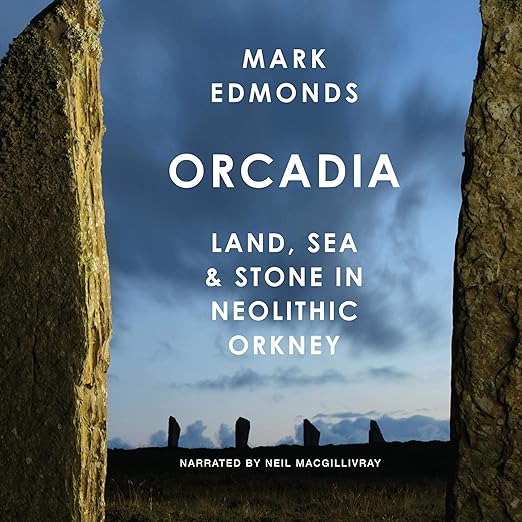
The Orkney archipelago is home to some of the most remarkable Neolithic monuments in the world. The Ring of Brodgar, the Stones of Stenness, the passage grave at Maeshowe, the village of Skara Brae. Edmonds has spent serious time on and around these sites, and that intimacy shows on every page. He is not writing about Neolithic Orkney from the outside; he is writing from the middle of it, and the difference in texture is immediately apparent.
Our Take on Orcadia
Edmonds’s central project is to trace the development of Orcadian Neolithic society from its beginnings in the early 4th millennium through the end of the period nearly two thousand years later. He uses artifacts, architecture, and the wider landscape as his evidence base, following a broadly chronological structure while moving between different kinds of evidence as they become relevant. What he does unusually well is frame the limits of that evidence honestly. He is clear about what archaeology can and cannot tell us: what the physical remains reveal, what they suggest, and what remains genuinely unknown after a hundred and fifty years of investigation.
The connections between Neolithic Orkney and other Neolithic societies, in Ireland, in southern Britain, at the western margins of Continental Europe, are one of the book’s most interesting threads. These weren’t isolated communities. The cultural and material links visible in the archaeological record suggest something more like a network of connected societies, and Edmonds traces those connections without overstating what can be known about their nature. This kind of intellectual discipline, holding the evidence firmly while acknowledging its gaps, is rarer in popular archaeology writing than it should be.
Why Listen to Orcadia
Neil Macgillivray’s narration is a significant asset. His Scottish inflection sits naturally with the Orcadian material, and the pace of his reading suits Edmonds’s prose, which moves between close archaeological description and wider landscape meditation in ways that require a narrator who can handle both registers without jarring the transition. Macgillivray doesn’t rush the lyrical passages or flatten the more technical sections, and the result is a listening experience that respects the writing’s range.
The opening discussion of Orkney’s environment and ecology, which at least one reviewer specifically praised for how it frames everything that follows, is among the audiobook’s best stretches. Understanding how the Orcadian landscape shaped the possibilities for settlement and monument-building changes how you receive the later archaeological analysis. Edmonds makes a persuasive case that landscape is not backdrop to Neolithic social life but constitutive of it, and that argument is more convincing in audio, where you can hear Macgillivray move between describing the land and describing the people who lived in it.
What to Watch For in Orcadia
The book’s reception is divided in ways that are worth understanding before you start. Readers who come to it wanting lyrical, humanizing archaeology, who want to feel the Neolithic communities as communities of people rather than as object assemblages, will find it exactly what they’re after. The reviewer who called it “refreshingly accessible” and “a joy to read” is responding to this quality. The reviewer who found it “WAY too romantic” and stopped a hundred pages in is responding to the same quality and finding it a distraction from verifiable fact.
Edmonds does speculate. He imagines what social and political interests monuments might have served, what the nature of connections between communities might have been, in ways that go beyond what the physical evidence directly supports. He generally signals when he’s doing this, but not always with the explicitness that more empirically minded readers would prefer. If you want claims to be tightly tethered to direct archaeological evidence, the book’s lyrical reconstructions will frustrate you.
Who Should Listen to Orcadia
Listeners who have visited the Orkney Islands, or who plan to, will find this audiobook a deeply enriching companion. Edmonds’s descriptions of the landscape and monuments will change how you look at them. More broadly, this is for anyone drawn to that specific zone where archaeology meets landscape writing, where the question of how people lived five thousand years ago is approached with imagination as well as evidence.
Skip it if you expect academic archaeology to stay strictly within the bounds of evidenced argument. This is not a polemic or an unscholarly book, but its author believes that imagining the past responsibly is part of the archaeologist’s work, and not everyone will agree with that premise.
Frequently Asked Questions
Do you need prior knowledge of Neolithic archaeology or Orkney history to follow Orcadia?
No. Reviewers specifically noted that Edmonds makes no assumptions about prior knowledge and is never simplistic or patronising. The opening discussion of environment and ecology provides all the context a newcomer needs.
Is Orcadia more academic or popular in its approach?
It sits deliberately between the two. Edmonds is a professional archaeologist and the scholarship is serious, but the writing style is lyrical and accessible rather than technical. One UK reviewer described it as ‘wonderfully well written and evocatively posed,’ though noted its speculative passages as a weakness.
Does Neil Macgillivray’s narration add to the experience of an Orkney-set archaeology book?
Yes, meaningfully so. His Scottish inflection grounds the material in its geographic and cultural context in a way that a neutral accent would not, and his pacing suits Edmonds’s movement between lyrical description and archaeological analysis.
How speculative is the book’s reconstruction of Neolithic Orcadian society?
There is genuine speculation, particularly around social and political organization. Edmonds usually signals when he’s inferring beyond the direct evidence, but some reviewers found the speculation excessive. The best approach is to treat the book as a rigorous imaginative reconstruction rather than a statement of established fact.