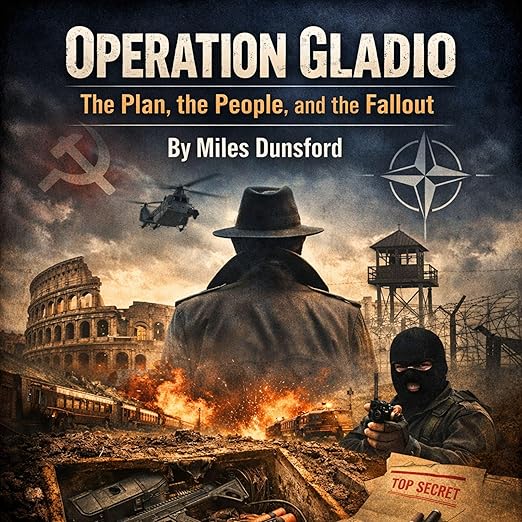
Quick Take
- Narration: Michael Prichard delivers with the measured gravity that Cold War intelligence history requires, authoritative and unsensationalized.
- Themes: covert state power and democratic accountability, Cold War shadow networks, the intersection of intelligence, crime, and politics
- Mood: Methodical and unsettling, the kind of history that makes you reconsider assumptions about the postwar Western order
- Verdict: A well-researched account of one of the Cold War’s most consequential and least-discussed covert programs, rendered accessible without sacrificing depth.
Some books have the quality of a door opening onto a room that has always been there. Operation Gladio was that book for me. I came to it aware of the name, which occupies a specific position in the literature on Cold War covert operations, but without a detailed understanding of how the network functioned, who built it, or what happened when it was exposed. I listened to most of it on a long drive through an overcast afternoon, which turned out to be the appropriate atmospheric context for a book about shadow armies hidden in the infrastructure of Western democracy across the postwar decades.
The stay-behind networks that NATO and various national intelligence services constructed across Western Europe after World War II were designed for a specific contingency: Soviet invasion and occupation. If Soviet forces moved into NATO territory, pre-positioned resistance cells, trained personnel, hidden weapons caches, and concealed communication equipment would activate and keep guerrilla resistance alive behind enemy lines. The network was professionally built, patiently maintained, and protected by layers of deniability. Names were compartmentalized. Plans were sealed. Ordinary citizens lived their lives never knowing the shadow army had been prepared. The Soviet invasion never came. And the world eventually discovered that the network had not spent the Cold War years simply waiting in readiness.
What the Book Argues and How It Does So
The author frames Operation Gladio as a story about the gap between institutional intention and operational reality. A stay-behind network designed for resistance against Soviet occupation necessarily had to be staffed with people willing to operate outside normal legal and political frameworks. Those people, and the organizations they built, did not vanish when their original purpose became moot. The connections the book draws between the Gladio networks and specific historical events, the Aldo Moro kidnapping, the Bologna railway station bombing of 1980, the attempted assassination of Pope John Paul II, are the most contested and most important parts of the argument.
One reviewer with direct memory of the Italian political landscape of the 1960s through 1980s found the documented events consistent with what they experienced as contemporaneous news coverage from behind the Iron Curtain and through Italian cinema that captured the era’s atmosphere of confusion and violence. Another notes sixty pages of endnotes backing the research. The book presents its case as documented history rather than speculation, which is the appropriate register for material this serious, and it invites critical engagement with its sourcing rather than demanding that readers simply accept its conclusions on faith.
Michael Prichard and the Weight of Documented History
Michael Prichard is one of the more reliable narrators in serious nonfiction audio, and he handles this material with the gravity it requires. The temptation with a subject like this is to lean into a conspiratorial register, the breathless revelation mode that encourages listeners to feel they’re receiving forbidden knowledge rather than reading documented history. Prichard avoids this almost entirely. His delivery is measured and clear, which is the appropriate register for a book that grounds its claims in documented sources and end notes.
When the material is genuinely shocking, and it is, the low-key delivery makes it more disturbing rather than less. Facts delivered in a calm, authoritative voice carry more weight than the same facts dramatized. Prichard seems to understand this, and across nearly twelve hours he sustains a consistent tone that lets the historical record speak for itself rather than amplifying it with performance. It is one of the cleaner examples of how the right narrator can serve difficult material.
The Document Versus the Conspiracy
It would be easy to listen to Operation Gladio and conclude that everything you thought you knew was a lie, which is how one reviewer described their reaction. That response is understandable but worth moderating with critical thought. The network’s existence is not disputed: Italian Prime Minister Giulio Andreotti confirmed it to the Italian parliament in 1990, triggering the political shockwaves the synopsis references. What remains genuinely contested is the extent to which the network was responsible for specific acts of political violence during the strategy of tension period in Italy. The book presents its case with documented sourcing, but readers should engage with it as one well-evidenced argument rather than as a settled and complete account. The history of Cold War covert operations is, by design, one where complete certainty remains elusive and probably always will.
Another reviewer describes the book’s breadth of information and attention to detail as its primary strength, noting that it illuminates many contemporary world events and activities by naming players, organizations, and backing claims with documented research. That’s an accurate account of what makes this listen valuable: not the thrill of secret knowledge but the sober documentation of decisions that had real consequences for democratic governance across Western Europe for decades.
Who Needs to Hear This and Who Will Find It Challenging
Listeners interested in Cold War history, intelligence studies, European political history, and the relationship between democracy and covert state power will find this one of the more substantive audiobooks available on the subject. The book’s geographic focus is largely European, particularly Italian, which reflects both where the network’s activities were most extensively documented and where the political consequences were most visible. American listeners may find the European political context requires some additional background, though the book provides enough framing to follow the argument without prior specialization. Listeners who are skeptical of intelligence agency culpability in Cold War events will need to engage with the sourcing rather than simply dismissing the conclusions. Those willing to sit with uncomfortable documented history will find twelve hours well spent and their understanding of postwar Western politics meaningfully altered.
Frequently Asked Questions
Is Operation Gladio’s existence historically confirmed, or is this primarily a conspiracy theory book?
Its existence is confirmed. Italian Prime Minister Andreotti disclosed it to the Italian parliament in 1990. The CIA and British intelligence involvement has been acknowledged. What remains contested is the specific connection of the network to acts of political violence during the Cold War period.
How does this audiobook relate to Paul L. Williams’ book of the same name versus other accounts of Operation Gladio?
The metadata lists Paul L. Williams as author with a Tantor Audio 2015 release, while the synopsis describes a different author framing. Both address Operation Gladio but may represent different interpretive takes on the same historical subject. Listeners should verify author attribution before purchasing.
Is this audiobook primarily about Italy, or does it cover the broader European network?
While Italy receives the most detailed treatment, because Italian disclosures were most extensive and the political consequences most visible, the book addresses the network’s presence across Western Europe including Germany, Greece, Belgium, and Portugal.
How does Michael Prichard’s narration handle the balance between documented history and more speculative claims?
Prichard’s measured, authoritative delivery treats all material with consistent gravity, which works in the book’s favor. He doesn’t signal which claims are more or less contested, so listeners should engage their own critical judgment when the argument moves from confirmed facts to drawn connections.