- Read by: Douglas Birk's voice replica is AI-generated; clear and consistent for procedural content, but lacking the interpretive emphasis a human narrator brings.
- At its heart: self-hosted AI, privacy and data control, practical AI setup without coding
- Vibe: Methodical and instructional, like a patient technical workshop
- Short version: A focused, honest guide for non-developers who want a private AI assistant with real cost and data control; best consumed with supplementary materials open alongside.
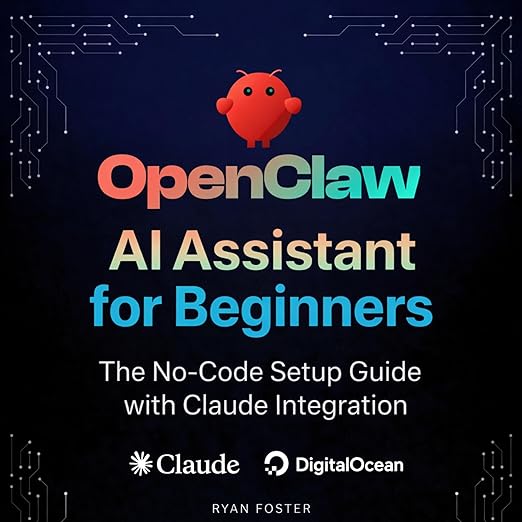
Ryan Foster's OpenClaw AI Assistant for Beginners is a practical technical guide dressed as an audiobook, and it comes with a very clear purpose. This audiobook was designed for the person who wants to build a private, self-hosted AI assistant on their own machine and has found developer-oriented documentation too opaque to follow. Foster spent nine years implementing AI systems in enterprise environments before writing this, and that background shapes the book's sensibility in ways that pure content-creator AI guides rarely match.
Narrated by Douglas Birk's voice replica, an AI-generated voice rather than a human performance, this is a production worth approaching with calibrated expectations. The delivery is intelligible and clean, which matters enormously for step-by-step technical instruction where clarity outweighs warmth. The question is whether it delivers what its target audience actually needs, and for the most part, it does.
Foster Hit the Walls Before Writing This
Foster is not a content creator explaining AI concepts for general curiosity. He is a solutions engineer who has hit the practical walls, API cost overruns, privacy concerns with third-party servers, integrations that break when services change their terms, and the book reflects that experience. The emphasis on cost controls, token limits, and data privacy is not boilerplate. It reads like someone who has fielded the calls when those things go wrong.
The scope is specific: install OpenClaw, connect it to the Claude API, set up a Telegram bot integration, add skills from ClawHub without touching code, and optionally deploy to cloud hosting. Foster walks through each step for Mac, Windows, and Linux. The audiobook edition includes installation walkthroughs covering every major operating system, detailed API integration guidance across Claude Sonnet, Opus, and Haiku model tiers, and a troubleshooting section using OpenClaw Doctor diagnostic tools. For a 3.5-hour runtime, it covers substantial practical ground.
Birk's Voice Replica Can't Flag Missed Steps
The narration requires an honest note. Douglas Birk's voice replica is AI-generated, not a human performance. The delivery is intelligible and consistent, which matters for procedural technical instruction where the listener needs to follow sequential steps. What the voice replica cannot provide is the interpretive judgment a human narrator brings, the subtle emphasis that signals 'this step is the one people miss' or the slight pause before a warning. Listeners accustomed to technical audiobooks narrated by experienced voices will notice the difference. For the practical purpose this book serves, it is workable, but it is worth knowing in advance.
The intended audience is clearly defined: writers and researchers who want AI assistance without routing their drafts through third-party servers, small business owners building a private team AI, privacy-focused users who want genuine data control, and freelancers working with sensitive client information. Foster frames the case for self-hosting with clear economic logic: subscription AI services change pricing, change terms, and change capabilities without warning. A self-hosted assistant with predictable API costs and no data retention on third-party servers is a genuinely different proposition, not just a technical preference.
Command-Line Comfort Is Still Required Here
A few things are worth flagging before you start. This is a book about a specific platform, OpenClaw, built around a specific API. If Anthropic changes its API structure or OpenClaw changes its installation process after this audiobook was recorded, some instructions may become dated. That is an inherent limitation of any platform-specific technical guide in audio format, where updates cannot be patched. The book's publication date is therefore worth checking against current OpenClaw documentation before following any specific steps.
The 'no programming required' claim is accurate within the book's scope, but listeners should understand that managing a self-hosted AI assistant still requires comfort with command-line interfaces, basic troubleshooting, and reading error messages. Foster does not assume coding knowledge, but he does assume a willingness to work methodically through technical steps. The audiobook format also means you cannot pause on a screenshot or copy a command from a printed page, so having a companion device or the supplementary materials open alongside the audio is essentially required for the installation sections.
The 3.5-hour runtime is efficient for the scope it covers, but that efficiency means each topic receives a concentrated treatment. Listeners who want a deeper conceptual grounding in how large language model APIs work, or who want a broader survey of self-hosting options beyond OpenClaw specifically, will need to supplement with additional reading. This book is a practical guide to one specific setup, and it is best evaluated on those terms.
One detail worth noting for prospective buyers: the book's title mentions OpenClaw, which is not a household name in the way that more prominent AI tools are. Foster dedicates the early sections to explaining what OpenClaw is and why it exists before moving into setup, so new listeners are not dropped into unfamiliar terminology without context. That orientation section is one of the more effective parts of the audiobook, setting realistic expectations about what self-hosting actually involves before any commands are typed.
Privacy-Conscious Writers Will Value Foster's Approach
This audiobook suits privacy-conscious professionals who have wanted to build a personal AI assistant but found developer-oriented documentation too opaque. Writers, researchers, consultants, and small business owners who work with sensitive material and want genuine data control will find Foster's approach practical and well-considered. Technical professionals who already work with APIs or cloud infrastructure will likely find the pace slower than necessary and the explanations more foundational than they need. The AI-generated narration is the main caveat: functional but without interpretive warmth, and worth knowing about before you start listening.
Is the OpenClaw AI audiobook narrated by a human or an AI voice?
The narrator credit is Douglas Birk's voice replica, which means this is an AI-generated voice performance, not a human narrator. It is intelligible and clear, but lacks the interpretive warmth and emphasis of a human performance.
Does this audiobook cover the latest version of OpenClaw and the Claude API?
The book reflects the OpenClaw and Claude API state at time of recording. Since both platforms update regularly, some specific steps or model names may differ from current documentation. Verify against current OpenClaw docs for installation steps.
Can I follow the audiobook installation steps while listening, or do I need to pause constantly?
The installation chapters effectively require a companion device. You cannot copy commands from audio, so having OpenClaw's documentation or supplementary materials open alongside the audiobook is strongly recommended for the setup sections.