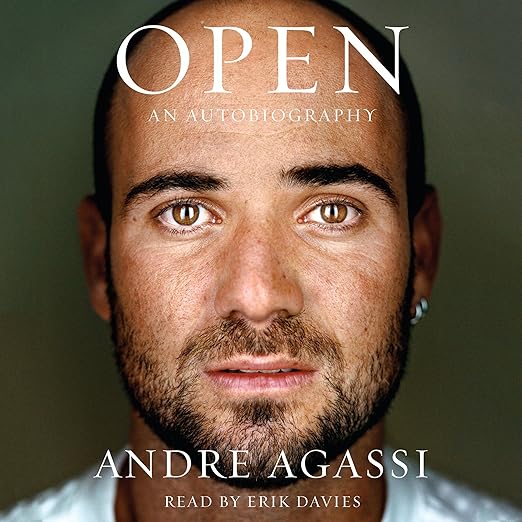
- Performance: Erik Davies finds Agassi's voice without caricaturing it, his handling of the match sequences and the introspective sections alike keeps eighteen hours from feeling long.
- What it covers: the cost of prodigy, performing brilliance under compulsion, identity reconstruction after elite sport
- Feel: Candid and psychologically dense, with an undertow of earned grief
- Our call: One of the more honest and literarily crafted sports memoirs in audiobook form, Agassi and Moehringer's collaboration produces something that outlasts the career it documents.
Andre Agassi's childhood sessions with his father and the ball machine, the machine his father called "the dragon", are rendered in this audiobook with a specificity that sets Open apart from virtually every sports memoir I have come across. I came to it expecting the standard career retrospective. What I found was something considerably more disquieting and honest.
Excelling at What He Profoundly Resents
Agassi's collaborator on this memoir is J.R. Moehringer, a Pulitzer-winning journalist, and the craft of the writing shows in every chapter. This is not an autobiography assembled from press conference transcripts; it is a book that genuinely tries to understand how a person can spend the better part of two decades excelling at something he profoundly resents. Agassi hated tennis. He says so clearly and early. He won eight grand slams at the highest level of a sport he had come to despise by his early twenties, driven there by a father who saw him not as a child but as a project. That central tension, performing brilliance in the service of someone else's dream, gives the book a psychological complexity that most sports memoirs never approach.
The coverage is genuinely comprehensive: his turbulent early career, his marriage to Brooke Shields and its dissolution, his relationship with Steffi Graf, his admitted methamphetamine use and the false claim he made to the ATP about a positive test, his declining years, and his return to form before retirement. Agassi writes candidly about all of it, and the candor is not performative. It is the product of someone who appears to have decided, finally, to be honest about what his life actually cost.
Davies Avoids Any Vocal Tic or Impersonation
Erik Davies narrates this audiobook, and his performance is one of the stronger reasons to choose the audio format over print. Davies captures Agassi's voice without doing an impersonation, there is no vocal tic signaling "I am performing Andre Agassi now." Instead, he finds a register that sounds like how a thoughtful, guarded person might actually speak when they have decided to stop being guarded. His handling of the match sequences, which Agassi describes in point-by-point detail across many pages, is particularly impressive. Tennis is a difficult sport to render in prose or audio because its drama is accumulative and incremental, and Davies keeps those sections taut without artificial urgency.
One reviewer described the memoir as far superior to the standard sports autobiography format, noting that Agassi provides insight that "differs from what he already gave in press conferences." That observation identifies exactly what Moehringer's craft brings to the project: the ability to get past the prepared answers and into something that feels discovered rather than curated. Davies's narration serves that discovery because he never sounds like he is reading something composed in advance; the delivery has the texture of someone speaking from memory.
Sentences Constructed for the Ear as Much as the Eye
At eighteen hours and four minutes, Open is a long audiobook. Its length is not padding; the career being documented spanned two decades at the highest level of professional sport, and the psychological texture requires time to develop. But listeners should know that the book is as interested in Agassi's interior life as in his matches, and the ratio of introspection to on-court action is roughly even. Readers who want primarily a tennis history will find this heavier on psychology than they might expect.
The book's treatment of the methamphetamine episode is brief relative to the public attention it received. Agassi covers the drug use, the positive test, and the lie he told to the ATP, but the memoir's emotional gravity sits elsewhere, in the relationship with his father, in the marriage to Shields, in the long process of discovering who he actually was outside the game. Some readers have found this proportioning accurate; others have wanted more sustained engagement with the drug story. That is a matter of expectation calibration rather than a genuine flaw.
The philanthropy work in Las Vegas, which Agassi built into one of the more significant outcomes of his later career, receives meaningful coverage in the memoir's final sections. For listeners interested in the full arc of how someone rebuilds meaning after the career ends, this section is substantive and not merely a feel-good appendix. It is also, notably, where Agassi sounds most settled.
One element that makes the audio format particularly suited to this memoir is Moehringer's sentence-level craft. His sentences are constructed to be heard as well as read, with rhythms that build and release in ways that work naturally at speaking pace. Davies understands this, and his delivery does not iron out the prose's pacing but rather follows it. Listeners who have read the print edition and found it effective may be surprised to discover how much the audiobook adds to the same text.
Eighteen Hours That Feel Shorter Than They Are
This audiobook rewards listeners across several audiences: tennis followers who want to understand Agassi's career from the inside rather than from a statistics sheet; memoir readers interested in the psychology of elite performance and the costs of prodigy; and anyone who has ever built a life around something someone else wanted for them and had to find their way to something genuine afterward. This is not a book that rewards only sports readers. It is one of the better accounts of the gap between external success and internal coherence in the memoir genre, and Erik Davies's narration makes the eighteen hours feel shorter than they are, which is the surest mark of a successful audiobook performance.