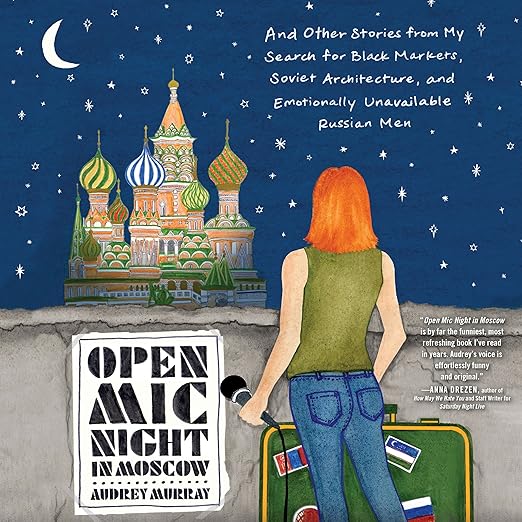
- Voice: Emily Woo Zeller matches Murray's comic timing with precision, capturing both the absurdist set pieces and the quieter, more searching emotional beats underneath them.
- Big ideas: Solo female travel through the former USSR, comedy as a coping mechanism, loneliness and independence as twin states
- Atmosphere: Chaotic and funny with a genuine current of vulnerability running underneath
- Worth it?: Murray's nine-month solo traverse of the former Soviet republics is an unusual travel memoir, genuinely funny and unexpectedly moving, and Zeller makes it even better as an audiobook.
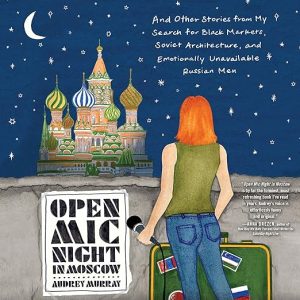
Audrey Murray arrived in Kazakhstan at twenty-eight on a one-way ticket, speaking no Russian, with a loose plan to perform stand-up comedy across nine former Soviet republics over nine months. The resulting audiobook of Open Mic Night in Moscow is one of those rare travel memoirs where the premise is exactly as improbable as it sounds and the execution is better than you have any right to expect. Emily Woo Zeller narrates with the kind of comic precision that serves Murray's voice without flattening it, and the result is 12 hours and 46 minutes that feel like excellent company on a long drive through somewhere unfamiliar.
The scene that sets the audiobook's tone best might be the Turkmenistan kidnapping, rated by Murray herself as 1 star in the mock travel-guide format she occasionally deploys alongside the narrative. That moment captures what makes the audiobook work: Murray is funny in the specific way that only comes from genuine alarm that has been processed into clarity after the fact, and Zeller understands that the comedy and the anxiety are not competing elements but the same experience wearing different faces. She delivers both with equal conviction.
The Verdict, Briefly
What distinguishes Murray's memoir from the crowded field of young-woman-travels-alone narratives is her subject matter. Not Western Europe or Southeast Asia or South America, but the former Soviet Union, specifically the republics that Western travel writing tends to skip entirely. Kazakhstan, Belarus, Uzbekistan, Tajikistan, Siberia, Turkmenistan. Murray describes the peculiar mix of imperial Russian opulence and Soviet decay that she found irresistible, and she is honest about the less flattering aspect of her obsession: a recurring pattern of attraction to emotionally unavailable Russian men that she both mocks and examines with genuine self-awareness rather than comfortable retrospective wisdom.
Reviewer Suzanne noted laughing out loud repeatedly, enough to make her husband keep asking what was happening. Reviewer Robert J. Curtis was struck by the sheer improbability of what Murray did, the practical willingness to get into strangers' cars in foreign countries without a shared language. Reviewer Amazon Customer inhaled the whole audiobook on a flight to India and found the timing perfect for processing what it means to be somewhere unfamiliar. All three responses are accurate simultaneously, and the audiobook holds them together without forcing resolution between them.
The audio format gives Murray's comic timing a direct channel that the printed page cannot quite replicate. This is a book that benefits from being performed rather than silently read, and Zeller is a narrator with real comedic instincts. She does not oversell the jokes. She delivers them at the pace Murray's writing implies and lets the silence after them do exactly the work they are designed to do. The memoir also has a genuine structural backbone that keeps the 12-plus hours purposeful rather than anecdotal. Murray is not simply cataloguing funny incidents in sequence. She is tracking something about what it means to be young, uncertain, and constitutionally unable to take the prescribed path when an impractical one presents itself.
The emotional through-line about loneliness and independence, about the specific feeling of being entirely alone in a place where no one knows you, gives the travelogue its weight and distinguishes it from the genre's lighter entries. Zeller carries the more vulnerable passages with the same commitment she brings to the comedy, which is the sign of a narrator who understands that the funny moments and the lonely moments in this memoir are in conversation rather than in contrast.
Things to Know Before Starting Open Mic Night in Moscow
The narrative is not strictly chronological, and Murray moves between extended set pieces and more reflective passages without always announcing the transitions. Some listeners may find the structure deliberately loose in a way that does not suit their preference. The humor is also specifically American in its register of self-deprecation and cultural bewilderment, which lands differently depending on your own relationship to that mode. Murray presents herself not as a competent traveler but as someone who kept going despite consistent evidence that she probably should not, and the comedy depends on the reader being in on that particular joke rather than frustrated by it.
The political and historical context of the former Soviet republics is present but not deep. Murray is a comedian and memoirist rather than a journalist, and while she provides enough context to orient listeners, this is not a book for anyone looking for serious analysis of post-Soviet governance or culture. The black market in Uzbekistan gets a 5-star rating in the mock-guidebook format. That tells you what kind of book this is and whether it is your kind of book.
Who Will Get the Most From It
Listeners who enjoyed Samantha Irby's essays or who found David Sedaris's willingness to deploy genuine embarrassment as literary material appealing will recognize something in Murray's voice. Fans of offbeat travel writing and the literary-comedian memoir crossover will find this audiobook squarely in their territory. It is particularly well suited to long commutes, flights, or any transit situation that benefits from a voice that is consistently surprising and occasionally, quietly wise. Listeners who prefer travel writing with serious historical depth or political analysis will find this book too committed to the personal and comedic to satisfy that appetite. Those who want to laugh at a situation they would never put themselves in, while also being moved by the person who did, will find exactly that here.
Does the audiobook of Open Mic Night in Moscow require any familiarity with former Soviet history to enjoy?
No prior knowledge is needed. Murray provides enough grounding context to orient listeners, and the memoir is focused on personal experience rather than political history. Some background on the Soviet republics will enrich certain passages, but the book works entirely as a standalone comedic memoir.
How does Emily Woo Zeller's narration handle the audiobook's blend of comedy and more serious reflection?
Zeller is an excellent match for Murray's voice. She has genuine comic timing and does not oversell the funny moments, which is exactly right for Murray's style of self-deprecating absurdism. She also handles the quieter, more vulnerable passages with equal commitment rather than treating them as interruptions to the comedy.
Is this audiobook appropriate for listeners who are not typically fans of travel memoirs?
The memoir is primarily a comedy and a coming-of-age story that happens to take place across the former Soviet Union. Listeners who enjoy first-person literary humor or autobiographical writing will find it accessible regardless of interest in travel writing specifically.
Does the audiobook cover Murray's stand-up comedy performances directly, or are they background to the travel narrative?
The comedy performances are present as recurring set pieces and as a framing device for Murray's encounters with locals, but the memoir is primarily about the travel, the relationships, and the internal journey. The stand-up comedy functions as a lens rather than the primary subject.