Quick Take
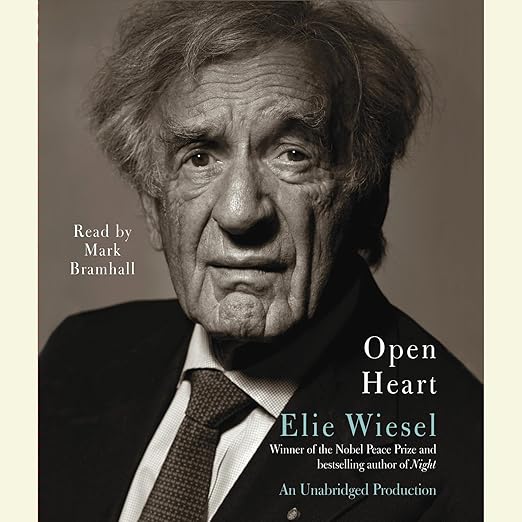
- Narration: Mark Bramhall brings a measured solemnity to Wiesel’s compressed prose, honoring its weight without performing it as spectacle.
- Themes: mortality and memory, faith under examination, the responsibility of witness
- Mood: Quietly devastating and profoundly reflective, intimate in scale but enormous in implication
- Verdict: A brief, essential memoir that belongs alongside Night in any serious engagement with Wiesel’s work and thought, not an epilogue but a final letter.
There are audiobooks you finish and immediately want to press into someone else’s hands. Open Heart is one of those, even though, or perhaps because, it is barely ninety minutes long. Elie Wiesel wrote it facing emergency heart surgery at eighty-two, which meant facing the real possibility that he might not survive the procedure. The book he produced in that interval is not a deathbed statement in any theatrical sense. It is something quieter and more searching: a man of great moral seriousness asking himself whether he has done enough with the life he was given, and finding that the question has no comfortable answer.
I came to Open Heart having taught Night in two separate courses over the years, and with a reader’s long familiarity with Wiesel’s public role as a witness and advocate. What surprised me about this memoir is how personal it is, not in the sense of private revelation, but in the sense of genuinely unresolved questioning. Wiesel does not arrive at peace on these pages. He asks about God, about the survivors he knew, about whether his writing and public life have honored the memory of those who did not survive. The questions remain questions at the end, which is the honest outcome.
The Duration That Fits the Book
At an hour and twenty-five minutes, Open Heart is among the shortest audiobooks I have reviewed in any recent period. That brevity is not a limitation; it is structural. The book is compressed in the way that thought becomes compressed when time feels genuinely finite. There is no digression, no padding, no detour into material that does not serve the central reflection. Every passage earns its place, and the accumulation of those passages, memories of family before and during what Wiesel called the unspeakable Event, reflections on marriage and children and grandchildren, questions put to God that receive no answer, produces an experience that feels far larger than its runtime suggests.
One reviewer described the book as invoking the preacher of Ecclesiastes, the conscience of Job, and the passions of Jeremiah in its most intense passages. That is not an overstatement for the sections where Wiesel puts his questions to God most directly. His decades of wrestling with the question of divine presence or absence during the Holocaust are present in every paragraph, not as a settled conclusion but as an ongoing argument that he refuses to abandon even in extremis.
What Memory Means at Eighty-Two
The faces and images that flash through Wiesel’s mind during his cardiac crisis are not ordered chronologically or thematically but the way memory actually moves: associatively, with gaps and sudden intensities. His family before the deportation. The people who taught him. The writers and thinkers he encountered in exile. The marriage that gave him children and grandchildren. The students he taught and what he hoped his teaching transmitted. The survivors he knew personally who are now gone. The memoir’s fragmentary quality is not a structural weakness but a formal choice that reflects the experience of reviewing a life under genuine pressure, when there is no time for the orderly narrative that we construct after the fact.
Several reviewers who came to the book having read Night years earlier, some having taught it to students, found Open Heart functioning as a retrospective on a long life of testimony. Wiesel’s question to himself, whether he has done enough for memory and for the survivors, is not answered with reassurance. He notes that atrocities keep happening despite everything, which is not resignation but a continued refusal to look away from what his witness was meant to address.
Mark Bramhall and the Challenge of This Material
Mark Bramhall faces a specific challenge with Open Heart. The book’s prose is spare and precise in a way that resists performance; any tendency to push the emotional content would tip the material toward sentimentality that Wiesel himself carefully avoids. Bramhall reads with a stillness that matches the text, letting the words carry their own weight without amplification. This is the right choice, and it requires discipline that not every narrator applies to material this weighted. The result is a listening experience that honors what Wiesel wrote rather than interpreting it through a performing sensibility imposed from outside the text.
The book was translated from French by Marion Wiesel, the author’s wife, which adds another layer to its intimacy. Her translation preserves the quality of careful, hard-won simplicity that characterizes Wiesel’s prose in its best form. Bramhall’s reading honors that simplicity without flattening it into mere plainness.
The book’s treatment of marriage is one of its quieter revelations. Wiesel writes about Marion, his wife and the translator of this volume, with a tenderness that feels hard-won rather than conventional. The gratitude he expresses for the life they have built together, the children, the grandchildren, the decades of shared work, is not separate from his questioning but woven into it. He is a man who has lived with large questions and also with specific people, and Open Heart holds both of those truths simultaneously without resolving the tension between them into something tidier. That refusal to resolve is, ultimately, what makes the memoir worth returning to.
Who Should Listen and When
Listen to this if you have read Night and want to understand what Wiesel was still asking himself decades after writing it. Listen if you are interested in what serious moral life looks like when confronted with its own finitude. Listen if you want ninety minutes that will require some sitting with afterward. Do not listen if you want reassurance or resolution; Wiesel does not offer either. This is not a book about arriving at peace. It is a book about continuing to ask the necessary questions across a lifetime, and then continuing to ask them at the end of that lifetime when the answers still do not come. That is its particular value, and the reason it rewards returning to at different points in a reading life.
Frequently Asked Questions
Is Open Heart suitable for listeners who have not read Night or any of Wiesel’s other work?
It can be listened to independently, but it gains considerably from prior familiarity with Wiesel’s life and work. The memoir assumes readers understand the basic outlines of his survival and subsequent role as a public witness. Night is the essential starting point, and readers who come to Open Heart having read it will find it a much richer experience.
How does the ninety-minute runtime affect the experience, and does the book feel complete at that length?
The brevity is a feature, not a limitation. Wiesel wrote under the pressure of genuine mortality, and the compression reflects that pressure. Every passage is present because it needs to be, and nothing is present that does not serve the reflection. The book feels complete at this length because it was designed to be exactly this size.
Does Wiesel resolve his ongoing questioning of God in this final memoir, or does the book end in ambiguity?
The book ends in continued questioning rather than resolution. Wiesel does not arrive at peace with the theological problems that have occupied him throughout his writing life. This is the honest and, in my view, the right outcome for a man who spent decades insisting that the questions mattered more than premature answers.
How does Mark Bramhall’s narration handle the memoir’s emotional intensity without overstating it?
Bramhall reads with restraint and stillness that matches Wiesel’s spare prose, resisting any tendency to perform the material’s emotional weight. This discipline is exactly right for a text that derives its power from precision rather than expressiveness. Listeners who prefer more expressive narration may find him understated; those familiar with the material will appreciate the restraint.