Quick Take
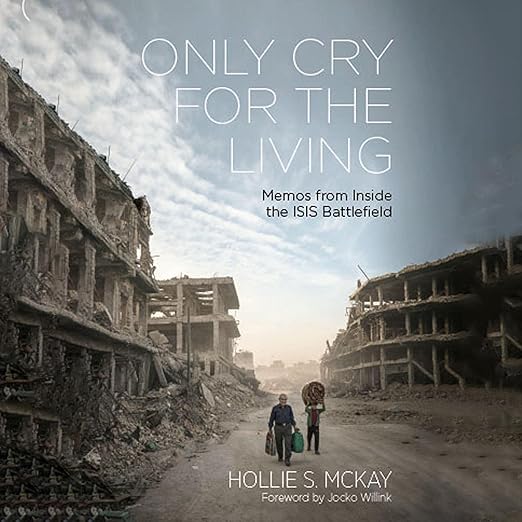
- Narration: Hollie McKay narrates her own book, and this is non-negotiable – seven years of frontline reporting in Iraq narrated in her own voice gives the testimony an authenticity no professional narrator could replicate.
- Themes: Genocide and survival among the Yazidi, the human cost of the ISIS caliphate, the responsibility of bearing witness
- Mood: Visceral and morally serious – reporting that refuses to aestheticize what it describes
- Verdict: One of the most important firsthand accounts of the ISIS caliphate’s impact on civilian populations, written by a journalist who was on the ground throughout and has the rare quality of making readers feel both horror and the weight of accountability.
There is a passage about forty minutes into Only Cry for the Living where McKay describes an interview with a Yazidi woman who survived what ISIS did to her community, and I had to pull over. Not because the prose is overwrought – it isn’t – but because McKay’s narration of her own writing, in her own voice, with the cadences of someone who was actually in the room where that conversation happened, produces a kind of presence that I find very difficult to describe. It felt less like an audiobook than like sitting in a car with someone who had just come back from somewhere terrible and needed to tell you what she had seen.
Hollie McKay spent seven years reporting from the frontlines of the ISIS war in Iraq. She arrived before the caliphate’s territorial peak and was still there during and after its military defeat. Only Cry for the Living is the account of what she saw and who she met during those years – primarily the civilians who lived under ISIS rule, survived it, or didn’t. The book is organized around these individual stories rather than around the military campaign that defeated ISIS, which is exactly the right structural choice. The campaign has been documented extensively. The human cost to the Yazidis, the Iraqi Christians, the Sunni and Shia communities in the caliphate’s territory – that documentation is rarer and more urgent.
The Yazidi Chapters That Cannot Be Looked Away From
The sections on the Yazidi genocide are the moral and emotional center of the book. ISIS’s campaign against the Yazidis – a syncretic religious minority whom the caliphate designated as devil-worshippers – was systematic and documented: mass executions of men, sexual enslavement of women and girls, the targeting of the Sinjar region specifically. McKay interviewed survivors, including women who escaped from sexual slavery and men who survived the massacres, and she renders their testimonies without the distancing apparatus of academic prose or the dramatization of popular journalism. The effect is testimony, in the legal sense: these are accounts meant to be believed and remembered.
Several reviewers have described the book as making ISIS real in a way that news coverage didn’t. That rings true to my experience. News coverage deals in numbers and events; McKay deals in specific people with specific histories and specific things done to them. The difference between knowing that thousands of Yazidis were enslaved and listening to the account of one woman’s escape is the difference between information and understanding.
McKay’s Methodology and Its Courage
The question that McKay asks at the end of each chapter – what is war? – sounds like it might become a rhetorical tic, but she earns it each time. The diversity of answers her subjects give, and the diversity of what war has meant to each of them, is itself an argument about the inadequacy of the abstract category. This is a book deeply suspicious of abstraction, including the abstraction that permitted the world to watch the ISIS genocide unfold without adequate response.
Multiple reviewers have described McKay as one of the most courageous journalists currently working in conflict zones, and the book’s existence is itself evidence for that characterization. She was not embedded with military units producing authorized accounts; she was in the field independently, making her own access, for seven years. The book carries the authority of that investment.
Self-Narration as the Only Option
At sixteen hours, this is a substantial listen, and McKay’s self-narration sustains the experience throughout. Her voice has the quality of a journalist who has learned to report without performing – she doesn’t reach for emotional effects because the material provides them without assistance. Listeners accustomed to professional audiobook narration with full production values may initially find her delivery slightly unadorned. Within thirty minutes, that quality becomes the book’s greatest asset rather than a limitation.
Who Needs This Book
Anyone who wants to understand what the ISIS caliphate meant to the people who lived and died under it – as opposed to what it meant as a geopolitical or military problem – should start here. Only Cry for the Living is not comfortable listening. It is not designed to be. It is designed to ensure that what happened to the Yazidis and other communities under ISIS is not simply filed and forgotten, and it succeeds at that purpose with unusual completeness.
Frequently Asked Questions
Is Only Cry for the Living primarily about the military defeat of ISIS or about its victims?
Primarily the latter. McKay’s focus is on the civilian communities who lived under the caliphate – especially the Yazidis – rather than on the military campaign that defeated it. Readers wanting a comprehensive account of the military operations should pair this with books focused on that dimension.
Is the content appropriate for all adult listeners, or is it particularly graphic?
The content is genuinely difficult. McKay describes the ISIS genocide against the Yazidis in specific detail, including sexual enslavement and mass killings. It is not gratuitously graphic, but it is honest about what occurred, and listeners who are sensitive to accounts of atrocity should be aware of what they are choosing.
Does McKay interview ISIS fighters as well as victims?
Yes. The book’s scope includes interviews with captured ISIS fighters and people who chose to join the organization. McKay’s effort to understand the recruitment and radicalization process is part of what makes the book more than pure testimony – she is trying to explain the phenomenon as well as document its consequences.
How current is the book’s account of the Yazidi community’s situation?
The book covers the height of the ISIS campaign and the immediate aftermath. The Yazidi community’s situation has continued to evolve – many remain in displacement camps, and the effort to document the genocide through formal legal mechanisms has continued. McKay’s account is the essential baseline, but the story is ongoing.