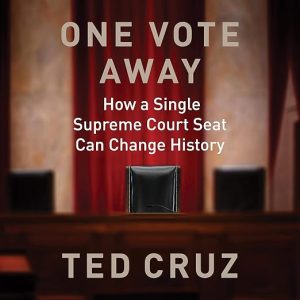
- Narrator: Timothy Andrés Pabon handles Cruz's argumentative prose with authority and clean legal vocabulary throughout.
- Subjects: Constitutional rights, Supreme Court appointment politics, the weight of judicial precedent across generations.
- Tone: Earnest and urgent, with the rhetorical energy of a closing argument sustained across ten hours.
- Bottom line: Genuinely informative on Supreme Court mechanics; best read with awareness of the explicit conservative framing.
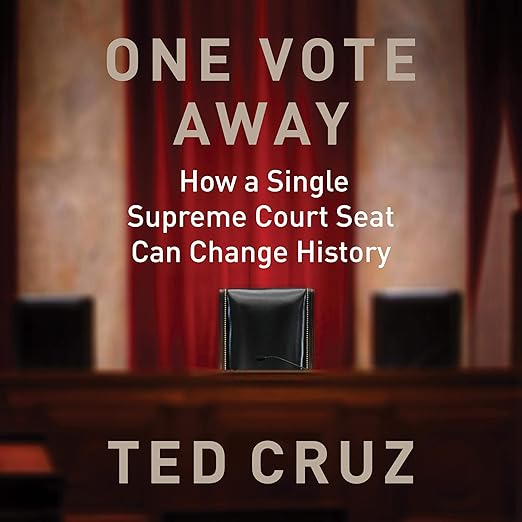
Few institutions shape American life as definitively as the Supreme Court, and few institutions are as poorly understood outside legal circles. One Vote Away, written by Senator Ted Cruz and narrated here by Timothy Andrés Pabon, offers something genuinely useful regardless of where you sit politically: a behind-the-scenes account of how major constitutional cases actually get argued, contested, and decided. As an audiobook, its ten hours move through legal history at a pace that keeps the procedural material from becoming dry, and Pabon's narration gives Cruz's arguments the rhetorical energy they were written to carry.
Cruz's ideological position is not hidden. This book is written from a conservative constitutional perspective, and it makes no pretense of neutrality. The value is not in the absence of perspective but in the specificity of access. Cruz clerked for Chief Justice William Rehnquist, served as Solicitor General of Texas, and argued cases before the Supreme Court as a private litigator. He is not narrating Supreme Court history from the outside; he was inside several of the cases he describes, and that proximity produces details you won't find in standard legal histories or news coverage.
The book's organizing principle is deceptively simple: many of the rights Americans take as foundational,free speech, Second Amendment protections, religious exercise,have been decided by a single vote at the highest level. Cruz walks through specific cases to demonstrate this, including District of Columbia v. Heller, Citizens United, and cases involving the rights of religious institutions in conflict with government mandates. His argument is that the composition of the Court matters more than most voters understand, and that a single seat shifting one way or another reconfigures the legal landscape in durable ways.
Timothy Andrés Pabon's narration serves the material well. Cruz's writing is argumentative and punchy, built for persuasion, and Pabon's voice has the right authority without tipping into pomposity. The legal vocabulary is handled cleanly, which matters when a narrator stumbles on cert and certiorari and amicus, the rhythm of the argument suffers. Pabon doesn't stumble.
Readers who disagree with Cruz's politics will find portions of the book frustrating, particularly the framing around cases involving abortion and immigration. But the case-by-case narrative of how oral argument works, how justices signal their thinking in questions, and how a case is built for Supreme Court consideration is substantive and largely non-partisan in its mechanics. The legal process material holds value independent of the ideological conclusions Cruz draws from it.
The Best Parts of One Vote Away
The book delivers genuine transparency about a process most citizens experience only through news headlines about outcomes. Cruz explains why certain cases were chosen for litigation, how legal strategy develops across multiple courts before reaching the Supreme Court, and what it feels like to argue before the nine justices in person. That insider account is rare and specific to someone who has actually done it at this level.
The historical sweep is substantial. Cruz covers cases from the past several decades alongside current-generation disputes, which gives listeners a sense of the Court as an institution with evolving jurisprudence rather than a collection of individual rulings. Understanding that precedent gets built, challenged, and sometimes reversed is essential context for why Court appointments generate such intense political conflict.
Pabon's performance sustains the ten-hour runtime without monotony, which matters for nonfiction of this density. The narration moves between the analytical and the anecdotal with natural pacing.
Before You Commit to One Vote Away
The book was published in 2020, timed to the confirmation battles of that period, and some of its most pointed passages reflect that specific political moment. Several of the Court personnel references have since changed, and listeners should apply their own contemporary context to Cruz's predictions about future decisions, some of which have since been borne out and others of which have not.
The chapters dealing with abortion jurisprudence are among the most politically charged in the book. Cruz writes from a clearly pro-life position, and the legal arguments he presents reflect that. Listeners seeking a neutral survey of reproductive rights law should look elsewhere; listeners interested in how that side of the debate builds its constitutional case will find the chapter detailed and direct.
The book is advocacy as much as memoir. Cruz's legal analysis is genuine, but the framing is consistently oriented toward building a case for conservative judicial appointments. Listeners who separate the legal narrative from the political argument will get more from the book than those who engage with it purely as a partisan text.
Should You Listen to One Vote Away?
This audiobook serves listeners who want substantive legal education alongside political argument. Conservative listeners will find it affirming. Readers who disagree with Cruz's conclusions will still find value in the procedural and historical material, particularly if they want to understand how the other side frames its constitutional arguments.
Law students and non-lawyers curious about how the Supreme Court actually functions at the level of case selection, oral argument, and decision-writing will find Cruz's insider perspective valuable in ways that standard civics coverage cannot provide.
For anyone who has ever wondered how a case goes from a local dispute to a Supreme Court ruling, or how a single justice's vote has altered what the Constitution is understood to protect, One Vote Away provides a detailed, partisan but substantively grounded answer from someone who has been inside those rooms.
Good to Know
Is the One Vote Away audiobook balanced in its political perspective?
No, and it doesn't claim to be. Cruz writes from an explicit conservative constitutional perspective. The legal procedural content has broad value, but the ideological framing is consistent throughout.
How has the audiobook aged given changes to the Court since 2020?
Some of Cruz's predictions have since come true; others haven't. The book's value is in its procedural and historical content, which remains accurate, rather than in its specific political forecasts.