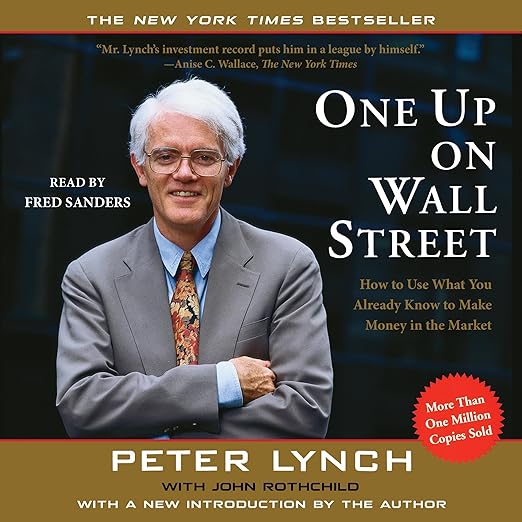
Quick Take
- Narration: Fred Sanders delivers Lynch’s conversational prose cleanly and at a measured pace that gives the analytical passages room to settle. Professional without being stiff.
- Themes: individual investor advantage, stock-picking from everyday observation, long-term thinking over market timing
- Mood: Confident and accessible, like a patient and experienced teacher who genuinely enjoys the subject
- Verdict: The 2025 re-recording makes this classic more listenable than ever, and Lynch’s core arguments hold up with impressive durability for anyone building a long-term investment approach.
I came back to One Up on Wall Street on a Sunday morning run, the kind of listening session where you want something that challenges your thinking without requiring a notepad. Peter Lynch’s voice, filtered through Fred Sanders in this December 2025 Simon and Schuster Audio recording, is immediately disarming. He writes the way a seasoned investor talks when they have stopped trying to impress anyone and just want to share what actually works.
This is a book that has sold more than a million copies for a reason. Lynch managed the Magellan Fund at Fidelity from 1977 to 1990, averaging annual returns that consistently beat the S&P 500 by a wide margin. What he argues in One Up on Wall Street is that ordinary investors have structural advantages over professional fund managers, advantages rooted in everyday life observation that most people never think to use. That argument is both more provocative and more practical than it sounds.
Our Take on One Up on Wall Street
The central thesis is deceptively simple: pay attention to what you observe in daily life. The supermarket you shop at, the restaurant chain that is always packed, the product your teenager cannot stop using. Lynch argues that these observations often precede Wall Street discovery of a company’s trajectory by months, sometimes years. By the time professional analysts have issued their reports and institutional money has moved, the individual investor who noticed early and acted has already built a position.
What makes this argument still compelling decades after its original publication is that Lynch does not stop at the observation. He walks through how to actually evaluate a company once you have identified it, how to read financial statements without an accounting degree, how to distinguish a tenbagger candidate from a no-shot, and how to categorize companies into types, cyclical, turnaround, fast-grower, stalwart, that require different analytical approaches. The framework is practical and transferable. It holds up because it is rooted in fundamentals rather than in the specific market conditions of any particular era.
One reviewer describes the book as clear, concise, and thorough, which is accurate. Lynch has no interest in mystifying what he does. He is, if anything, evangelical about making investment analysis accessible, and that evangelical quality comes through in the writing’s energy and directness.
Why Listen to One Up on Wall Street
The 2025 Simon and Schuster Audio recording is significantly more polished than older versions of this text. Sanders’ narration is steady and clear without being clinical. The pacing gives listeners time to absorb each concept before moving to the next, which matters for material that benefits from reflection rather than the speed-read approach that works for narrative nonfiction.
At ten hours and fifteen minutes, this is a thorough listen that rewards attention rather than passive background engagement. Lynch’s humor surfaces occasionally and keeps the material from becoming dry. He is not afraid to be direct about what he considers foolish investment behavior, whether that is chasing tips, trying to time the market, or trusting institutional money to be smarter than it is. That directness is part of what has kept this book in print and on reading lists for so long.
What to Watch For in One Up on Wall Street
One reviewer offers a useful caveat: Lynch’s emphasis on the individual investor’s speed advantage over institutional money is genuinely persuasive in his framing, but some readers find the argument slightly simplified. Institutional investors do move slowly when building or exiting large positions, but that same institutional weight shapes price in ways that cut both directions. Lynch acknowledges this in passing but does not dwell on it. Hold his thesis with appropriate nuance rather than absolute faith.
Also worth noting: Lynch wrote this in the late 1980s, and while the core principles translate cleanly to current markets, specific company examples and market references are dated. The 2025 re-recording does not update the content itself, only the audio production. Treat the specific examples as historical illustrations of the analytical principles rather than as current guidance.
Who Should Listen to One Up on Wall Street
This is an ideal first investment audiobook for someone intimidated by finance but curious about building a stock portfolio. It is also worth revisiting for experienced investors who want to recalibrate their thinking around fundamentals versus noise. Those looking for technical analysis, quantitative strategies, or day-trading frameworks will find little here. Lynch is a fundamentals-and-patience investor, and that orientation shapes every recommendation he makes.
Frequently Asked Questions
Is this the original text or a revised and updated edition for the 2025 recording?
The December 2025 Simon and Schuster Audio release is a new recording of the original text, not a revised edition. The content reflects Lynch’s perspective from the late 1980s, so treat specific company examples as historical illustrations rather than current picks.
How does Fred Sanders’ narration handle the financial and technical sections of the book?
Sanders navigates the more technical passages, financial ratios, balance sheet concepts, stock categorizations, at a measured pace that gives listeners time to absorb each point. The narration does not rush through the analytical sections the way some business audiobooks do.
Does Lynch’s argument about individual investor advantage still hold in the age of algorithmic trading?
Lynch’s argument focuses on observational advantage in consumer-facing businesses, and that argument retains some validity even today. However, algorithmic trading and information velocity have compressed certain advantages he describes. Most listeners treat his framework as a philosophy and long-term orientation rather than a literal edge over institutional competition.
What makes One Up on Wall Street different from other classic investment audiobooks like The Intelligent Investor?
Lynch is far more accessible and conversational than Graham, and his framework is built around real-world observation rather than strict value investing formulas. The Intelligent Investor is more rigorous and theoretical; One Up on Wall Street is more readable and immediately practical for a general audience.