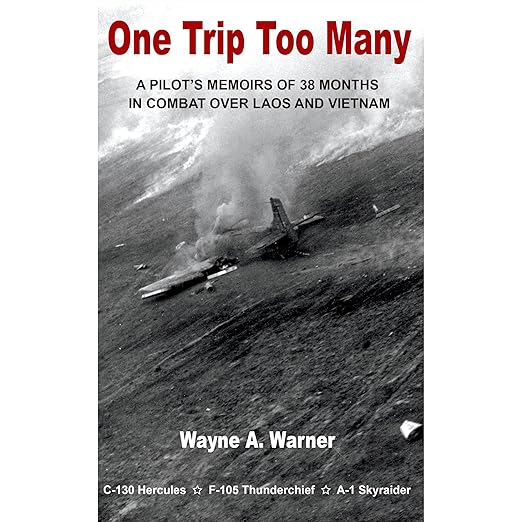
Wayne Warner flew three combat tours in Southeast Asia across three different aircraft, the C-130 Hercules, the F-105 Thunderchief, and the A-1 Skyraider, and One Trip Too Many - A Pilot's Memoirs of 38 Months in Combat Over Laos and Vietnam is his account of those 38 months. This audiobook delivers the memoir through Virtual Voice narration, and that detail needs to be addressed directly: for a first-person military memoir built on the specific texture of one man's experience, the AI-generated narration is the format's primary weakness. The content is genuinely substantial and worth the investment for listeners interested in Vietnam-era aviation combat, but the delivery will not carry the emotional weight a human narrator would bring to passages about a bailout over hostile territory or the crash on takeoff that ended Warner's active duty career.
Reviewer trwsells, who has read more than 700 Vietnam-era books, specifically recommended this one, a meaningful endorsement from someone who has calibrated comparative value across the genre. Reviewer Mike Stover noted that the writing is not as polished as popular fiction but that the content is interesting and provides a mixed perspective covering multi-engine tactical air, fighter-bomber operations, and prop-driven close air support. That range is genuinely unusual. Most Vietnam-era aviation memoirs focus on a single aircraft type and a single operational context. Warner's three-tour, three-type account gives the audiobook a panoramic quality that differentiates it from the more common single-mission-focused memoir.
Like Band of Brothers, Top Gun, and Forrest Gump
The structure is chronological and conventional: Warner traces his path from Air Force Academy admission through pilot training, into his first tour in C-130s and then forward through increasingly dangerous assignments. The decision to cover all three tours in a single volume means each aircraft section gets proportional treatment rather than exhaustive detail, which will frustrate some aviation specialists but makes the audiobook considerably more accessible for general listeners interested in the period. The C-130 section establishes the logistics-under-fire context; the F-105 section covers what was among the most dangerous strike-fighter assignments of the war; and the A-1 section, which ends with the bailout that gives the book its title, carries the most sustained personal intensity.
The reviewer description as a combination of Band of Brothers, Top Gun, and Forrest Gump is marketing language but not inaccurate as a generic position. The Band of Brothers comparison works for the unit cohesion and mutual dependence. The Top Gun comparison applies to the technical specificity of the F-105 passages. The Forrest Gump reference captures something real about Warner's presence in the war at multiple different phases and locations, a kind of peripatetic witness to the conflict's full arc. What the comparisons cannot account for is the book's plainness. Warner writes about his experiences with minimal embellishment, and that restraint is both the memoir's main quality and its main challenge for the audio format.
Lived It and Walked the Walk, One Reviewer Says
The technical specificity is the book's most distinctive offering. Warner does not just describe flying the F-105 Thunderchief. He explains what the training required, what the mission parameters looked like, and what the specific failure modes were that cost pilots their lives over North Vietnam. That level of operational detail is rare in memoir, and for listeners who want to understand what combat aviation in the Vietnam era actually looked like from inside the cockpit, this audiobook provides it in more granular form than most published accounts manage.
The hospital and aftermath sections at the end of the book are unexpectedly strong. Warner describes his injuries and recovery with the same plainspoken clarity he brings to the combat passages, and the epilogue covering life after retirement provides the kind of long-term perspective that is frequently absent from war memoirs focused on the action period. Reviewer Francisco Rojas described it as a personal story of a man who lived and walked the walk, and that personal quality, the ordinariness of the life before and after the extraordinary events, is what gives the final section its weight.
A Bailout Handled Like a Checklist Under Pressure
The bailout in the A-1 Skyraider is the book's dramatic climax and is preceded by enough technical grounding in how the aircraft handles that the sequence has genuine specificity rather than generic crisis. Warner describes the pre-bailout emergency with the methodical quality of someone who was trained to run checklists under pressure, and the narration of that process, even in Virtual Voice, carries the compressed intensity of someone moving through a prepared sequence while knowing the aircraft is not going to cooperate much longer.
Also worth close attention are the passages comparing the institutional cultures of multi-engine tactical air and single-seat fighter operations. Warner experienced both, and his observations about the differences between the C-130 community and the fighter pilot world are among the memoir's more insightful sections. Those differences shaped how the war was fought and how its veterans understood their own service, and Warner is unusually well-positioned to articulate them from direct experience across both communities.
Sample the Virtual Voice Before All 9 Hours
This is best suited for listeners with a specific interest in Vietnam-era aviation or military memoir, and for those who prioritize firsthand operational detail over literary polish. Mike Stover's observation that the writing is unpolished compared to fiction is accurate and worth weighing. This is not a work of literary memoir but a service veteran's account told in direct, functional language. The Virtual Voice narration means listeners sensitive to AI-generated audio will want to sample before committing to the full 9 hours and 44 minutes. For listeners who can set that limitation aside, the content is substantially more comprehensive and technically specific than most comparable titles available in audio format.
Quick Take
- Performance: Virtual Voice narrates this memoir, which is a meaningful limitation for a first-person combat account. The AI-generated delivery cannot carry the weight of a veteran's personal narrative in the way a human narrator would, and listeners who prioritize emotional authenticity in memoir should factor that in before purchasing.
- What it covers: Combat aviation across three different aircraft types, survival and luck in sustained warfare, the long aftermath of military service
- Feel: Plainspoken and specific, with the quiet intensity of someone accounting for what actually happened
- Our call: Wayne Warner's combat memoir covers three tours and three aircraft with unusual technical detail and personal honesty. The Virtual Voice narration is the main drawback for an audiobook format that would benefit most from a human voice.