Quick Take
- Narration: David Shaw-Parker brings a period-appropriate British register to Fleming’s prose, capturing the dry wit and understatement that define the writing without overplaying either.
- Themes: 1930s Asia in political upheaval, journalistic adventure, colonial-era travel writing and its limitations
- Mood: Wry, observant, and historically absorbing
- Verdict: A rewarding listen for anyone interested in travel writing as a literary form or in the political history of 1930s China and Manchuria from an unusually candid eyewitness.
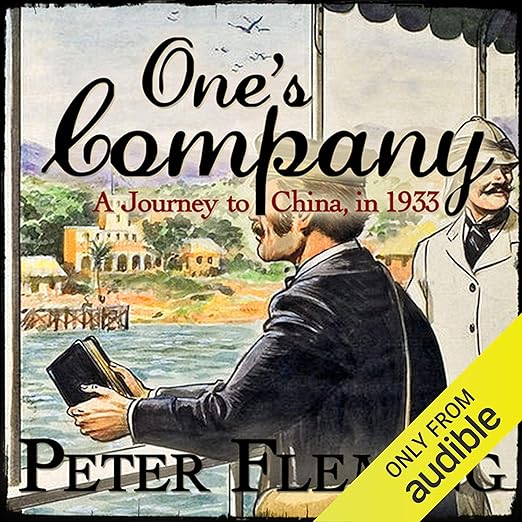
I finished One’s Company late on a weekday night when I should have been sleeping, which felt appropriate for a book about someone who kept finding himself in situations that were equally inadvisable and irresistible. Peter Fleming traveled through Russia and Manchuria to China in the 1930s as Special Correspondent to The Times, with the stated aim of investigating the Communist situation in South China. He was twenty-six years old. He described himself, with characteristic self-deprecation, as the brother to which nothing ever happens.
Fleming is often overshadowed by his brother Ian, which is one of literary history’s more persistent injustices. Peter was, by any honest accounting, the more adventurous of the two and by several readers’ estimates the more talented prose stylist. One’s Company, published in 1934, catches him on a journey through Siberia by train, across Manchuria under Japanese occupation, and into a China already in the middle of a political crisis that would define the following century. He wrote about it with a mixture of humility and sharpness that defines his best work and keeps it readable across ninety years.
Our Take on One’s Company
What makes this audiobook hold up so well is Fleming’s particular combination of acknowledged limitation and acute observation. He repeatedly declares himself unqualified to understand China’s politics while simultaneously demonstrating a sharp, clear-eyed grasp of what he is witnessing on the ground. His account of Japanese-occupied Manchuria and the Communist anti-Nationalist front is as relevant in retrospect as any subsequent historian’s analysis. One reviewer noted the parallels to American involvement in Vietnam with striking accuracy: the ineffective and corrupt Nationalist army, the resourceful insurgency, the foreign correspondent watching from the margins and writing it all down with dry precision.
The personal incidents Fleming includes are as revealing as the political observation. Brake failure on the Trans-Siberian Express. An impromptu Eton Boating Song singing lesson in Manchuria. The specific texture of travel where infrastructure is provisional and bureaucracy is both arbitrary and omnipresent. Fleming finds the comedy without turning it into farce, and the book is better for that discipline throughout.
Why Listen to One’s Company
David Shaw-Parker is an excellent choice for this material. His narration has the period quality the prose requires, British and slightly formal without tipping into parody. Fleming’s wit is dry to the point of invisibility if delivered carelessly; Shaw-Parker finds the humor in the understatement and lets it land without overplaying it. The ten-hour runtime is well-suited to a journey this geographically and historically dense, and the pacing feels natural rather than padded.
David Shaw-Parker is an excellent choice for this material. His narration has the period quality the prose requires, British and slightly formal without tipping into parody. Fleming’s wit is dry to the point of invisibility if delivered carelessly; Shaw-Parker finds the humor in the understatement and lets it land without overplaying it. The ten-hour runtime is well-suited to a journey this geographically and historically dense, and the pacing feels natural rather than padded. Listeners who enjoy this entry would do well to seek out Fleming’s subsequent Brazilian journey, Brazilian Adventure, which extends the same voice into an even more improbable expedition.
What to Watch For in One’s Company
This is, genuinely, a dated book. Fleming writes from the perspective of a 1930s British correspondent, and that perspective brings assumptions and blind spots that modern readers will notice. Some observations about Chinese people and culture reflect colonial-era framing that Fleming did not interrogate because it was invisible to him. This does not diminish the historical value of the account, but listeners should approach it as a document of its era rather than a neutral or authoritative contemporary report.
Who Should Listen to One’s Company
This audiobook is for listeners who love literary travel writing and have a genuine interest in Asia’s political history in the early twentieth century. It works well alongside other interwar British travel narratives and alongside histories of the Chinese Civil War for listeners who want historical context. Skip it if you are looking for contemporary travel writing or a comprehensive political overview; this is a personal account with all the limitations and irreplaceable charms that come with that form.
Frequently Asked Questions
Do I need background knowledge of 1930s China or Russian history to follow this book?
Some familiarity helps, but Fleming writes accessibly and contextualizes the political landscape as he goes. The book is more travelogue than political analysis, so the focus stays on personal observation and incident rather than historical argument.
How does Peter Fleming compare to other interwar British travel writers?
Fleming is often grouped with Evelyn Waugh, Robert Byron, and Eric Newby as one of the defining voices of British interwar travel writing. His prose is more understated than Byron and more politically aware than Waugh, occupying a distinct and rewarding middle ground.
Is the book’s 1934 colonial-era perspective a significant barrier for modern listeners?
The framing is noticeable and worth keeping in mind, but most reviewers find that Fleming’s humor and observational sharpness transcend the period assumptions. Reading it as a document of its time rather than a contemporary voice is the most productive approach.
Does David Shaw-Parker’s narration suit Fleming’s writing style?
Yes. Shaw-Parker captures the dry British wit that is central to Fleming’s appeal. Reviewers consistently find the narration well-matched to the material, with the understatement and period register handled naturally and effectively.