- Voice: Grace Noble carries no findable prior credit; steady, unhurried delivery is what this heavily cross-referenced material needs most.
- Big ideas: Intelligence networks, institutional subversion, blackmail in the digital era
- Atmosphere: Dense, methodical, quietly alarming
- Worth it?: A genuine sequel that rewards readers who already finished Volume I; not the place to start cold.
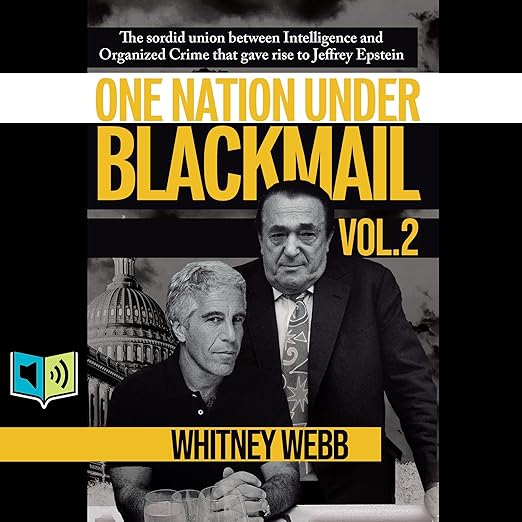
Volume two of One Nation Under Blackmail picks up mid-argument on this audiobook, assuming a listener already spent volume one inside Whitney Alyse Webb's account of organized crime and intelligence networks, and it makes no attempt to re-explain that foundation before building further on top of it. The byline itself is worth noting: this listing credits the author's full name, Whitney Alyse Webb, middle name included, a formal touch that matches the book's own dense, footnote-heavy reputation among its readers.
Belonged to Intelligence During His First Arrest
Direct questions drive this volume from its very first page: how did Jeffrey Epstein evade justice for decades, who enabled that, and why were legal officials reportedly told he 'belonged to intelligence' during his first arrest in the mid-2000s. From there the book traces Epstein and his closest associates, Leslie Wexner and Ghislaine Maxwell among them, against the organized crime and intelligence networks volume one already laid out, with a specific focus on espionage activity and how blackmail itself evolved once it went digital.
At least one review captures both the density and the reward of that approach. One reader calls the whole project well-sourced and cross-referenced, a dense book demanding a genuinely focused read, admitting they got hooked despite the difficulty. That same review raises a complaint worth flagging directly: needing a larger print size to read comfortably, a concern that belongs to a print edition rather than this audio one, and a sign that not every attached review is actually responding to the format being sold here.
Other reactions lean into how thoroughly the book reframes what readers thought they already knew. One calls the two-volume set life-changing, admitting deep initial skepticism that gave way to wanting a second full read of both volumes. Another specifically praises the documentation over supposition, calling the amount of money and power on display genuinely eye-opening.
A third review frames the material in more explicitly political terms, describing decades of skepticism toward government and foreign policy, and connecting this book's findings to independent research the reviewer says they conducted themselves in a research paper at Air University. Whatever a listener's own starting position on that framing, the pattern across these reviews is consistent: readers describe arriving skeptical or merely curious and leaving convinced the documentation holds up under their own scrutiny.
Publisher credit here goes to SpokenTome.media rather than one of the larger mainstream audiobook houses, which tracks with independent investigative publishing more broadly: a book this willing to name specific individuals and institutions directly often finds a smaller, more specialized home than a conventional imprint would be comfortable offering.
Grace Noble Carries No Prior Audiobook Credit
Its own synopsis is explicit about the angle: this volume claims to expose topics vastly under-explored compared to other Epstein coverage, rather than retreading the tabloid-familiar timeline most listeners already half know. Positioning a true crime and biography title around intelligence networks and institutional subversion, instead of the more sensational personal details other coverage leans on, is a genuine point of difference worth taking at face value given how much has already been written and produced about this case. Fifteen hours and fifty minutes is a substantial runtime, but it matches the scale of the claim: tracing espionage activity and institutional subversion across multiple named associates needs real room to lay out its evidence rather than compressing everything into a quick summary.
Grace Noble carries no prior audiobook credit that surfaces anywhere, leaving genre fit as the only real basis for judging this pairing. Heavily sourced, cross-referenced nonfiction like this benefits from a steady, unhurried delivery that lets dense factual claims land clearly rather than rushing past names, dates, and institutional connections a listener needs to actually track. Overselling energy or urgency into a delivery this fact-dense would likely work against the material rather than for it, so a plainer, more measured approach is the safer bet even without a confirmed track record to point to.
One Rating Logged, Five Perfect Responses Visible
Starting here without volume one is a real risk. The synopsis assumes familiarity with the organized crime and intelligence networks framework built in the first book, and nothing about this listing suggests a recap exists for newcomers. Anyone tempted to skip straight to volume two for the Epstein-specific content should expect real gaps in the surrounding argument.
The rating math points to something odd: only one rating is logged, while five written responses are visible on the page, and every single one of those five awards a full five stars, all sitting above the 4.8 badge on display. That leaves at least four enthusiastic responses the counter does not seem to know exist, on top of the print-versus-audio confusion in one of those five reviews noted above. A badge this far below every visible score it is supposedly built from is worth remembering as a display quirk rather than a literal measurement.
Passing On This One Makes Sense
Investigative nonfiction listeners already following the Epstein case who want the intelligence-network and institutional-subversion angle, rather than another pass through familiar tabloid details, are the clear audience. Readers who already finished volume one and want the argument extended into Wexner, Maxwell, and the digital-era mechanics of blackmail specifically will get the most direct payoff. Readers of independent investigative publishing generally, comfortable with a book that argues its case at length rather than summarizing it in a single chapter, will also find the pacing familiar rather than exhausting.
Passing on this one makes sense if volume one is not already behind you, or if dense, heavily cross-referenced nonfiction sounds like more commitment than you want from a true crime title. Listeners wanting a lighter, faster-paced treatment of the same subject matter should look elsewhere first. This is also simply not the place to start if the Epstein case itself is unfamiliar territory, since neither this listing nor the synopsis offers the kind of background a total newcomer would need before the argument makes full sense.
Good to Know
Does this audiobook's Volume II focus on different material than Volume I?
Yes. The synopsis frames volume one as laying out the organized crime and intelligence networks framework, while this volume applies that framework specifically to Epstein, Leslie Wexner, and Ghislaine Maxwell, tracing espionage activity and how blackmail evolved in the digital era. Treat it as an extension rather than a repeat of the earlier volume's ground.
How is Grace Noble's narration for a dense, heavily cross-referenced nonfiction book like this?
No prior credit for Grace Noble turns up anywhere, leaving no track record to judge from directly. Material this dependent on names, dates, and institutional connections generally benefits from calm, unhurried pacing, and that general genre fit is the only basis available for an assessment here.
Does this audiobook require having listened to Volume I first?
Functionally, yes. The synopsis builds directly on organized crime and intelligence networks established in the first volume without pausing to re-explain them, so newcomers starting here should expect real gaps. Listeners serious about the argument should treat the two volumes as one continuous project rather than separate entry points.