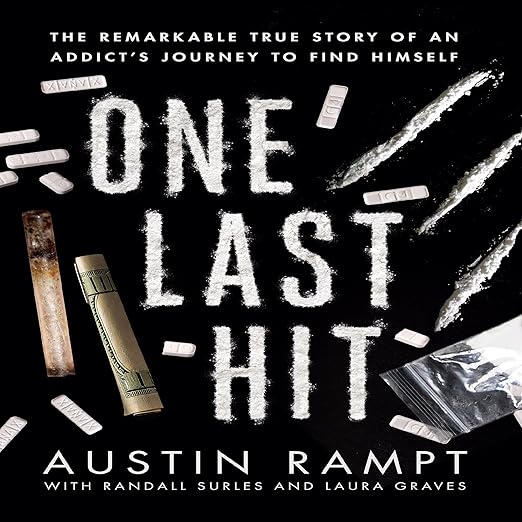
At a Glance
- Narrator: Austin Rampt narrates his own memoir rather than handing it to a professional, a real choice worth knowing about going in; how it actually sounds is not something any review here gets into.
- Subjects: addiction and incarceration, cartel danger, family as an anchor, hard-won redemption
- Tone: Raw and unflinching, with real momentum
- Bottom line: Recovery-memoir listeners who value authenticity over narration polish should come away satisfied, backed by five reviews that are unanimously five stars.
Can a memoir narrated by the person who lived it carry more weight than one read by a professional, or does it just risk sounding too close to the material to stay clear-eyed? One Last Hit puts that question to a real test: Austin Rampt wrote this account of addiction, incarceration, and a very literal flight into the orbit of the Sinaloa Cartel, and he also reads it himself for this audiobook.
Pulled Back by His Children and Wife Haley
The arc Rampt lays out is unflinching by design: a troubled Tampa childhood, eight separate stints in rehab, jail cells, and a stretch of his life spent fleeing the country and living inside cartel territory before addiction nearly costs him everything. What eventually pulls him back, per the synopsis, is his children, his wife Haley, and a friend whose impact outlasts the book itself. That is a specific, grounded cast of real people anchoring a story that could otherwise read as pure chaos.
One oddity worth flagging upfront: the catalog files this under sports and outdoors, with an Adventurers, Explorers and Survival tag attached, alongside the more expected biographies-memoirs and health-wellness categories. For a book about addiction and incarceration rather than literal wilderness survival, that classification says more about how loosely some platforms bucket memoirs than it does about the book's actual content.
Momentum Over Lingering, in Under Five Hours
The defining production fact here is simple: Rampt narrates his own story rather than handing it to a professional voice actor. For a memoir this personal, that is a real choice with real tradeoffs, and it shapes the listening experience before a single review gets weighed.
Runtime sits at four hours and fifty-six minutes, compact for a memoir covering childhood, active addiction, multiple rehab attempts, and a cartel-adjacent flight from the country. Manhattan Books published it at the end of 2025, and that brisk length suggests a book more interested in momentum than in lingering over every chapter of a genuinely eventful life, a tradeoff that shows up directly in how reviewers describe the pacing.
He Does Not Tell It, He Lives It
Stacy B.'s review describes the experience as cinematic, saying it felt like watching a movie rather than reading a book, and singles out how the vivid, specific detail pulls in listeners regardless of whether they have lived through addiction themselves. That kind of immersive, almost visual reaction is a strong signal for a memoir built on scene-level detail rather than abstraction.
Joshua's review carries unusual weight for its brevity: a reader who says it had been roughly twenty years since finishing a book cover to cover calls this one impossible to put down, praising its honesty about a subject, addiction, that rarely gets treated so directly. Randall Surles goes further into the specifics, tracing the Tampa-to-cartel-to-redemption arc in detail and calling the survival itself close to miraculous, framing Rampt as on the run from himself right up until circumstances force a choice between redemption and relapse.
Andrea L.'s review gets personal and unusually effusive, stacking up descriptors like haunting, raw, honest, warm, funny, and victorious in a single title, and describing finding herself inside Rampt's story despite having lived a very different life. That kind of cross-experience recognition speaks to how the specific, unglamorous details of addiction translate into something more universal about struggle generally, rather than staying confined to readers who share the exact same history.
Amazon Customer's review lands on the detail most relevant to the audio format specifically: the observation that Rampt does not just tell the story, he lives it for the listener, a review written before this recording existed but one that anticipates exactly what self-narration adds to a memoir like this. Taken together, these five reactions describe a book whose hope and redemption throughline lands as earned rather than tacked on, a real distinction from memoirs that dwell in misery without much payoff.
Every Visible Review Sits at Five Stars
This is intense, unflinching material by design. Addiction, incarceration, cartel danger, and family strain are not softened for a general audience, and listeners sensitive to detailed accounts of substance abuse or its consequences should know that going in. Nothing in the synopsis or the five reviews here suggests the book pulls its punches for the sake of comfort.
On narration, temper expectations around polish. Rampt is the author living the events he narrates, not a trained voice actor, and his reading goes entirely unmentioned across the reviews on this listing, four of which are dated before this specific audiobook's release and were clearly written in response to the text rather than the recording. What self-narration buys in authenticity, it may cost in the kind of pacing and vocal control a professional narrator brings by trade.
The rating data is worth a plain look rather than a deep read. The listing shows 4.4 across fourteen total ratings, and every single one of the written reviews visible here lands at five stars, no exceptions. That is a strong, consistent signal from the reviews a listener can actually read, whatever the other nine ratings not shown here look like.
One more practical note: several of the visible reviews, including Randall Surles's and Andrea L.'s, are dated in the weeks before this audiobook's official release, which suggests advance access rather than anything irregular. It is worth mentioning only because it means the enthusiasm on record predates most listeners' ability to actually buy this specific recording, not because it casts doubt on the reactions themselves.
The One Person Who Was Actually There
Listeners drawn to raw addiction and recovery memoirs, especially ones narrated by the person who survived them, are the clear audience. Anyone who has struggled with substance abuse personally or through a family member is likely to find the specificity Stacy B. and Andrea L. both describe genuinely resonant rather than exploitative, and the short runtime, under five hours, makes it an approachable entry point into memoir as a genre.
Skip it if graphic accounts of addiction and its consequences are difficult material for you right now, or if a polished, professionally trained narrator matters more to your listening experience than the authenticity of hearing an author narrate his own survival. What remains, for most listeners, is a short, intense, apparently well-received account of a life that, by its own telling, very nearly did not make it this far, delivered in under five hours by the one person who was actually there for every part of it.