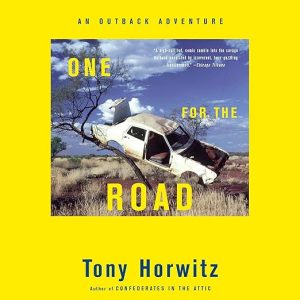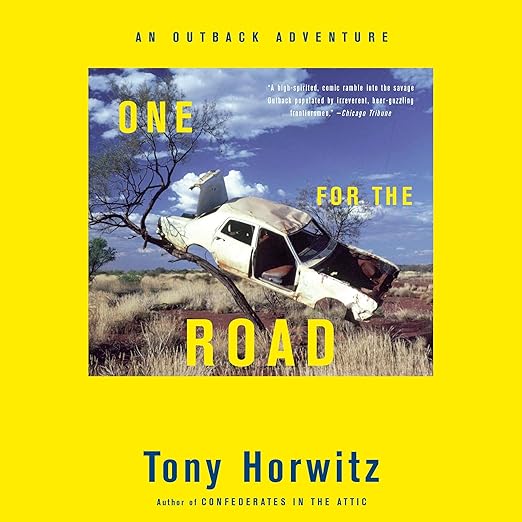
I came to Tony Horwitz backwards. I read Confederates in the Attic first, then Baghdad Without a Map, and only then circled back to find One for the Road, the book that launched everything. There's something instructive about reading a writer's debut after their mature work - you can see exactly where the voice was already formed and where it was still finding its register. I listened to this one on a long drive through empty highway, which felt appropriate. Horwitz hitchhiked 7,000 miles through the Australian outback in 1987 at age 27. The least I could do was keep moving.
The premise is clean: newly transplanted to Sydney with his Australian wife, Horwitz grows restless with the city's comfortable expat life and decides to hitchhike across the continent. What follows is a series of encounters with people who exist well outside the tourist Australia - opal diggers in Coober Pedy, jackaroos on remote stations, Aborigines navigating a country that has systematically dispossessed them, card sharks, drifters, pub philosophers, and a startling number of people who measure distance in the number of beers consumed between stops. The outback's distances are genuinely staggering, and Horwitz uses them well: the landscape becomes a character that dwarfs every human drama enacted against it.
This is not the most sophisticated book Tony Horwitz wrote. He said as much himself, and the rougher edges of a debut are visible - some passages that strain for effect, a few encounters that don't quite earn their space in the narrative. But the essentials of what made him one of the best American travel writers of his generation are all here: the ear for dialogue, the ability to find dark comedy in genuinely uncomfortable situations, the refusal to romanticize what he's observing. The section involving a near-fatal car accident reads with shocking immediacy even though you know the author survived to write the book. And his treatment of the Aborigines he encounters - respectful, curious, aware of the limits of his outsider perspective - is more thoughtful than might be expected of a 27-year-old journalist on his first book.
What Makes One for the Road Worth Hearing
The choice of narrator here is unusual and, I think, genuinely moving. Nathaniel Horwitz, Tony's son, reads the audiobook. Tony Horwitz died in 2019, which lends the whole listening experience a layer of feeling that no amount of skilled outside narration could achieve. Nathaniel reads with a natural ease that sounds like someone who grew up hearing this material, and there's a quality of inheritance to it - the son giving voice to the young father who hadn't yet become the person his son would know. For listeners already fond of Horwitz's work, that dimension makes this audiobook feel like something more than a standard production. It's worth seeking out specifically for that reason.
Things to Know Before Starting One for the Road
Readers who come to this expecting the structural polish of Confederates in the Attic may need to adjust their expectations. One for the Road is episodic in a way that reflects the actual nature of hitchhiking - you go where the ride takes you, and some destinations are more interesting than others. The pub culture Horwitz describes so vividly can feel repetitive across the middle section, and some encounters resolve without the resonance of his later work. The comedy is broad in places where Horwitz would later have trusted subtlety. These are the limitations of a first book, not flaws that undermine what works. And what works is the best of it: the sense of a young writer genuinely surprised by what he's finding, with the honesty to report it as found rather than as it should have been.
Who Tony Horwitz Is Writing For
Tony Horwitz fans should absolutely listen to this, if only for the narrator and the context it provides for everything that came after. Travel writing readers who appreciate comic journalism in the tradition of Bill Bryson or Paul Theroux will find plenty to enjoy here, while noting that Horwitz's strengths are distinct from both - he's more interested in history and politics than Bryson, and more humanizing in his portraiture than Theroux. Listeners who want a polished, precisely structured narrative may find the episodic looseness frustrating. And anyone with even a passing interest in Australia's interior - its landscape, its contradictions, its people living at the margins of a country that mostly looks the other way - will find this a rich and honest account.
The Short Version
- Read by: Nathaniel Horwitz reads his father's debut with an intimacy that no outside narrator could replicate - there's affection in every sentence without sentimentality, which is exactly the tone the book requires.
- At its heart: outsider-in-the-landscape, the comedy of discomfort, what travel reveals about home
- Vibe: Sun-baked and irreverent, with moments of genuine darkness tucked between the laughs
- Short version: A rewarding travel memoir that earns its reputation as Horwitz finding his voice - sharper and more poignant for being his son who reads it.
Why does Tony Horwitz's son narrate the audiobook, and does that affect the listening experience significantly?
Nathaniel Horwitz reads the audiobook following his father's death in 2019. For listeners who know and care about Tony Horwitz's work, it adds a genuinely affecting dimension - the intimacy and ease in Nathaniel's reading feel earned in a way no outside narrator could replicate.
At 7 hours and 34 minutes, does the audiobook maintain its momentum given the episodic nature of hitchhiking narrative?
Mostly yes, with a slight dip through the middle section when the pub-to-pub rhythm becomes repetitive. The opening and closing sections are consistently strong, and the near-fatal accident midway through arrives with real force.