Quick Take
- Narration: Omar El Akkad narrates his own work with a controlled, measured intensity that makes the most difficult passages land without melodrama, a significant creative choice that pays off.
- Themes: Western moral hypocrisy, immigrant disillusionment, political witness
- Mood: Searching and grieving, with the precision of someone who has thought about this for a very long time
- Verdict: One of the more honest and formally disciplined political essays of recent years, and hearing El Akkad read it himself adds a layer of accountability that no hired narrator could provide.
I finished this one on a Sunday morning, sitting with a second cup of coffee I had not planned to make because I did not want to put the audiobook down long enough to let the kettle boil. Omar El Akkad’s voice is calm, almost professorial, and the contrast between that tone and what he is actually saying gives the book its particular unease. He is not shouting. That is the point.
El Akkad, who worked as a journalist covering the Wars on Terror, Ferguson, climate protests, and Black Lives Matter before winning literary awards for his fiction, has spent twenty years accruing what he describes as evidence. This book is his reckoning with that evidence. His core argument is that the West’s foundational promises, freedom, justice, universal human dignity, are not being betrayed in the case of Gaza but are rather functioning as designed: as cover for selective application, available to some and withheld from others according to the needs of power. That is a sharper claim than most political essays are willing to make explicitly, and El Akkad makes it with care rather than fury.
Our Take on One Day, Everyone Will Have Always Been Against This
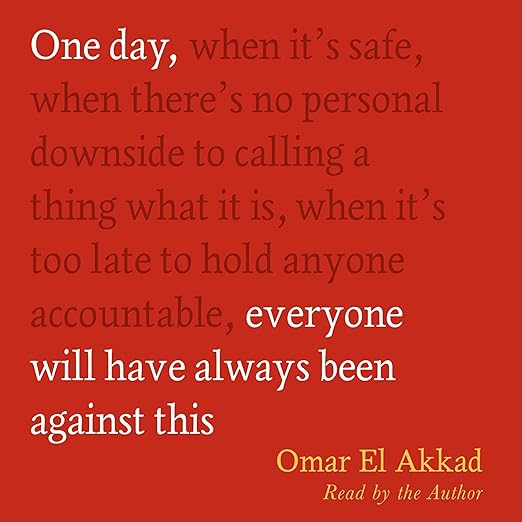
The title is the book’s conceptual center. El Akkad is describing the mechanism by which historical atrocities are eventually disowned in retrospect, how the people who supported or ignored a catastrophe while it was happening will eventually claim, once it becomes safe to do so, that they were always against it. He has watched this process operate in several contexts throughout his career, and he is writing, explicitly, while the outcome in Gaza remains uncertain, partly to create a record that cannot be revised in that retrospective direction.
Structurally, this is memoir and political essay braided together. El Akkad moves between his personal history as an immigrant who arrived believing in Western promises and his experience as a journalist watching those promises fail in real time. The personal sections are not digressive but generative: they establish why he is positioned to make these arguments and what it has cost him to arrive at his conclusions. Reviewer Deb Blanchard described it as emotionally jarring but compelling, part memoir and part political and historical commentary, which captures the form accurately.
Why Listen to One Day, Everyone Will Have Always Been Against This
El Akkad’s decision to narrate his own work is substantively significant. There is something uncomfortable about hearing a writer speak his own conclusions about complicity in a calm, measured voice. It removes the distance that would exist with a professional narrator. You cannot separate the argument from the arguer. That discomfort, I think, is intentional. One reviewer noted that this functions as a gut punch to America and to the reader, and that calibration is more precise in El Akkad’s own voice than it would be in anyone else’s hands.
At five hours and twenty minutes, this is a short audiobook relative to its weight. El Akkad does not pad. The prose is dense with specifics, which means it rewards attentive listening rather than background consumption. One dissenting reviewer found the argument too slow to develop, but I read that as a response to the book’s refusal to provide easy conclusions. El Akkad is not writing a policy paper or a protest pamphlet. He is trying to account for how a person of conscience is supposed to live inside structures they cannot fully exit.
What to Watch For in One Day, Everyone Will Have Always Been Against This
The book’s subject matter is Palestine and Gaza specifically, and El Akkad does not soft-pedal his conclusions about what is happening there or about Western governments’ roles in enabling it. This will be deeply uncomfortable for some listeners and essential for others. One reviewer offered a dissent on the characterization of events in Gaza, which indicates the book will generate genuine argument rather than consensus approval. El Akkad anticipates that resistance throughout the text and addresses it directly. Readers who prefer political essays to remain abstract and general will be frustrated. Readers who want specificity and accountability will find exactly that.
Who Should Listen to One Day, Everyone Will Have Always Been Against This
This is for readers who want a sustained, precise political argument from a writer with direct journalistic experience of the events he describes. It is for people who can sit with discomfort rather than needing resolution. It works particularly well in audio because El Akkad’s own narration is inseparable from the book’s meaning. Skip it if you are not in a place to engage with the subject matter, or if you prefer political writing that separates personal stakes from analytical argument.
Frequently Asked Questions
Is this primarily a memoir, a political essay, or journalism?
It is all three, deliberately braided. El Akkad uses his personal history as an immigrant and his professional experience as a foreign correspondent to ground political arguments that might otherwise feel abstract. The form is essayistic rather than strictly structured.
How does hearing El Akkad narrate his own book change the listening experience?
Significantly. His calm, measured delivery against genuinely difficult content creates an effect no hired narrator could replicate. The argument and the arguer are inseparable in a way that adds moral weight to every claim.
Is this book only valuable for readers who already agree with El Akkad’s position?
No, though readers who strongly disagree with his framing will find it a challenging listen. El Akkad anticipates counterarguments and addresses them directly. The book is worth engaging with precisely because it is specific and accountable rather than abstract.
At just over five hours, does the audiobook feel complete or compressed?
It feels complete. El Akkad’s prose is dense and specific, so the short runtime reflects precision rather than superficiality. This is not a book that could have been shorter; it is exactly as long as the argument requires.