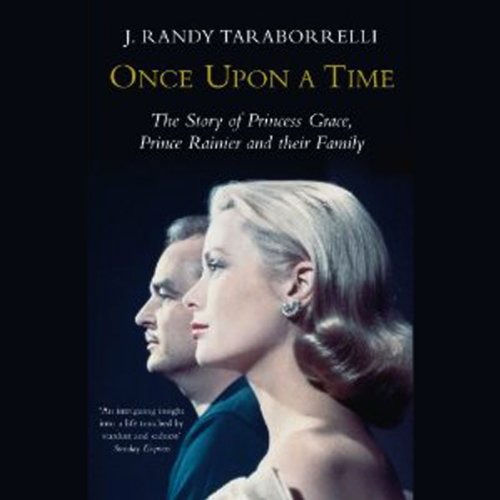
Grace Kelly traded a movie career for a palace, and this audiobook argues that the trade cost her more than any fairy-tale photograph ever let on. Once Upon a Time follows Kelly from Hollywood star to Princess of Monaco, a title that arrived with a husband, Prince Rainier, she barely knew, a new role as Her Serene Royal Highness, and a family whose private conflicts turned out to be as ordinary and as painful as any other household's, crown or no crown. The synopsis credits 'master storyteller J. Randy Taraborrelli' as the source of this account, drawn from what it describes as hundreds of exclusive interviews with family and friends.
Beller on the Cover, Taraborrelli in the Text
The book's real subject is the gap between Grace Kelly's public image and her private experience, and it does not flinch from the uncomfortable parts of that gap. Kelly is described as 'exhausted by the show-business lifestyle' before the marriage, then, 'once in the palace,' finding herself 'trapped in a fairy tale of her own making,' forced into sacrifices that cut against who she was as a woman. That is a considerably more clear-eyed framing than the standard glamorous-princess narrative most casual readers already carry around, and it gives the marriage itself real weight as a mutual, complicated arrangement rather than a one-sided sacrifice.
Worth noting directly: the catalog record for this audiobook lists Elizabeth Beller as the author, while the synopsis text itself credits J. Randy Taraborrelli by name. That is a metadata discrepancy worth flagging plainly rather than glossing over, and this review evaluates the actual content described, Taraborrelli's account of Grace Kelly and the Grimaldi family, on its own terms regardless of which name appears on the listing.
The synopsis promises the book portrays its subjects with passion and sympathy, revealing Grace, Rainier, Caroline, Albert, and Stephanie in ways both startling and compelling, and that ensemble scope is part of what separates this from a narrower celebrity biography. Rather than treating Rainier and the children as background to Grace's story, the book gives the entire family unit room to be flawed and sympathetic at once, consistent with reviewers who describe finishing the book feeling like they understood the whole Grimaldi household, not just its most famous member.
The synopsis opens by promising the story of 'one of royalty's most secretive families,' and that framing sets real expectations for a book willing to go past the postcard version of Monaco's ruling family. Readers coming to this expecting only red-carpet glamour should be prepared for a story that spends real time in the family's private difficulties, treating Grace, Rainier, and their children as a genuinely complicated household rather than a fairy-tale prop.
Grace Kelly's transformation carried an added cultural charge specific to her nationality: she became one of the most famous Americans ever to marry into a reigning European royal family, a real-life narrative that fed directly into the twentieth century's fascination with American glamour meeting old-world aristocracy. That cultural context is part of why her story still gets retold decades later, this book being one of many attempts to look past the tabloid version toward something more complete.
Herrmann's Fixed Catalog, Recorded Before He Died
Edward Herrmann narrates, and his measured, authoritative delivery is close to a safe default recommendation for exactly this kind of sweeping, narrative-driven biography. Herrmann, an Emmy winner for playing FDR in Eleanor and Franklin and familiar to television audiences as Richard Gilmore on Gilmore Girls, brings a documentary-weight seriousness to the material that trusts the facts to carry emotional impact rather than pushing for it. He died in 2014, so this recording is part of a fixed catalog rather than an ongoing body of work, which makes it worth seeking out deliberately.
Reviewers respond specifically to how thoroughly the book folds history into personal story. One wrote, 'I love the historical aspect weaved in with their personal story,' while another described feeling like they genuinely 'knew this Grimaldi family' by the end, using the royal family's actual surname rather than treating them as distant public figures. That sense of intimacy, built from the hundreds of interviews the synopsis describes, is the book's clearest strength.
Herrmann's broader audiobook catalog makes him something close to a default safe recommendation whenever a sweeping, narrative-momentum biography needs a narrator, and that reputation was earned across many similar projects, not just this one. Listeners who already know his work from other historical or biographical narrations will recognize the same measured control here, the same trust that a well-researched story does not need vocal embellishment to land.
Herrmann's voice carries a natural gravity that suits a story about the private cost of public glamour particularly well; a narrator who leaned lighter or more theatrical would risk undercutting the more somber threads running through Grace's story, the sacrifices, the isolation, the slow surrender of ambition the synopsis describes directly. His restraint keeps the tragic undercurrent legible without ever tipping into melodrama.
The Authorship Discrepancy, Worth a Second Mention
The authorship discrepancy noted above is worth a second, practical mention here: if you are specifically seeking a book credited to Elizabeth Beller, confirm the details before listening, since everything in this synopsis and its reviews points back to the same Grace Kelly and Prince Rainier material described above.
One reviewer, in a review titled 'Not Everything Starts as a Fairy Tale,' pushes back gently on the romanticized version of this story most people already know, arguing that society tends to take history 'on face value' rather than examining it closely. That review is a useful corrective for any listener expecting a purely swoony royal romance; this account earns a more clear-eyed reading than its title alone might suggest.
Not Everything Starts as a Fairy Tale
Royal-family history readers, classic Hollywood fans who grew up on Grace Kelly's films, and anyone drawn to narrative-driven biography with real critical distance will find plenty here. Fans of Taraborrelli's other celebrity biographies should recognize his approach immediately: thorough, interview-driven, and unafraid of the less flattering details.
Skip this one if you specifically want an uncomplicated, purely romantic retelling of the Grace Kelly fairy tale; this account is more interested in complicating that image than reinforcing it. Listeners who need airtight author-name accuracy before starting a book should also confirm the byline situation directly, given the discrepancy between the credited storyteller in the text and the catalog author listing.
Is the Once Upon a Time audiobook narrated in a documentary or dramatic style?
Documentary-style. Edward Herrmann's measured, authoritative delivery treats the facts and interviews as sufficient on their own rather than dramatizing the material for effect.
Does this Once Upon a Time audiobook cover Grace Kelly's Hollywood career too, or just her time as princess?
It covers both, opening with the show-business exhaustion that shaped her decision to marry Prince Rainier before following her life inside the Monaco palace.