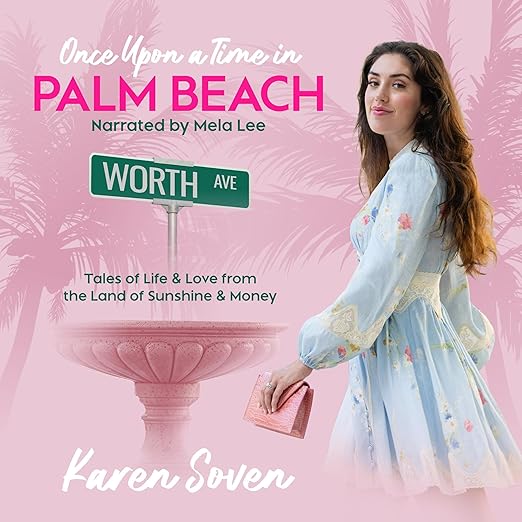
Karen Soven's prose in Once Upon a Time in Palm Beach announces its priorities early: she writes about light, color, and the specific textures of Island living with the precision of someone who arrived as an outsider and spent years learning to read a landscape that was never quite designed for her. This audiobook, narrated by Mela Lee, runs eleven hours and thirty minutes and covers ground that sounds gilded from a distance. But the memoir earns its subtitle, Tales of Life and Love From The Land of Sunshine and Money, by insisting on the cost of that life alongside its pleasures, and by refusing to let the glass slipper remain unbroken.
The author's trajectory moves from Manhattan fashion apprentice to sales director for handbag designer Lana Marks to soccer mom to business owner, with a fairy godmother socialite appearing at one of the pivotal turns. Soven frames each role with the Wonderland metaphor she establishes early: like Alice, she entered through a door not designed for her and had to learn the rules of a place that operated on logic she had not been born into. It is a structure that works because Soven does not romanticize the transformation. The glass slipper does shatter, and the memoir is honest about what that shattering costs in practical and psychological terms.
Mela Lee's Control Through the Tonal Shifts
Mela Lee's narration suits the material well. She has a precise, controlled quality that matches the social world Soven is describing, where presentation is everything and the performance of ease matters enormously. Lee handles the memoir's tonal shifts, from the genuinely glamorous to the genuinely difficult, with enough range to keep the eleven-hour runtime from feeling uniform. The passages dealing with financial hardship and the personal upheaval that threatened Soven's constructed world require a different register than the set pieces involving celebrity clients and Worth Avenue socializing, and Lee navigates those shifts without jarring transitions.
Reviewer Lyn's description of the book as elegant, witty, and quietly sharp captures something true about the text. Soven is not a bitter narrator, which is a meaningful choice. She could have written a takedown of Palm Beach's insularity and social performance. Instead she writes a memoir that holds the world up to examination without contempt, which is harder and more interesting. The glamour sparkles on its own terms. The critique is embedded in the specifics rather than stated overtly, which gives the book a texture that straight social satire would not achieve.
The Real Cost Behind Happily Ever After
The audiobook format is a strong choice for this memoir. Soven's descriptive writing, the sky blues and cotton candy pinks of Island living she references in her framing, is the kind of prose that benefits from a skilled narrator's pacing. Lee gives those passages room to land. Social detail is often most vivid when delivered at the pace of recounted memory rather than the speed of a reader moving through text, and the eleven hours allow the accumulation of specific detail that makes the book's world feel genuinely inhabited rather than impressionistically sketched.
The memoir's central structural question, what is the real cost of happily ever after, is embedded in the book's longest and most substantive section, which deals with Soven's rebuilding of her husband's law firm and the navigation of personal upheaval that came alongside professional reinvention. Soven's gift for creating authentic connections, which she identifies as her most durable skill across all the roles she inhabited, is what makes this more than a fish-out-of-water narrative. Her ability to build genuine relationships across class lines, from hip-hop legends to old-money socialites, is the thread that runs through every phase of the story.
Worth Avenue as Stage, Not Just Setting
Listeners should pay particular attention to the sections involving Worth Avenue, which Soven describes as both setting and subject. Worth Avenue's combination of old money retail, social performance, and the way that specific public space functions as a stage for Palm Beach's self-presentation is described with the authority of someone who watched the scene closely for years. Lee's narration does justice to the atmospheric quality of those passages, and they reward slower listening rather than the background mode that some memoir sections permit.
Reviewer Lorena Reyes described living vicariously through Soven's experiences as a primary pleasure of the read, and that vicarious quality is one of the memoir's genuine achievements. The world is specific enough to feel real, the author's perspective is generous enough to be good company through eleven hours, and the difficulties are handled with enough honesty to prevent the whole from becoming aspirational fantasy. Reviewer Diamela noted the book as a must-read for anyone curious about high society and the stories hidden beneath the glamour, which accurately names the memoir's primary audience.
A Memoir for Behind-the-Gates Wealth Watchers
Listeners who enjoy behind-the-gates memoirs about wealth and social milieu, and who have appreciated books like Tatler-adjacent accounts of upper-class life or accounts of outsiders navigating elite institutions, will find this memoir familiar in structure and satisfying in its specificity. Those who come to the book through an interest in the fashion industry or in the Palm Beach social world specifically will find relevant and detailed insider perspective throughout.
The memoir is also genuinely useful for listeners interested in the mechanics of business reinvention and reputation management in high-stakes social environments, since those are the practical underpinnings of Soven's story beneath the social glitter. Listeners expecting a pure takedown of wealthy excess will find the book more complicated than that. Soven is a sympathetic narrator who genuinely loved aspects of the life she built, and the memoir's intelligence lies in its refusal to retroactively condemn what she participated in. Eleven hours is a substantial commitment, but the audiobook earns it through consistent specificity and an authorial voice that is good company throughout.
At a Glance
- Narration: Mela Lee brings Karen Soven's voice to life with a sophisticated register that suits the Palm Beach milieu, navigating the memoir's tonal range from social glamour to genuine financial hardship with consistent control.
- Themes: Reinvention and identity, the real cost of social ambition, grace under financial pressure
- Mood: Sun-drenched with shadows underneath, elegant and quietly sharp
- Verdict: A memoir that rewards listeners who enjoy behind-the-curtain accounts of wealthy enclaves and the people who navigate them from the outside.
A Few Questions About Once Upon a Time in Palm Beach
Is Once Upon a Time in Palm Beach audiobook a tell-all about Palm Beach society?
It is more memoir than expose. Soven writes as a participant-observer who navigated Palm Beach's social world as an outsider, and her account is sharp and specific without being primarily focused on exposing others. The critique is embedded in the details rather than stated directly.
How does Mela Lee's narration handle the memoir's emotional range?
Lee manages the shift between the memoir's glamorous set pieces and its harder passages, including financial upheaval and personal crisis, with enough tonal range to prevent the eleven-hour runtime from feeling emotionally uniform. She brings a controlled sophistication that suits the Palm Beach setting well.
Does the audiobook cover Karen Soven's career in fashion in detail?
Yes. Soven's path from Manhattan fashion apprentice to sales director for designer Lana Marks is covered in detail and forms the foundation for understanding how she arrived in Palm Beach and what skills she brought to that world.
Is this audiobook suitable for listeners who don't follow celebrity or society culture?
Yes. While Palm Beach society and celebrity clients appear throughout, the memoir's real subject is identity, reinvention, and the gap between external success and internal stability. Those themes translate well beyond interest in the specific social milieu.