Quick Take
- Narration: Margy Stein handles the conversational structure of Chomsky and Vltchek’s dialogue with clarity, distinguishing the two voices well without overplaying the difference.
- Themes: Western colonialism and imperial control, propaganda and media complicity, the politics of naming violence
- Mood: Combative and unsparing, with the intimacy of a private intellectual conversation
- Verdict: Essential for anyone who wants Chomsky’s political framework in conversation form, though it assumes significant prior knowledge of the conflicts discussed.
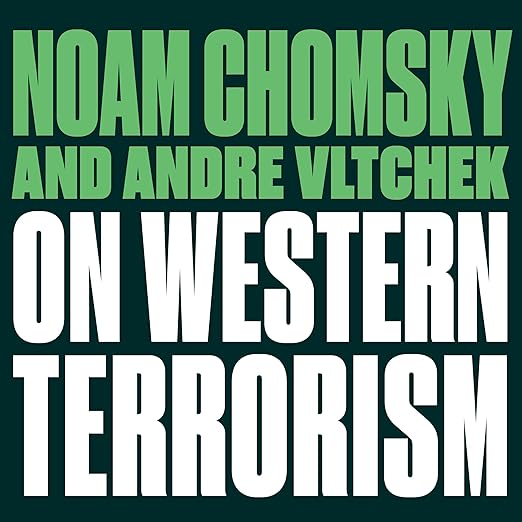
I tend to read Chomsky in concentrated doses followed by long pauses, because his accumulated evidence about Western foreign policy has a quality that is difficult to sustain continuously. Not because the argument is weak, but because it is relentless, and relentlessness has its own cognitive cost. On Western Terrorism is a different format from his longer analytical works. It is a conversation between Chomsky and filmmaker Andre Vltchek, conducted across multiple sessions, covering colonialism, imperial control, propaganda, drone warfare, the Arab Spring, and what Chomsky calls the legacy of mass murder that Western powers have administered and then systematically failed to acknowledge.
The book began as a series of discussions and was originally published in 2013. This Pluto Press audiobook edition, released in January 2026, includes a new foreword by Chomsky and a refreshed design. That the conversation remains relevant is itself part of the book’s implicit argument: the patterns it describes do not change quickly, and the mechanisms of Western self-exculpation are durable.
Our Take on On Western Terrorism
What distinguishes this from Chomsky’s more formal writing is the dialogic quality. Vltchek functions less as an interviewer in the conventional sense than as a co-thinker who shares many of Chomsky’s premises and pushes the conversation toward specific cases and geographic contexts, including Syria, Nicaragua, Cuba, China, Chile, and Turkey. Reviewer King Kobra described the experience accurately: you are present as you observe two intellectuals discuss matters concerning colonialism and people and resource exploitation. That presence is different from reading a monograph. The conversation moves, doubles back, and occasionally lingers in ways that formal essays do not.
Reviewer NRJ offered a more critical assessment, noting that because Chomsky and Vltchek share so much background knowledge, the conversation is not particularly useful for listeners with no prior knowledge of the conflicts being discussed. That is a fair limitation to acknowledge. The book is an introduction to Chomsky’s political thought in the sense that it is more accessible than Manufacturing Consent or Deterring Democracy, but it is not an introduction in the sense of starting from first principles. Specific conflicts and specific acts of Western intervention are referenced without the kind of extended contextual scaffolding that would allow a genuinely uninitiated listener to follow.
Why Listen to On Western Terrorism
Margy Stein’s narration handles the conversational format well. The challenge of a two-voice dialogue delivered by a single narrator is maintaining enough distinction that listeners can track who is speaking without having the differentiation feel theatrical. Stein manages this consistently. The book is just over five hours, a relatively short audiobook for the scope of the argument, which means the conversation moves at pace and does not circle back exhaustively on individual points.
The shortness is both an asset and a limit. Reviewer King Kobra noted it does not sound too preachy, which is an accurate characterization of how Chomsky and Vltchek handle the material. The tone is discursive and analytical rather than declamatory. They are working through ideas together, not performing outrage.
What to Watch For in On Western Terrorism
This is firmly a work of left political thought, and it does not pretend otherwise. Reviewer Carmen A. described it as a mind-blowing look at what is really going on, according to two great leftist thinkers, and that framing is accurate. The analytical framework is Chomsky’s consistent one: Western states apply the term terrorism selectively to justify their own exercise of violence while exempting their own historical and ongoing actions from the same label. Listeners who find that framework compelling will engage differently with the evidence presented than those who do not.
The conversational format also means that some of the claims made between Chomsky and Vltchek are assumed rather than argued. Several assertions about specific historical events are made in passing without the citations or extended evidence that Chomsky provides in his longer analytical works. Listeners who want to pursue specific claims further will need to follow up with his more documented titles.
Who Should Listen to On Western Terrorism
This is for listeners who are already broadly familiar with Chomsky’s analytical framework and want to hear him apply it conversationally to a range of contemporary and historical cases. It is also for anyone who wants a compact introduction to his political thought that does not require committing to one of his longer analytical works first. Reviewer C. Watson described it as a useful supplement to other readings, and that function as a contextualizing text alongside other sources is probably its best use.
Listeners who want a balanced treatment of Western foreign policy, or who approach these questions from a different political framework, will find the book frustrating rather than illuminating. It is not designed to persuade skeptics. It is designed for readers who are already asking Chomsky’s questions and want to hear him answer them in an open-ended conversational form.
Frequently Asked Questions
Is this a good introduction to Chomsky’s political ideas for someone who has never read him?
It is more accessible than his longer analytical works, but reviewers have noted it assumes significant background knowledge of the conflicts and countries discussed. Listeners genuinely new to Chomsky’s framework may find specific claims difficult to evaluate without that context. Manufacturing Consent is a more complete introduction to his political framework, though much longer.
What is the role of Andre Vltchek in this book, and how does the conversation format work?
Vltchek is a filmmaker and investigative journalist who shares most of Chomsky’s analytical premises. He functions as a co-thinker who steers the conversation toward specific geographic cases and contemporary events rather than as a neutral interviewer. The format has the quality of a private intellectual conversation between two people with shared commitments.
How does the January 2026 edition differ from the original 2013 publication?
The 2026 edition includes a new foreword by Chomsky updating the context for the conversations, along with a refreshed design. The core conversations are unchanged.
Does Margy Stein effectively differentiate between Chomsky and Vltchek’s voices in the narration?
Yes. Stein maintains enough distinction between the two voices to keep the conversational format legible without making the differentiation feel theatrical. For a single narrator handling a two-person dialogue, this is a genuine challenge that she handles competently throughout the five-hour runtime.