Quick Take
- Narration: Edoardo Ballerini brings quiet authority and careful pacing to the anthology format, reviewer CMV specifically cites his narration as another great way to enter these teachings.
- Themes: Non-sectarian Tibetan Buddhism, the nature of mind, compassion and altruism across traditions
- Mood: Contemplative and spacious, asking more of the listener than it gives, in the best possible sense
- Verdict: An essential anthology for anyone seriously engaged with Mahayana Buddhism, curated by one of the most respected Western interpreters of Tibetan teachings.
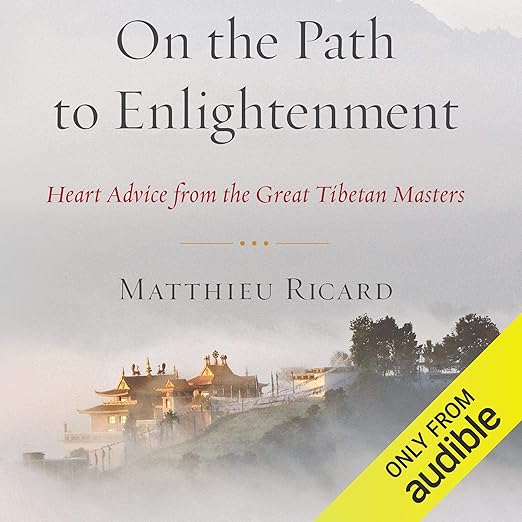
There is a particular kind of reading I save for early mornings before the day gets complicated. Slow, dense texts that require something more like listening to music than processing information. Matthieu Ricard’s anthology of Tibetan Buddhist teachings has sat in that category for me across multiple sessions, rarely consumed in long stretches, more often returned to in shorter deliberate ones. That is, I think, the right way to encounter it.
Ricard is one of the most credible translators and interpreters of Tibetan Buddhism for Western audiences, a French scientist turned Buddhist monk who has been a close student of some of the most significant teachers of the twentieth century. The occasion for this anthology came from Khyentse Rinpoche, who told Ricard that understanding the depth of the eight great traditions of Tibetan Buddhism reveals that only ignorance leads to a sectarian view. The entire collection is organized around demonstrating that convergence.
Our Take on On the Path to Enlightenment
The scope of sources Ricard draws from is genuinely remarkable. The anthology includes teachings from the Buddha himself, from classical masters like Nagarjuna, Atisha, and Shantideva, from later Tibetan figures including the Fifth Dalai Lama, Milarepa, and Longchenpa, and from contemporary teachers including the Fourteenth Dalai Lama and Mingyur Rinpoche. Arranged across the eight great lineages, the anthology makes its argument not through editorial commentary but through juxtaposition. You hear different teachers arriving at similar understandings through different routes, and the cumulative effect is exactly what Khyentse Rinpoche described: the sectarian distinctions become less important than the shared direction.
Reviewer Shambhala, writing from what sounds like a practitioner’s perspective, notes this is especially suitable for those initiating serious study and practice of Mahayana Buddhism with a free, open, and non-sectarian spirit. That framing matters. This is not a general introduction to Buddhism for curious Westerners. It assumes some familiarity with core concepts and is oriented toward listeners already on or entering a practice path.
Why Listen to On the Path to Enlightenment
Edoardo Ballerini is one of the more skilled narrators working in spiritual and philosophical nonfiction. His pacing is calibrated to the weight of the material, and he does not rush toward comprehension. The teachings in this anthology are not meant to be processed quickly, and Ballerini’s delivery honors that. Reviewer CMV, who praises the book as a precious anthology, specifically notes the Ballerini narration as another great way to enter into these teachings, which is meaningful praise from someone clearly familiar with the source material in other forms.
The listening experience benefits from being treated like meditation instruction rather than information delivery. Reviewer JOHN M MCCAFFERY, keeping his assessment brief, notes he can see himself going back to this book many times. That is the correct relationship to an anthology like this: return visits reveal different things depending on where you are in your practice or understanding.
What to Watch For in On the Path to Enlightenment
Reviewer Shambhala makes an important technical observation: this anthology is not the kind that directly reveals the Buddha’s Vision in the way that Dzogchen, Mahamudra, or Prajnaparamita teachings do. If you are specifically seeking pointing-out instructions or direct introduction teachings, those are not what Ricard has curated here. The anthology operates at the level of what one reviewer calls Heart advices and general teachings, meaning foundational orientation teachings rather than the most advanced transmissions.
Reviewer ramon notes a desire to be able to place these teachings in modern context, and suggests that other works by Ricard might serve that purpose better. Ricard’s books like The Art of Happiness or The Monk and the Philosopher offer more of that bridging quality. This anthology is more purely textual, trusting the sources to speak across centuries without extensive editorial mediation.
Who Should Listen to On the Path to Enlightenment
Practitioners and serious students of Tibetan Buddhism, particularly those interested in the inter-lineage conversation across the eight traditions, will find this invaluable. Listeners new to Buddhism who want a general introduction will be better served by something more contextual. The non-sectarian framing makes it suitable across the major Tibetan lineages. At just over six hours, it is long enough to develop a genuine sense of each tradition’s contribution while short enough to be re-listened to as one’s understanding develops.
Frequently Asked Questions
Do I need to have prior knowledge of Tibetan Buddhism to benefit from this anthology?
Yes, some familiarity helps significantly. The teachings assume knowledge of core Buddhist concepts like taking refuge, compassion practice, and the nature of mind. Reviewer Shambhala describes it as particularly suitable for those initiating serious study, implying a practitioner or committed student orientation rather than a beginner introduction.
What are the eight great traditions of Tibetan Buddhism that the anthology covers?
The eight major lineages of Tibetan Buddhism are the Nyingma, Kagyu, Sakya, Gelug, Jonang, Chod, Shangpa, and Shiche traditions. Ricard curates teachings from across all eight to demonstrate their doctrinal convergence rather than their distinctions.
How does Edoardo Ballerini’s narration suit this kind of anthology material?
Ballerini is particularly well-matched to this type of content. His pacing is measured and contemplative, and he does not impose emotional interpretation on teachings that benefit from being heard with openness. At least one reviewer specifically praises his narration as an effective entry point into the material.
Is this appropriate for practitioners from Theravada or Zen traditions, or is it specifically Tibetan?
The anthology is specifically curated from Tibetan Buddhism’s eight great lineages. While the underlying philosophy of Mahayana Buddhism has points of contact with Zen and other Mahayana traditions, the specific teachers, texts, and terminology are firmly within the Tibetan context.