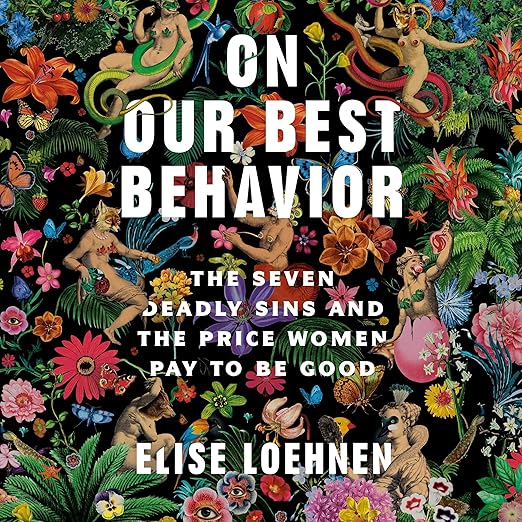
Quick Take
- Narration: Author-narrated with conviction and personal warmth; Loehnen’s familiarity with her own material gives the performance an intimate confessional quality that suits the subject.
- Themes: Patriarchal conditioning, the Seven Deadly Sins as social control, women’s internalized self-denial
- Mood: Intellectually charged and quietly urgent
- Verdict: A rigorously researched and personally felt argument for why women should stop congratulating themselves for self-erasure.
I came to this one on a Sunday afternoon when I had a full plate of tasks I kept pushing aside to do something for someone else first. That felt like exactly the right frame of mind. Elise Loehnen’s On Our Best Behavior arrived as a New York Times bestseller with a premise that sounds almost too neat: the Seven Deadly Sins, those fourth-century constructs codified by a desert monk named Evagrius Ponticus, have functioned less as universal moral guides and more as a specifically gendered cage. And Loehnen makes that argument with enough historical specificity that it stops feeling like a thesis and starts feeling like something you suspected all along but never quite named.
I finished the book’s opening chapters standing in my kitchen, having told myself I would just listen while I cooked. I was still standing there when the food went cold. That’s the particular pull of a well-executed ideas audiobook: you forget you have a body.
A History That Explains Your Monday Morning
Loehnen doesn’t begin with abstraction. She begins with the donut in the office breakroom, the email you decided not to send in anger, the 5am alarm you set to earn your day. These are the small rituals by which women signal virtue. What Loehnen then does, methodically and with genuine scholarly reach, is trace each of these rituals back through centuries of religious and cultural pressure. Pride, greed, lust, envy, gluttony, wrath, sloth: she takes each sin and turns it over to examine what it has specifically demanded of women versus men. The finding is blunt. Where sloth applied to men as laziness in worldly affairs, it applied to women as any moment of rest, any refusal to be productive and available. The sin was deployed differently depending on whose compliance needed managing.
The review from Bryan Carey noted that this is essentially a cross-examination of how these concepts have been used to keep people in their place, and that framing is accurate. But what lifts this beyond a historical survey is Loehnen’s willingness to implicate herself. She shares her own moments of disordered compliance, her own internalized policing. The book breathes because of that honesty.
Where the Personal and the Structural Meet
One of the book’s genuine strengths is how cleanly Loehnen links structural arguments to everyday female experience. The gender wealth gap, which she puts at 55 percent, is connected directly to the conditioning around greed: women who have absorbed the message that wanting more for themselves is sinful simply don’t negotiate as hard. That’s not a soft claim. It’s a measurable economic outcome with a cultural root she’s willing to name. Listeners who grew up inside religious frameworks will find the historical excavation particularly pointed. Loehnen is clear that she is not arguing against spirituality; she is arguing against the way specific theological constructs were weaponized over centuries to produce obedient female behavior.
Some listeners, including one reviewer here, found sections that drifted from the central argument. I noticed this too in a passage toward the middle of the book where the scope widens into broader world traditions. But Loehnen’s stated aim is to offer alternative spiritual wisdom as counterbalance, and when she returns to her central frame the momentum recovers quickly.
Reading Your Own Work Out Loud
Loehnen narrates this herself, and it shows in the best way. There is a directness to her delivery that avoids the smoothed-out neutrality of professional narration. When she describes her own experiences, her voice carries the weight of someone who has actually lived the argument she is making, not merely researched it. Listeners familiar with her podcast Pulling the Thread will recognize the tone immediately: conversational but grounded, willing to sit inside a difficult idea without rushing to resolve it. One reviewer described the bibliography as their next reading list, and I understand that completely. This is the kind of audiobook that generates its own ecosystem of follow-up curiosity.
Who This Will Reach and Who Should Look Elsewhere
If you grew up female in any moderately Western, moderately religious or post-religious context and have ever felt obscurely guilty about wanting something for yourself, this book is likely to feel like a long overdue conversation. It’s also useful for anyone interested in the history of how social norms get manufactured and maintained across generations. Men appear in the argument too, not as villains but as fellow sufferers of a system that demanded its own distorted performance from them. Listeners expecting a light self-help listen should know this is primarily a history and cultural critique, dense in places and requiring real engagement. Anyone looking for a quick motivational fix will find the middle sections demanding. But for those willing to commit, the reward is a framework for understanding behavior patterns that most of us carry without ever examining their origins.
Frequently Asked Questions
Does Loehnen address all seven of the deadly sins equally, or does she focus on certain ones?
Each sin receives its own chapter-length examination, but Loehnen’s treatment is not perfectly uniform. Sloth and gluttony receive particularly detailed unpacking in terms of how rest-denial and appetite-suppression function in women’s daily lives. Pride and greed are explored through economic and professional lenses, while lust receives a nuanced treatment around sexuality and bodily autonomy.
Is this book religious in tone, or does it work for secular listeners?
It functions well for secular listeners. Loehnen’s argument is historical and sociological rather than theological. She traces how religious frameworks produced cultural conditioning that persists even in largely secular contexts. She does draw on spiritual traditions from outside Christianity as counterpoint, so openness to that material helps, but belief is not required.
How does the author-narrated format affect the listening experience compared to a professional narrator?
It adds intimacy and authenticity, particularly in the personal sections. Loehnen’s voice is warm and direct, and her familiarity with the material means pacing feels natural rather than rehearsed. The tradeoff is that professional polish is absent in places, but most listeners will find this a reasonable exchange for the sense of direct conversation it creates.
Is this book more focused on history or on practical self-help guidance for women?
It is primarily a historical and cultural critique, not a self-help manual. Loehnen offers some reorienting perspectives toward the end, but the bulk of the nearly 12-hour listen is analytical: tracing how the sins were constructed, deployed, and internalized. Readers wanting actionable steps will need to do that work themselves, but the analytical framework is precise enough to be genuinely useful.