Quick Take
- Narration: January LaVoy handles Serpell’s dense, stylish critical prose with the kind of interpretive intelligence the text demands, she understands the difference between a quote from Morrison and Serpell’s commentary on it.
- Themes: Toni Morrison’s formal experiments, the relationship between Black women’s literary tradition and the American novel, how to read complexity without domesticating it
- Mood: Rigorous and exhilarating, literary criticism as its own form of art
- Verdict: Namwali Serpell’s study of Morrison is the rare work of criticism that earns comparisons to its subject: it reads like it was written to be read slowly, and January LaVoy’s narration gives that slowness a voice worth trusting.
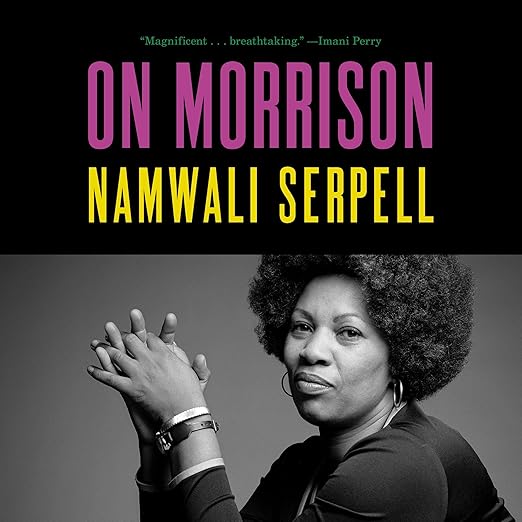
I came to this book with some wariness. Literary criticism in audio format can be an awkward proposition. Close reading depends on the ability to return to a passage, to sit with a sentence, to mark a page and come back. Namwali Serpell’s On Morrison is a book that demands that kind of attention: it is dense, ambitious, and self-consciously literary in its own prose. I wasn’t sure it would survive the translation to audio. I was wrong about that, and January LaVoy is a significant part of why.
Serpell is both a prize-winning novelist (her debut, The Old Drift, won the Windham Campbell Prize) and a Harvard professor who teaches a course on Morrison’s work. That combination is rare, and it shapes every page of this book. She writes with the novelist’s investment in the work and the critic’s systematic attention to how the work is constructed. The blurbs from major reviewers quoted in the synopsis are unusually consistent: Time called it “literary criticism at its finest,” Cathy Park Hong called it “a classic,” and The New York Times used the word “thrilling.” When reviewers across outlets converge on the same vocabulary, it usually means the book is doing something genuinely unusual.
The Argument About Form
Serpell’s central thesis is that Morrison’s genius lies not primarily in her themes or her subject matter, significant as those are, but in her experiments with literary form. What Morrison did to the novel structurally, temporally, narratively, and syntactically is what Serpell wants her readers to see. Reviewer L-Booknerd, who had read the book with prior knowledge of Morrison, noted appreciation for Serpell’s insights into Morrison’s ability to render voice on the page, specifically citing a section on a passage from Sula where Serpell’s analysis illuminates something in Morrison’s use of character names that less careful readers would pass over.
This close-reading approach has real implications for how the book works in audio. Serpell is quoting Morrison frequently and at length, then analyzing specific word choices and structural decisions. LaVoy handles this well by making audible the difference between Morrison’s sentences and Serpell’s analytical commentary on them. It’s a subtle distinction that requires sustained attention from both narrator and listener, and LaVoy consistently pulls it off.
The Oeuvre, Not Just the Hits
One of the book’s most valuable features is its coverage. Serpell moves through Morrison’s entire output: the major novels from The Bluest Eye through God Help the Child, but also the literary criticism, the dramatic works, and the poetry. Reviewer Amazon Customer noted that the book made them want to reread Morrison’s novels, which is the highest compliment any piece of literary criticism can receive. The book is structured as a chronological journey through the oeuvre, with each chapter giving focused attention to a specific work while maintaining sight of the larger arc of Morrison’s development as a formal innovator.
At nearly thirteen hours, this is a substantial commitment that rewards active listening. You won’t absorb everything on a first pass. But Serpell writes prose that bears revisiting, and LaVoy’s performance gives the denser passages an interpretive frame that makes them more navigable than they might be in print on first encounter.
Who This Is For and What It Assumes
The Wall Street Journal’s description, “invigorating and accessible,” is fair but should be understood with calibration. The book is accessible relative to academic literary criticism, not relative to popular nonfiction. Serpell assumes readers have some existing acquaintance with Morrison’s work, and the deepest pleasures of the book are available to listeners who have read at least three or four of the novels. For a complete newcomer to Morrison, this would be an unusual starting point; Beloved or Song of Solomon first, then Serpell.
For readers already inside Morrison’s world, this is the critical companion they’ve been waiting for. Reviewer Kindle Customer, reading from an advance copy, described Serpell’s focus on a specific chapter of Sula as making visible something in Morrison’s technique that the reviewer recognized but had never been able to articulate. That recognition-and-articulation service is what the best literary criticism does, and Serpell performs it with unusual elegance.
Listen if: You have read Morrison and want rigorous, stylish critical analysis that treats the formal complexity of the work with the seriousness it deserves.
Skip if: You’re new to Morrison and looking for an introduction rather than a scholarly companion, or if you find dense literary criticism easier to absorb in print than in audio.
Frequently Asked Questions
How many of Morrison’s novels should I have read before tackling this book?
Serpell covers the full oeuvre, and the book is most rewarding for readers familiar with several of the major novels. Having read Beloved, Song of Solomon, and Sula would give you a strong foundation. The book can also function as a reading guide, prompting you to read Morrison’s works alongside or after each chapter.
Does January LaVoy’s narration handle the distinction between Morrison quotations and Serpell’s critical analysis clearly?
Yes. LaVoy makes the tonal and interpretive distinctions audible throughout. For a book that depends on the listener tracking which voice is speaking at any given moment, Morrison’s prose or Serpell’s analysis, this is a crucial performance skill and LaVoy has it.
Does the book engage with controversies around Morrison’s work, including the critical debates about identity, universality, and literary canon?
Yes. Serpell is not writing hagiography. She engages with the complexity of Morrison’s position as, in her words, the only truly canonical Black female writer, and what that designation has meant for how her work has been received and sometimes reduced by readers and institutions.
Is On Morrison primarily for academic readers or does it work for serious general readers?
It works for serious general readers who are willing to engage actively. Multiple reviewers without academic backgrounds found it rewarding. The prose is dense but not jargon-heavy. Serpell writes as a novelist as well as a critic, and her sentences are made to be read as well as analyzed.