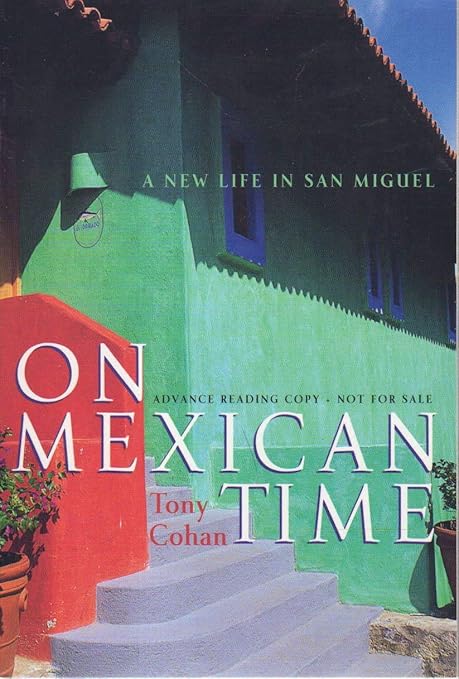
I came to On Mexican Time through the back door, a friend pressed the physical book into my hands years ago and I read it in two sittings, which is the kind of reading pace the book explicitly argues against. When I returned to it in audio form, I did it more slowly, as it deserves: twenty minutes here, half an hour there, the way you might sit in a Mexican plaza and watch the afternoon change. That is the mode the book operates in, and Tony Cohan self-narrating his own memoir in his measured literary voice makes that pace feel like the only correct one.
The premise is deceptively simple. Tony Cohan and his partner Masako arrive in San Miguel de Allende, a colonial hill town in central Mexico, on what was supposed to be a brief visit. They buy a ruined house instead. The book follows the renovation, the workers, the dust, the collapsed walls, the slow revelation of something worth keeping underneath the damage, and the simultaneous renovation of two people who have decided to live on different terms. Los Angeles is behind them. San Miguel, with its baroque churches and markets and particular quality of light, is what they are moving toward.
Cohan writes with genuine affection for the town and its people without sentimentalizing Mexico into a backdrop for Western self-discovery. The Mexicans in the book are specific people with specific histories, not local color. The renovation is not a metaphor that the book announces; it emerges from the accumulated detail of what it actually takes to bring a crumbling colonial house back to life, the lime plaster, the ironwork, the particular way the light enters a newly opened window. Cohan is a novelist and the prose shows it. Sentences earn their weight.
No user reviews were available in the data for this title, which means I am drawing on the book's long-standing reputation as a cult classic in expat and travel memoir literature. That reputation is deserved. Since its publication it has sent a measurable number of readers to San Miguel de Allende to see what Cohan was describing, which is the specific test a travel memoir can pass: it makes you want to go to the place, not just read about it.
The Strengths
The self-narration is a genuine asset. Cohan does not have the theatrical range of a professional narrator, but he has something more valuable for this particular text: he sounds like someone recounting his own life carefully, choosing words the way you choose what to keep when a house is being rebuilt. The audio version at five and a half hours is a manageable length for material this atmospheric, long enough to sink into, short enough to finish before the spell breaks.
The book also functions as a portrait of San Miguel de Allende for listeners who have not visited. Cohan is attentive to the town's architecture, its expat community, its markets, its festivals, and its particular relationship to time, the quality that the title names. Readers who have visited San Miguel will find themselves recognizing specific plazas and light conditions. Readers who have not will understand why people go.
What to Watch For in On Mexican Time
This is not a book with dramatic events. Nothing terrible happens and nothing triumphant is achieved in the conventional sense. The conflict is the slow, uncertain process of deciding to stay somewhere and of learning to live there rather than just visiting. Readers who need external stakes or propulsive plotting will find the pace frustrating. Readers who want a book that makes them feel a place, its quality of light, its texture, its social life, will find On Mexican Time one of the most effective examples of that mode in travel literature.
The prose can slip into the lyrical in ways that some readers find rich and others find indulgent. Cohan is clearly in love with his subject, which is appropriate for a memoir of this kind, but listeners who prefer their nonfiction more plainspoken will occasionally feel that he is working too hard to make the beautiful things beautiful.
Recommended For
This is the audiobook for anyone who has ever daydreamed about leaving and starting somewhere entirely different, for listeners who love travel memoir that goes deep rather than wide, and for anyone curious about San Miguel de Allende specifically. It is not for listeners who want incident, revelation, or resolution in the conventional sense. Come to it in a mood to be still, and it will reward you accordingly.
Before You Listen
Do I need to know San Miguel de Allende to enjoy the book?
No prior familiarity is needed. Cohan is describing the town for readers encountering it for the first time, and the writing is specific enough that the place becomes legible through the prose.
How does Tony Cohan's self-narration work for listeners who prefer professional narrators?
Cohan is a novelist rather than a performer, so his narration is measured and literary rather than dramatically varied. For this particular memoir, that quality matches the material. Listeners who require high-energy narration may find it too quiet.
Is the book dated given when it was first published?
On Mexican Time was first published in 1999 and reflects that era's San Miguel de Allende. The town has changed significantly since then, particularly in terms of its international profile and cost of living. The memoir reads partly as a period document and partly as a timeless portrait of a place with deep roots.