Quick Take
- Narration: Dean Smart delivers a measured, unhurried read that suits the solo-paddler pace of the journey: clear diction, no theatrics, steady company for eight hours.
- Themes: Solo self-reliance, Caribbean wilderness, the pull of the open sea
- Mood: Sunlit and quietly tense, alternating between wonder and real danger
- Verdict: A richly detailed open-water adventure memoir that rewards patient listeners who want to feel the Caribbean’s forgotten edges, not its resort pools.
I started this one on a gray Tuesday morning when I had two hours before my first meeting and no particular desire to be indoors. I put on my headphones, closed my laptop, and let Scott B. Williams take me somewhere entirely else. By the time I had to stop, I was standing in my kitchen with my coffee going cold, somewhere between Florida and the Bahamas in my head, already calculating when I could come back.
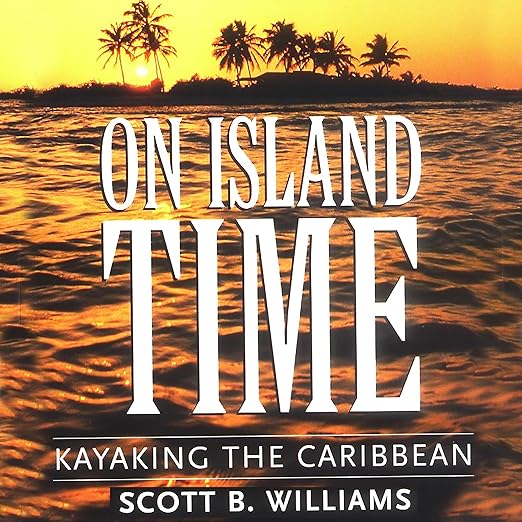
On Island Time is the written account of a journey Williams undertook in his mid-twenties: a solo kayak trip down the western coast of Florida, through the Bahamas, and onward to Hispaniola, Puerto Rico, and the Virgin Islands. He paddled a 17-foot sea kayak. No companion. Often, no one knew where he was for weeks. The premise alone is enough to make your chest tighten.
Our Take on On Island Time
What distinguishes this memoir from the genre’s sunnier entries is Williams’s refusal to romanticize the difficulty. Yes, the Caribbean cays are pristine. Yes, the solitude is addictive. But relentless headwinds turn paddling into a war of attrition. Sharks ram his hull. Countless beaches posted off-limits force him to sleep on his boat or seek permission from hostile landowners. Williams writes about these moments without melodrama, which is exactly what makes them feel real. This is not the Caribbean of travel brochures. It is the Caribbean of consequence.
The book reads as the work of a young man who made a genuinely reckless decision and survived it largely through competence, stubbornness, and a capacity for solitude that most people never develop. One reviewer compared the experience to riding in the number two hatch of a twin-seat kayak, and that’s close to accurate. Williams’s prose puts you close enough to smell the salt air and feel the hull shudder in confused chop.
Why Listen to On Island Time
Dean Smart’s narration is the right match for this material. He keeps things steady and unadorned, which suits a memoir that is fundamentally about patience and persistence. There are no dramatic voice shifts, no performed excitement, just a reliable presence guiding you through long passages at sea. For a nearly eight-hour listen, that consistency matters more than flair. The audiobook format suits the journal-like structure of the book, where each chapter tends to cover a new leg of the journey, a new island, a new encounter with locals or weather or wildlife.
Multiple reviewers drew a comparison to Paul Theroux’s island travels by kayak, and it holds in at least one direction: both writers use water as a way to get beneath the surface of places that tourism has flattened. Williams lacks Theroux’s literary bitterness, but he has something Theroux sometimes doesn’t, genuine wonder at what he finds. A reviewer who identified themselves as a native Virgin Islander noted Williams’s detailed, affectionate rendering of their home island, which feels like high praise for accuracy and attention.
What to Watch For in On Island Time
The pacing is not uniformly gripping. Extended passages about navigation, wind patterns, and supply logistics are honest to the experience but can test listeners who came primarily for dramatic encounters. The solo-journey format also means the cast of characters rotates quickly, people appear, help or hinder, and then disappear. If you’re hoping for sustained human relationships to anchor the narrative, you’ll need to make peace with the fact that the sea itself is the constant character here.
The book also shows its age in places. Published originally in the early 2000s, some of the islands Williams visits have changed significantly, particularly in their tourist infrastructure. This is a minor caveat for a memoir, but worth noting if you’re using the book as any kind of practical guide to the region.
Who Should Listen to On Island Time
Listen if you’re drawn to solo adventure narratives with genuine physical stakes, if you have any interest in sea kayaking or the Caribbean beyond its resort layer, or if you responded to books like Endurance or The Brendan Voyage and want something on a smaller, more human scale. This also works well for anyone who has entertained the idea of chucking their desk job and heading somewhere impractical, Williams actually did it, and the account is honest enough about both the beauty and the cost to feel true.
Skip it if you need a propulsive narrative with a strong dramatic arc, or if the extended stretches of logistical and navigational detail will frustrate you. This is a memoir that unfolds the way the actual journey did: one slow, deliberate paddle stroke at a time.
Frequently Asked Questions
Does the audiobook cover the full journey all the way to South America?
Not quite. The subtitle is Kayaking the Caribbean, and the narrative covers the journey from Mississippi through the Florida coast, the Bahamas, Hispaniola, Puerto Rico, and the Virgin Islands. Williams describes the journey as open-ended from the start, aimed at seeing how far south he could go, so the ending reflects the reality of what a solo kayaker could sustain rather than a pre-planned finish line.
Is this suitable for listeners with no kayaking background?
Yes. Williams explains enough about conditions, equipment, and navigation that non-paddlers can follow the journey without prior knowledge. The technical detail adds texture rather than barrier, and the broader themes of solitude, self-reliance, and wilderness travel translate to any adventure-minded reader.
How does Dean Smart handle the quieter, more reflective sections of the memoir?
Smart keeps a measured, unhurried tone throughout, which works well in the meditative passages but occasionally flattens some of the more tense moments. Overall, his narration is reliable and unobtrusive, he serves the material rather than performing it.
Is On Island Time comparable to other famous kayaking or open-water memoirs?
Reviewers frequently cite the Paul Theroux island-hopping parallel. In terms of lone-paddler narratives, it sits closer to the documentary end of the spectrum than something like Derek Hutchinson’s technical guides, but with more literary ambition than a simple trip log. If you’ve read and enjoyed Jonathan Raban’s Passage to Juneau or Redmond O’Hanlon’s travel writing, the spirit of the book will feel familiar.