The Short Version
- Narrator: author and narrator are the same person, so the memoir arrives at its subject's own pacing.
- Subjects: six decades of public health, HIV and AIDS, Covid, seven presidents, institutional life in Washington.
- Tone: measured, dense with policy and epidemiology, personal in stretches.
- Bottom line: a substantial first-hand record, best taken as testimony rather than as an outside assessment.
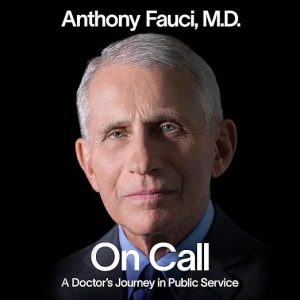
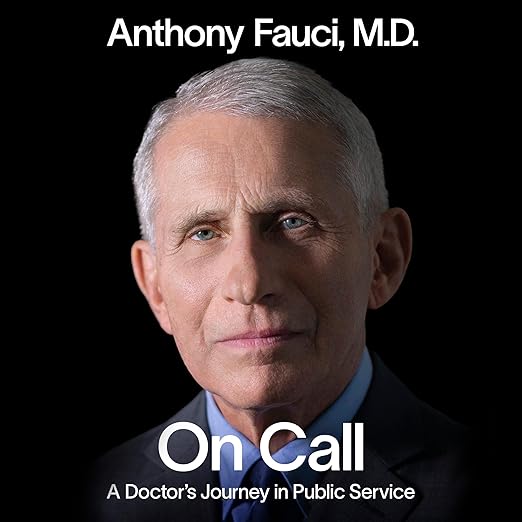
The man whose voice you hear is the man the book is about. Anthony Fauci M.D. fills both the author field and the narrator field on this audiobook, which is common enough for a memoir and still worth pausing over when the memoir runs nineteen hours and twelve minutes and covers six decades of public service. Nobody is interpreting him. No actor decides how a sentence about the arrival of AIDS in 1981 should land, and no third party smooths the account of seven presidents. What you get is the subject's own pacing, applied to his own version of events, from the first sentence to the last.
Penguin Audio released it on June 18, 2024, and the scope on offer is genuinely large. The description tracks a boyhood in Brooklyn, decades of caring for critically ill patients, and a career that put him in the room with seven presidents on questions from global AIDS relief to infectious disease preparedness. HIV, Ebola, SARS, West Nile and anthrax all appear before Covid does, which is the point the copy is most anxious to make: the pandemic most listeners associate with the name is the last chapter of the story, not the whole of it.
Five grades are visible under this listing, and every one of them is five stars. The badge above them reads 4.8. For a count of five, a 4.8 average requires the votes to total twenty-four out of a possible twenty-five, which means one star is missing from a clean sweep and one of those votes is not the five it appears to be. Both things cannot be true at once. Somewhere between the ratings the store counted and the reviews it chose to display, a grade has gone astray, and the discrepancy is small but it is arithmetic rather than opinion. It is also a useful reminder of how little five votes can carry on a title of this profile, where the number of people with a fixed view of the author runs to seven figures and the number who filed a grade here runs to five.
Why Listen to On Call
Fauci reading Fauci is the argument for this edition over the print one. A memoir about testifying, negotiating, briefing and being shouted at is a book about how a person talks, and the audio hands you the actual instrument. That is not a claim about how well he performs it, since nobody on this page has written a word about the recording, but it is a structural fact worth weighing: the emphases are the author's own choices, and the passages about colleagues, about his parents and wife and daughters, and about the failures he concedes are delivered by the person who made them.
Both of the pull-quotes the publisher selected point at the same quality. The Washington Post calls it an eventful autobiography and a classic American story. Jerome Groopman, writing in The New Yorker, describes one of the most consequential and most prominent careers in American medicine in the past fifty years. Neither is reviewing the recording, and both are doing what jacket copy does, but between them they set an expectation of narrative rather than testimony, which matches what the reviewers below actually describe.
MJK, posting in December 2025, does something unusual: quotes another review from this same page. The entry opens by saying that the reviewer known as amachinist, who wrote in September 2024, took the words right out of MJK's mouth, then reproduces that review at length. amachinist's original is still there, three entries down, dated September 12, 2024. The quotation is also where MJK's text stops, cut off mid-word by the page itself, so the passage being endorsed is truncated exactly where it starts. It is an odd little loop, and it means one of your five data points is largely a copy of another.
What to Watch For in On Call
Anthony Fauci is not a neutral name, and the column knows it. MJK ends by calling him a true American and international hero who should be respected by all, especially by President Trump. The entry filed from Japan, under a handle that renders in non-Latin characters, offers two sentences: this is my bible as a medical doctor, and the United States should be proud of him, not that president or the secretary of HHS. Both are five-star grades, and neither is really about the book. If you want to know how the writing holds up, this column is going to tell you about politics instead.
A nineteen-hour memoir also has weight distribution, and the most detailed review here flags where it sits. amachinist describes a work that doubles as a history of modern infectious disease, notes that November 1981 is where the AIDS epidemic enters, cites 86 million people infected with HIV worldwide by 2023, and records that Fauci concedes homophobic prejudices may have slowed the early response. That is a book with a research spine, not a celebrity memoir with anecdotes. Listeners hoping for a brisk personal story should expect long stretches of epidemiology, policy and institutional detail.
Listeners should also notice how little of this column is about the audiobook at all, and how far-flung it is. Of five entries, one was filed in Canada and one in Japan, and Anna Christie's entry, filed in Canada, calls it a page-turning memoir, which is a phrase about paper. The dominant note across all five is gratitude toward the subject. That is a legitimate response to a life, but it is a weak instrument for deciding whether nineteen hours of a scientist reading his own prose is how you want to spend the next two weeks of listening.
The Right Listener for On Call
Pass if you want an outside account. This is the subject's own telling, delivered in the subject's own voice, and it is structurally incapable of contradicting itself. Pass too if the Covid years are your only interest, because the copy makes clear they arrive late and share the book with HIV, Ebola, SARS, West Nile and anthrax, and you would be paying nineteen hours for a fraction of it.
Anyone with a real interest in how public health institutions actually operate has an unusually direct source here, read by the person who ran one of them for decades. The material is substantial, the pull-quotes are from serious places, and the self-narration removes a layer of interpretation between you and the account. Nineteen hours with a first-hand witness to the epidemics that shaped modern public health is a considerable offer, provided you accept that the witness is also the narrator, in every sense.
Good to Know
Does Anthony Fauci narrate the On Call audiobook himself?
Yes. The author field and the narrator field both read Anthony Fauci M.D., so the nineteen hours and twelve minutes are delivered by the subject himself. Nobody in the column comments on the recording, but the credit means the emphases and the pacing are an author's choices rather than a hired performer's.
How much of the audiobook is about Covid?
Less than the cover suggests. The description places Covid last in a sequence that includes HIV and AIDS, Ebola, SARS, West Nile and anthrax, and reaches back to a Brooklyn boyhood and decades of clinical work. The most detailed reviewer describes a history of modern infectious disease rather than a pandemic memoir.