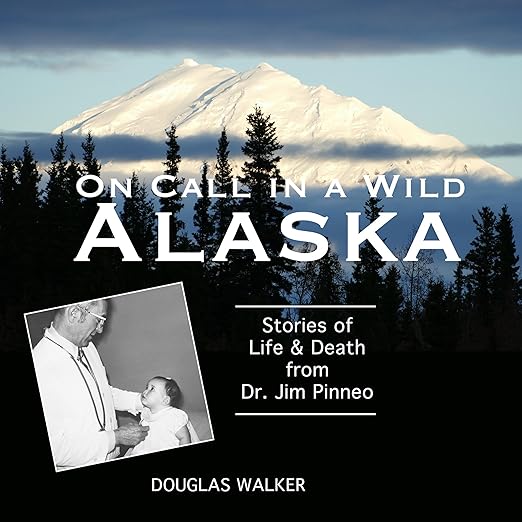
In Brief
- Narrator: Douglas Walker records the book Douglas Walker wrote, on a listing where the publisher line gives that name a third time.
- Subjects: Frontier medicine, one doctor covering eight roles, mission service in a valley with no second hospital.
- Tone: Warm and anecdotal, with weather and distance doing the plotting.
- Bottom line: A tribute rather than an examination, strong on incident and silent about who assembled it.
Dr. Jim carries this whole audiobook and never once gets a surname from the description. He is an ER physician, a surgeon, a counselor, an ambulance driver, an obstetrician, a stand-in veterinarian, an administrator and a family doctor, all of it between 1954 and 1987, all of it in Alaska's Copper River Valley. Eight hours and forty-five minutes of a working life, and the man at the center of it is identified by a first name and a title.
Instead the surname arrives from a reader. Liane's entry calls the portrayal of Dr. Jim and Lois Pinneo stunning and accurate, which supplies a family name and a second person the description never mentions. Whether Pinneo belongs to both of them or only to Lois, that entry does not say, and the listing offers nothing to settle it. Anyone who wants to check whether any of this is verifiable has to trust a review for the spelling before starting.
The stories are the reason this exists, and the description is not shy about them. Roadside deliveries in subzero temperatures. Emergency flights through blizzards. Mountain-climbing tragedies, bear maulings, an outbreak of diphtheria. Patients traveling from an area the size of Ohio because Faith Hospital in Glennallen was the only medical facility in the region for years. One patient's line is quoted directly and does most of the work: whoever heard of one doctor doing all that. Thirty-three years of it is a great deal of narrative for one voice to place, and the summary does not pretend to arrange it into anything more shapely than a run of emergencies.
Faith Hospital's mission affiliation is stated plainly, and the description closes on encouragement rather than assessment, saying the biography challenges its audience to look beyond themselves. That sentence tells you the register. This is a tribute and not an examination of rural medicine, and the phrase a man with a servant heart sits in the summary without irony. One of the two written responses arrives at that theme unprompted, describing a man of intense faith serving his neighbors and his God.
Walker Wrote It, Reads It, and Published It Too
Douglas Walker wrote this, Douglas Walker reads it, and the publisher line gives the name a third time, which makes the whole thing an independent production from manuscript to microphone. For a biography that depends on anecdote and timing, having the person who gathered the stories deliver them is usually an advantage; pauses land where the teller intends. Nothing on the page describes earlier recording work, so what reaches your ears is the voice of the person who gathered the material, not a hired one.
Nearly nine hours is a workable shape for this kind of book. Episode-driven medical memoirs live or die on the ratio of case to reflection, and the description promises a great deal of case: a diphtheria outbreak, psychiatric emergencies in a place with no second facility, deliveries at the roadside, flights into weather. That structure breaks into natural stopping points, which matters more to a listener than to a reader, and it is the clearest reason to prefer the recording to the page.
Geography does work no writer has to manufacture. A single facility serving a region the size of Ohio, with one doctor holding eight job titles at once, is a premise that generates conflict without help. The years matter as much. From 1954 to 1987 is a long enough stretch that the practice described at the beginning and the practice described at the end cannot be the same job, and Dr. Jim stayed for all of it rather than dropping in for a season.
Four Perfect Votes, Two Written Responses, No Surname
Four votes, all of them perfect, and only two people wrote anything. The arithmetic is settled: four whole-star an average of five across four votes rules out any grade below a five, so no voter dissented. What that sweep cannot tell you is anything about scale. Two written responses on an eight-hour biography is a thin evidence base, and both dates fall in the ten days before February 4, when the recording went on sale.
A second gap sits underneath the first. This is a biography, which means Douglas Walker is writing about someone else, and the listing never explains the connection between them. A colleague? A patient? A relative, or a researcher who arrived decades later with a recorder? The listing does not say, and the two written responses do not either. For a book whose value rests on accuracy, and one entry calls the portrayal accurate, that is the question you would most want answered.
Then the title. On Call in a Wild Alaska reads oddly, with an article where most listings would drop it, and neither the description nor the two responses use the phrase again. Add a subject tag that files a book about bear maulings and roadside deliveries under Professionals and Academics, and you get metadata assembled in a hurry. None of that affects the recording. All of it affects how easily anyone finds the recording, and with author, reader and publisher being one person, nobody else stood in a position to catch it. Independent production buys freedom and costs you a second pair of eyes.
Faith Declared Outright, Never Smuggled Into the Story
Anyone who has lived at the end of a long road will recognize the shape of this immediately: the nearest help is hours away, the weather votes, and whoever shows up has to be competent at everything. Rural medicine listeners, readers drawn to Alaska, and people who like a professional life told as a run of emergencies are the core audience. The faith element is present and declared rather than smuggled in, which makes it easy to opt into or around. The description names listeners rather than readers when it says who the book encourages, which is a small courtesy print-sourced copy usually forgets.
Encouragement is what the description commits to, openly, and the only two written verdicts on the page are unqualified praise, so anyone after a critical account of mission medicine in a remote valley is in the wrong place. What is here instead is a first-person delivery of a life spent holding eight jobs at once, with a perfect score behind it and almost no explanation of who assembled it or why. Set it aside if that provenance matters to you more than the stories do.
A Few Questions About On Call in a Wild Alaska
Who is Dr. Jim, and why does the audiobook never give a surname?
The description identifies him by a first name and a title only: an ER physician, surgeon, obstetrician and family doctor working Alaska's Copper River Valley from 1954 to 1987. A surname, Pinneo, surfaces in one written response beside a Lois Pinneo, though whether it belongs to both people is left open.
Does the author read the audiobook?
Yes. The author field and the narrator field both read Douglas Walker, and so does the publisher line, which makes this an independent production from writing through recording. No earlier narration work is described anywhere on the page, so the delivery on offer is authorial rather than trained.
How much of the book is medicine and how much is faith?
Both are declared up front. The description lists diphtheria, bear maulings, mountain-climbing tragedies and roadside deliveries, then closes by calling this the biography of a man with a servant heart and naming the mission affiliation of Faith Hospital. One written response reaches that theme unprompted, so expect it throughout.