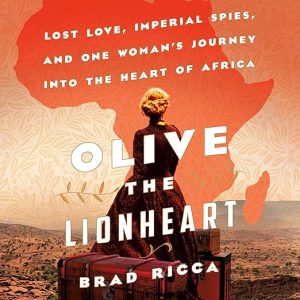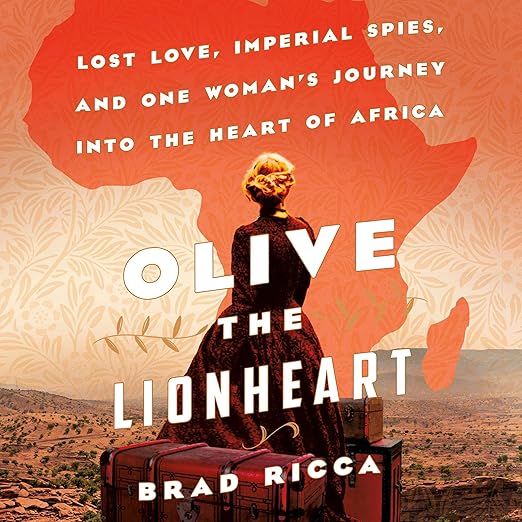
I had not heard of Olive MacLeod before picking up this audiobook, which is part of what drew me in. Here is a 30-year-old Scottish aristocrat in 1910 who receives word that her fiancé, the naturalist Boyd Alexander, has gone missing somewhere in Africa, and who responds to that news by going to find him herself. With two companions, across jungles and swamps and deserts. In ill-fitting boots. The story does not need embellishment. Brad Ricca's challenge as an author was simply not to get in the way of it.
I listened to Olive the Lionheart over a long weekend, and I will say this: Billie Fulford-Brown's narration is what carries the experience in its slower passages. AudioFile gave this their Earphones Award, and that recognition is deserved. Fulford-Brown's delivery has the quality of someone reading aloud from letters found in a family archive, which fits Ricca's source material almost exactly, since he drew extensively on Olive's own letters and secret diaries. There is a kind of quiet intimacy to the narration that makes the more dramatic sequences land harder by contrast.
Where This One Lands
The book's structure is essentially a quest narrative: Olive sets out to find Boyd, encounters escalating obstacles, and eventually confronts a truth about her situation that reframes everything that came before. Ricca manages that revelation carefully, and it is genuinely surprising without feeling manufactured. The final chapters, where Olive has to reconcile what she came to Africa believing with what she actually found, are the strongest in the book. The emotional work Ricca does to get there is more patient than exciting, but the destination is worth the journey.
Several reviewers noted that the writing is not as dynamic as the subject matter, and this is a fair criticism. Ricca is meticulous about accuracy and he writes with genuine appreciation for Olive as a historical figure, but his prose does not always generate the velocity that the material could support. The cobras and crocodiles, the leopard cult, the two lion cubs Olive adopts, the invisible Islamic warlord who may know what happened to Boyd: all of this has the ingredients of something breathless. The book is not breathless. It is careful and well-researched and occasionally slow.
Why Olive the Lionheart Works as an Audiobook
Billie Fulford-Brown is the answer to the prose question. Her narration provides a texture that compensates for the passages where Ricca's writing is thorough rather than propulsive. When the prose is at its strongest, Fulford-Brown's delivery elevates it further. When it is moving through necessary historical context more deliberately, she keeps the experience from stalling. The British accent is not an affectation here: it is period-appropriate for a Scottish aristocrat of 1910, and it makes the Victorian-era social world Olive inhabits feel real rather than dressed-up.
At eleven and a half hours, this is a substantial listen. The early sections, which reviewers noted start slowly, are establishing the world Olive came from and the assumptions she carried into Africa. Those assumptions matter enormously for the book's conclusion, so the investment is structurally necessary even when it feels like overture. Listeners who hit the midpoint will find the pace shifts as Olive moves deeper into the continent and the obstacles become more personal.
What Gives Us Pause
Ricca is the Edgar-nominated author of Mrs. Sherlock Holmes, and his instinct for uncovering overlooked historical women is consistent across both books. He is explicitly stepping back to let Olive's own words carry the narrative, drawing on letters and diary entries rather than dramatizing events from outside. This approach has an integrity to it: you are getting Olive's own voice and perspective as much as possible, filtered through careful historical scholarship. The limitation is that Ricca sometimes holds himself at too respectful a distance from the material, observing rather than inhabiting it.
The colonial context, which at least one reviewer wanted more of, is present but not foregrounded. Boyd Alexander's expeditions were happening during the height of colonial expansion in Africa, and the forces around Olive's journey are partly colonial in nature. Ricca acknowledges this without making it the book's central analysis. Readers who want a sustained interrogation of Victorian colonialism in Africa will need to look elsewhere. What Olive the Lionheart offers instead is a specific woman's experience of that world, which is valuable in its own right.
Who Should Listen to Olive the Lionheart
Recommended for readers who enjoyed Candice Millard's The River of Doubt or Sarah Bakewell's adventure-adjacent biography work, and who appreciate true historical narratives where the subject is remarkable enough to carry a careful rather than dramatic telling. The Earphones Award for narration is a reliable quality signal. Skip it if you need narrative velocity throughout or if you want the colonial historical context to be more explicitly analyzed. Come for Olive and stay for what Ricca reveals about why she really made the journey.
A Few Questions About Olive the Lionheart
Is the final revelation about why Olive really went to Africa genuinely surprising, or does it telegraph itself early?
Most readers find it genuinely surprising. Ricca seeds the narrative with details that recontextualize in retrospect but do not announce themselves as significant in the moment. The reveal works best if you avoid reading extensive summaries before starting.
Does Billie Fulford-Brown's narration address the pacing concerns that some reviewers raised about the prose style?
Significantly, yes. AudioFile's Earphones Award specifically cited her narration as adding realism and texture. Several reviewer complaints about the prose being less dynamic than the material feel less acute in audio form because Fulford-Brown's delivery provides atmosphere that the writing alone does not always generate.